Sunday, 15 July 2012

'Dot' Slip Ware 1670-1795

The official cute nick name of this pottery secures these rare mudlarking finds a separate post. The dots apparently were often applied to rims and necks and could be light or dark. 


Thames Mudlarking 'Dot' Slipware Pottery Shards
In the first half of the 17th century it was produced in Wrotham in Kent and in London and then Staffordshire until end of the 18th century. 


Staffordshire Slipware Posset Cup 1670-1795 (Museum of London) 

Staffordshire Type Red Slipware Posset Pot 1781-1800 (Museum of London ) 

Friday, 13 July 2012

Metropolitan slipware 1630 -1700

Slipware is essentially a type of decoration, a runny fine clay mixture is applied to clay either by painting, splashing or dripping, once it is leather hard. Sometimes the rather fabulously termed engobe (a white or coloured slip) is applied. The most common slip technique was slip-trailing, in which patterns were drawn by dripping slip through a cow’s horn or similar device. 

‘In the London area, slip-decorated pottery was used from the 16th century onwards, inheriting a tradition for using decoratively slips of different colours that has its origins in the 12th century. The products of local potteries and imported wares from as far away as Devon, Somerset, the Midlands, the Netherlands, Germany and Italy all found a place in the London market, where they provided some of the most attractive and affordable, decorated household ceramics available between the 16th and 18th centuries.’ (Museum of London)

I spot a piece of slipware on every trip to the Thames foreshore. As I laid out the slipware I’d collected, the one type I thought I had suddenly transmuted into a confusing multitude. I’d previously identified the bakewell tart lookalike Staffordshire combed slipware 1680- 1770  and marbled ware, these are quite straight forward , kept in a separate box and covered in a previous post.

Both groups looks very old. One set is dark brown almost black from afar with rather attractive raised trails of cream slip, often partially worn, I presume by the Thames. The clay bodies are brick red. The two lower dark brown pieces differ in three respects, the white slip, colour of the clay in one case white the other pinkie and the glaze only covers the top.
Mudlarking on the Thames: Slipware pottery finds
The next lot have an orangey red clay body. The background is  lighter brown,  the trailed slip appears more yellowy and the slip is different in style.

The brown I’ve discovered is a brown ‘ground’ formed by applying a slip over the clay. I’m assuming a number of these pieces are 300-400 years old Metropolitan slipware, the most common slipware in London it was produced  17 miles away in Harlow Essex. London was the obvious market, hence the name, mainly trailed white slip under a thick glossy clear glaze, which renders the white yellow. Clay with a high iron content varied in colour from light brown to bright red orange to darker red brown, with some thicker forms having a grey core. Some say only clear glaze was used, others suggest it could also be a ginger brown. Apparently it rarely extended over rim edge. The original objects were mugs, cups, candlesticks, chamber pots, salts and chaffing dishes. Vessels were wheel thrown, with heavy knife-trimming often apparent on open forms such as dishes.
Metropolitan Slipware Mug (Museum of London)
Metropolitan Slipware Dish 1630- 1700 (Museum of London) 


Alternatively one or both collections may in fact be London redware with major industries around Woolwhich and Deptford from late 17th – 18th  centuries. I’ve also read slipware was produced in Wrotham Kent.

Sunday, 8 July 2012

Thames Mudlarking and Find of the Day

Friday, another grey and rainy day – but not bad enough to divert me from another much anticipated mudlarking trip. Left later than planned as had to rid myself of a fast emerging migraine. Still woozy with the after effects of the migraine tablets, almost skipped down the road to catch the 141, forgetting that travelling by road in the rain in London is always a bad idea – increasing journey time  by at least a third. The city was warm and damp. Lovely to see the river again, tearing out to sea. The foreshore was deserted, apart from a couple of workmen who had sneaked down for a surreptitious spliff – ‘mornings’ were exchanged – they then moved off perhaps imagining I wouldn't clock, leaving the unmistakable whiff trailing through the air.

Even the stones and rubble at the top of the shore were dark and shiny from the rain, making it easier to spot finds. This time I really tried to get my eye in for the coins and small metal objects, willing myself to spot something amid the occasional patches of sand or mud – to no avail. Gave up and returned to gently running my eyes over the pebbles looking for my usual finds.

I’m becoming so familiar with this stretch of foreshore, certain sections tend to throw up particular objects, there’s the large chunks of blue and white pottery patch, the medieval stretch  with large chunks of delftware, the clay pipe stem and old glass bottle section and the area with tiny bits of pottery.  

Half way through my jaunt it looked like a trip without a ‘find of the day’ – but of course when you start thinking that you come across one. Today’s was a plaque of  haymaking or a farmyard scene, probably English brown stoneware not sure of its date.
Brown Stoneware Plaque Depicting Hay Wagon Found Mudlarking on Thames 
Just about to leave and come across a pyramid of a horn sticking out of the sand – conscious of the complaints it would generate on arrival  home – I still pulled it from its muddy home. It's not curly enough to be from a sheep, perhaps it's from a cow?
Thames Mudlarking:  Horn
The rest is the usual mix of large pieces of delftware chargers which I can’t seem to resist picking up, delicate glass, probably too much blue and white, some nice examples of medieval or Tudor pottery and a piece of  shiny black glaze, a pipe bowl from 1640, plus a stone with a hole, which maybe something to do with fishing if my memory serves me right.
Thames Mudlarking Pottery Finds 
I couldn’t tempt my lovely friend Victoria down to the beach, so we met at the Tate for yummy lunch  and long time no see catch up. We did make it to the new Munch Exhibition – very uplifting with its mix of joyful colour and poignant images- definitely warrants another visit.
Snow Falling in the Lane Munch 1906 (friends of art)
As we emerged we were both taken aback by blue sky and rain fresh crisp light, rendering St Pauls crystal clear and shining white bright in the skyline – magnificent. As I walked over the Millennium bridge struck by the relaxed party atmosphere,  people mooching around enjoying a guy playing piano on the waterfront, others snapping those wonderful Thames views now with the Olympic rings hanging from tower bridge, my usual cynicism for large national sporting events suspended.

Friday, 6 July 2012

Black Basalt Stoneware 1760s – 1800

These shards are clearly so much more refined and sophisticated than the often found coarse pottery fragments on the Thames foreshore.


Black Basalt Pottery Shards Found Mudlarking on the Thames
I found a piece of black basalt on my second ever mudlarking trip. When I asked our Thames Discovery guide what it was he simply responded ‘Wedgewood’ and indeed it probably is.

Some writers use black basalt interchangeably with Egyptian black, others draw clear distinctions.

‘ Josiah Wedgewood pioneered the development of black basalt ware in the late 1760s, creating an exceedingly hard form of vitreous stoneware that required no external glaze. This new material improved upon an earlier form of Staffordshire earthenware known as Egyptian Black, which had been stained with iron oxide to create a black finish. Not only did Wedgewood’s new material offer greater durability and sheen than its predecessor, it proved far more suitable for creating finely detailed ornamentation. Black basalt ware consisted of Staffordshire clay, ground glass slag, manganese oxide and calcined ochre that had been mixed together and fired at a temperature slightly lower than that of hard paste porcelain. Wedgewood accentuated the shiny appearance of this material by applying a varnish, re-firing it and then polishing it with a cloth dipped in milk.’ Stephan Osdene at materialculture
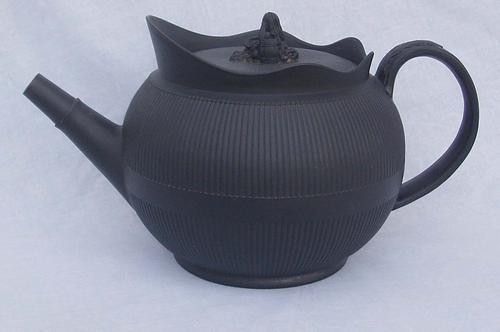
Wedgewood Style Black Basalt Teapot 1800 (bid or buy) 
Black Basalt is named after the volcanic rock, basalt, which was widely used at the time in the manufacture of vases, candlesticks and busts of historical figures. Wedgewood’s quest was partly inspired by the desire to emulate the Etruscan black pottery pieces called ‘buchero onto’ that were being excavated at Pompeii at the time and hence neo classically inspired. The range of goods was impressive, vases, lamps, ink stands, candlesticks, ewers (a vase shaped jug which is often decorated),  plaques and tableware. The  tea and coffee ware with its cups, milk jugs, tea pots and sugar bowls was the most popular.   Their capacity to withstand boiling water being poured directly  into them without cracking made them popular on two fronts function and design.

Black Basalt was a huge hit in its day, Wedgewood’s first major commercial success. In the height of its popularity in 1790-1800, selling out more quickly than it could be produced. After Wedgewood, many factories began to produce black basalt ware, notably Spode and Neale, some even copied his designs.

Monday, 2 July 2012

Mocha Ware 1792- 1850


Another type of pottery looking far more modern than the period it was made. Pretty common on the Thames foreshore, at least one piece being found on most mudlarking trips.
Mocha wear pottery shards found Mudlarking on the Thames 
It took me a while to find this pottery on the internet and a while longer its name. It seems to be called ‘Mochaware’, a type of dipped ware decorated with slip. The feature which sets it apart  is clearly the fuzzy, blotting paper, sea weed like decorations. The technical name is ‘dentric’ (tree like or branching). They were thought to resemble the natural geological markings on moss agate known as ‘Mocha Stone’ (pictured below), imported from Arabia through the port of Mocha (al Mukha in Yemen) – hence the name. Apparently geological patterns were rather popular in this period.

Moss Agate (from theimage.com)
Mochaware was produced in potteries throughout Britain. It was the cheapest decorated ware available. I’ve read that most British production was exported, but clearly it was still a popular item in domestic market, in London at least. Usually used for kitchen ware, but also evidently chamber pots, one of only two images I can find of this type of mocha wear. 

Mocha wear chamber pot (from artistheanswer) 
Clearly a new technique, it was achieved by dripping a coloured acidic solution into wet alkaline slip. The colour would instantly disperse into the random dentric markings. The bodies were creamware or pearlwear, later heavier and thicker whiteware bodies were used.

The main type of mochaware I’ve found has been the yellow bodies with blue dentric markings. I’ve read this is also called ‘yellow wear’. I’ve found a few other bits of mocha which I’ll cover in a future post, hoping to pick up a few more examples on my mudlarking wanderings. 

Tuesday, 26 June 2012

Thames Mudlarking: A good day for clay pipes + more

Last Saturday, I have to admit I was really looking forward to mudlarking – hadn’t been down for over two weeks, it felt like longer. Jumped off the bus at Bank this time, accompanied by one very reluctant teen and our good friend Patsy.

As we made our way through the narrow streets toward the Thames, the lights inside St Stephen Walbrook caught our eye. Pasty and I couldn’t resist a quick snoop – much to our young companions dismay. Neither of us had a clue what it was, a kindly gentleman on hand as part of the ‘celebrate the city’ enlighted us. One of Wren’s creations, some say his finest, planned in the 1670s just after the fire of London. I strained to remember which bits from the Thames would have been knocking around at the same time, bartmann jugs and delft came to mind, Pipkins and bone nit combs added when I returned home. The church was just breathtaking. Amusingly with Henry Moore altar in the middle, surrounded by tapestry kneeling cusions by Patrick Heron,  causing predictable consternation when installed in the 1980s.
St Stephen Walbrook with Altar by Henry Moore
It was a beautiful day a gorgeous combination of rain filled smoky grey clouds and bursts of sunshine and blue sky. The river was slithering out fast as we descended to the boulder strewn foreshore, the tide a really low one. Spotted my first washed up fish, a long glistening, silvery eel. We were only down there for an hour, as much as my teen could tolerate, between the three of us we gathered up  some lovely things. Top find has to go to our teen, a decorated clay pipe probably from 1840- 1910. I’ve been looking for one of these for ages.

Decorated Clay Pipe frm 1840-1910 found Mudlarking on the Thames
I also picked up a small fragment of  imprinted pipe stem ‘138 Bemondsey’ one side, ‘...aull’ on the other. A good day for clay pipes.
Imprinted Clay Pipe Stem found on the Thames. 

Another combined nit/comb caught my eye. It doesn’t look finished to me as the teeth just look too close together. This time the material looks like wood rather than the expected bone and it’s darker than the other two I’ve found.  Underlining  the teeth are thin golden looking lines.
Nit/comb found on Mudlarking on the Thames Foreshore
Other bits and pieces below,  include a vibrant large chunk of polychrome delft found by Patsy, porcelain, medallion from Bartmann jug, sections of medieval roof tile, mocha wear, shards of more refined plates and cups, another heavily finger printed fired clay scrap and yet more glass pieces we couldn’t resist.

Thames Mudlarking Another Day's Finds

A perfect London day was replete with lunch at the  Tate,  a quick canter through Damien Hirst with shark, inside of the cow and beautiful live butterflies fortunately momentarily capturing the teens approval, and a walk along the northern Thames path towards London Bridge to catch the bus home – noticing the shard is nearly complete. An irritating interruption to minecraft for others. 

Friday, 22 June 2012

Derbyshire Stoneware Ink Bottle

I don't often find glass or pottery with writing on. Over the last few months mudlarking these are probably the best examples. Nice to find sufficient writing to help trace precise origins. ‘VITREOUS STONE BOTTLES WARRANTED NOT TO ABSORB J.BOURNE PATENTEE DENBY & CODNOR PARK POTTERIES NEAR DERBY’ was stamped onto these 150 ink bottles, produced by a Derbyshire pottery between 1833 – 1850


Large fragments of Derbyshire Stoneware Ink Bottle 1833-1850

The Bourne company was set up in 1806 by William Bourne, a local entrepreneur,  who heard about the exceptional clay found  during construction of a Derbyshire  road. He purchased some of the land and started production in 1809. He appointed his son Joseph to run the pottery. The "J. Bourne & Son" mark was not used until about 1850.

The clay used in making the stoneware bottles was a coarse, sandy and heat-resistant quality. When fired at a high temperature it became very hard, dense and non-absorbent. These bottles are referred to as salt-glazed pottery; salt glazing was a popular method of decorating stoneware in the mid 1800's. Common salt was thrown onto the kiln fires when the embers were at their hottest. The salt vapor combined with the surface of the pot to produce a shiny brown surface coating. The process for producing these salt-glazed wares was patented as noted by the stamp at the base of the bottle below the J. Bourne & Son company name.


The complete Ink Bottle from Museum of London