 |
| Midnight Mudlarking |

Mudlarking on the Thames, London
Thursday, 25 July 2013
Another Midnight Mudlark
Sadly I've had to return to pretty much full time work, so very little time to mudlark and no time to blog, so I suspect posts will be far and few between. However I did manage to meet up with London Mudlark last night, to catch the lowest Thames tide of the year. This time we weren't the only ones down there and there were several head torched mudlarkers, each stooped over their individual pool of light, you can just make them out dotted along the foreshore in this rather poor picture below. It will take a while for me to post my finds, but I expect London Mudlark will be posting hers soon and she found some delights, which you'll be able to see shortly here https://www.facebook.com/LondonMudlark

Friday, 5 July 2013
More Low Tide Mudlarking
I always cycle to work and as I said goodbye my husband asked me where my bike was, I’d forgotten to tell him I’d taken the
morning off work to go mudlarking. Having been down for the midnight mudlark
the night before, ‘your obsessed’ were his parting words, but one more mudlark during these midsummer low tides was not to be missed.
As I descended the stairs to the Thames I
spotted a woman I recognised, Hilary
Bravo who I follow on pinterest, an artist who makes jewelry from her
mudlarking finds, which you can see here. It was lovely to meet her out of that social networking world and a
coincidence as I’d arranged to meet Tania Covo, another artist who makes
fabulous jewelry from her Thames pottery finds, you can see her work on her facebook page here.
I did a bit of mudlarking London Mudlark style, where the rewards are usually small and metal and find of the day has to be this minuscule spoon at the end of a hollow 4cm silver arm with a hole for attaching at one end. I didn’t have a clue what it was. I assumed it was part of something larger but expert mudlarker Mackie put me right and immediately identified it as a ear scoop the equivalent of today's cotton buds. No idea what period it's from, could be anything from 15th C to the Victorian period.
 |
| Mudlarking Find: Silver Ear Scoop |
Mackie said he thought it was silver so I later looked up the treasure act, which requires you to report items (apart from coins) which are 300+ years old and silver, presumably including this little thing if it's that old. I'll certainly be taking this find down to the Museum of London when I finally get a slot.
Also found a couple of lead cloth seals, these ones are probably 19th Century and a clay marble, only my second.
Ended the morning with lunch at the Tate with the 'Ladies who Mudlark' , after which we pored over and delighted in each others finds. Again struck by how this mudlarking business takes you to places off the beaten track you never would have visited and lovely people you never would have met.
Also found a couple of lead cloth seals, these ones are probably 19th Century and a clay marble, only my second.
 |
| Mudlarking Finds: Clay Marble and lead cloth seals |
Monday, 1 July 2013
Midnight Mudlarking
A midnight mudlark - Richard gave us the idea as we left the foreshore last Sunday and he was right the tides were super low at night an amazing 0.1m. I was ridiculously excited as the bus trundled down to the Thames. I loved the madness of it. Met up with London Mudlark of facebook fame and we made our way down to the shore.
I had visions of torch lit mudlarkers scouring large stretches of river bed that the Thames usually hides. But surprise surprise we were the only ones daft enough to go down there.
The contrast between the smooth bricked modern city above and the rubble and wooden stumps of its past where we scrabble about was somehow heightened in the dusky light. Later the shore was bathed in city neon so navigating our way was easy.
Head torches and bike lights lit up circles of shore for us to examine. Low tide came and went and still I'd hardly found a thing. It was only after midnight that my luck turned and I glimpsed a few pieces of choice pottery. But find of the day must be this small bit of flint. I have no idea how old these human workings are or what they were for, I hope the Museum of London will be able to help me out.
Or are they as Jim suggests below part of a sea urchin fossil?
This time I've had very little luck in identifying my finds on the net. I doubt this first one is very old, possibly Victorian. Once I see design in relief it's in my bag.
Rather confused by this next piece. I presume it's a pot rim with the remains of handle protruding, possibly from a skillet. Quite well made with spots of green glaze. What confused us was the indentation on the inside, which made us wonder whether it fed a spout. If it had a function was it to release steam into the handle?
Lastly a bit of delft with a thin line drawing, I suspect from a delft tile.
Half way through I took a break from mudlarking and walked a long way along the shore, as far as I could go to try and capture the speed of the tide going out. The reflected lights distract from the rip of the tide somewhat, but you can catch it if you look carefully.
and then the red moon rising south of Tower Bridge, as party boat after party boat passed by with drunken Londoners shouting and singing their hearts out.
I had visions of torch lit mudlarkers scouring large stretches of river bed that the Thames usually hides. But surprise surprise we were the only ones daft enough to go down there.
The contrast between the smooth bricked modern city above and the rubble and wooden stumps of its past where we scrabble about was somehow heightened in the dusky light. Later the shore was bathed in city neon so navigating our way was easy.
Head torches and bike lights lit up circles of shore for us to examine. Low tide came and went and still I'd hardly found a thing. It was only after midnight that my luck turned and I glimpsed a few pieces of choice pottery. But find of the day must be this small bit of flint. I have no idea how old these human workings are or what they were for, I hope the Museum of London will be able to help me out.
 |
| Mudlarking Find: Flint Fossil |
 |
| Sea Urchin Fossil (tesswyatt.blogspot) |
 |
| Mudlarking Find: Cream pottery with brown glaze and relief flowers |
 |
| Mudlarking Find, pot rim with handle possibly from 16th C. |
 |
| Skillet 16th Century Ashmolean Museum Oxford |
 |
| Mudlarking Find: Possible piece of delft tile 18th C. |
 |
| London Delft Tile circa 1750 (Martyn Edgell) |
and then the red moon rising south of Tower Bridge, as party boat after party boat passed by with drunken Londoners shouting and singing their hearts out.
Monday, 24 June 2013
An Evening Mudlark
I've been keeping my eye on the tide tables and had spotted that the lowest tides of the year seem to be this week, coinciding with the summer solstice. Last night there was an amazing 0.5m, just too low to resist.
My first evening mudlark - I was quite excited. As I trotted down the road conscious that most other people were winding down, sorting out their evening meal before settling down to Sunday telly, quietly preparing for the working week ahead.
Grey clouds crowded the sky. It was surprisingly gloomy not quite the midsummer mudlark I'd envisaged. As I descended the steps I was rewarded with a huge stretch of exposed shore with two hours still to go before low tide.
I saw Lara's silhouette down the shore and made my way over for our arranged mudlarking meet. It was fun to share stories and great to have some Lara mudlarking tips.
It was such a productive trip that I can't decide which is my find of the day, so I'll start off with my top four. The first is Lara's favourite, a roman or medieval tile with a small hoof print, not sure if it's a piglet, lamb or kid. After tiles were cut out and shaped they were laid out to dry before firing, which is when a few collected prints from mice, dogs or livestock.
I was delighted with my first whole Bellamine face, there seem to be endless versions. This one is rather scary bearing his teeth through a distorted mouth, with bags under his strange poppy out eyes but with a rather refined nose, as my good friend Gerry later pointed out.
I came across what I've been hoping to find since I started mudlarking, a 7cm long wild boar's tusk. The black doesn't match the pictures of white tusks I've found on the net, perhaps the enamel has worn off, unsure of the other tooth's origin - any ideas?
My last find of the day is a small 1.5cm lead cloth seal. I've wanted to find one of these for ages so made up even through the imprints are very worn on one side. Lara's top tip is smear with olive oil to bring out the design. I'm hoping that now I've got my eye in for these I'll find more on future trips.

As ever a handful of pottery made its way into my bag. These are my favourite pieces, from left to right clockwise, hand painted tea bowl, early transferred pearlware, flow blue and green transferware. The whole lot probably spans from around 1760 - 1900s.
Lara will be posting her finds shortly on her site here. Our next planned mudlark is one with a difference and will definitely be one to remember - watch this space!
My first evening mudlark - I was quite excited. As I trotted down the road conscious that most other people were winding down, sorting out their evening meal before settling down to Sunday telly, quietly preparing for the working week ahead.
Grey clouds crowded the sky. It was surprisingly gloomy not quite the midsummer mudlark I'd envisaged. As I descended the steps I was rewarded with a huge stretch of exposed shore with two hours still to go before low tide.
I saw Lara's silhouette down the shore and made my way over for our arranged mudlarking meet. It was fun to share stories and great to have some Lara mudlarking tips.
It was such a productive trip that I can't decide which is my find of the day, so I'll start off with my top four. The first is Lara's favourite, a roman or medieval tile with a small hoof print, not sure if it's a piglet, lamb or kid. After tiles were cut out and shaped they were laid out to dry before firing, which is when a few collected prints from mice, dogs or livestock.
 |
| Mudlarking Find: Roman or Medieval Tile with hoof print |
 |
| Mudlarking Find: Bellamine face 1550- 1700 |
 |
| Bartmann Jug 1551 - 1700 (Museum of London) |
 |
| Mudlarking finds: Mystery tooth & wild boar tusk. |
 |
| Mudlarking Find: Lead Cloth Seal 1200- 1800s. |

As ever a handful of pottery made its way into my bag. These are my favourite pieces, from left to right clockwise, hand painted tea bowl, early transferred pearlware, flow blue and green transferware. The whole lot probably spans from around 1760 - 1900s.
 |
| Mudlarking Finds: pottery shards. |
Friday, 14 June 2013
Staffordshire Figurines 1775 onwards
I’d expected to come across a head of a china figure at some point
but didn’t consider it could be a torso. I still do wonder why on earth I
picked this broken old thing up. It’s a specimen of things I could never stand -
china figurines, but things always seem rather more interesting when you ease
them out of the mud and want to figure out what they are and the story they
have to tell.


Press moulds were used, the worker’s finger print can be seen clearly inside my find, left as they pressed the clay into the mould. Earlier figures were made with back and front moulds with features and colour all the way round. Enamel colours were painted onto the glazed figures by hand, fixed by another firing at lower temperatures, occasionally gilt was then added before a final firing.
After 1840 figures tended to be slip caste in one mould and flat backed so they could sit flush with the wall atop mantelpieces.
The emphasis was on cost. The figurines were churned out cheaply and quickly using child and women’s labour for 12 hours a day 6 days a week. There were dozens of potteries producing them. Virtually no one bothered to imprint maker’s marks. Many potteries went out of business in this highly competitive market and sold on their moulds and stock. Therefore it’s rare you can trace particular figures to specific potteries.
What’s interesting about the figurines is the insight they provide into popular taste. They offered the middle classes an affordable alternative to the expensive porcelain figures produced by the Meissen pottery in Germany and Chelsea and Derby factories in England.
It seems the Victorians were particularly mad about these figurines. Perhaps more people had greater disposable income as the industrial revolution kicked in and production costs declined so they were within reach.
The early Georgian figurines tended to represent biblical or classical figures or romantic representations of rural life.
In Victorian times, the celebrities, venerated and events of their day were quickly caste. Likenesses were copied from prints. Purchase and display was a way of communicating your erudition, cultivation, humour and how with it you were, perhaps equivalent to the facebook likes, shares and retweets of today.
Actors and comedians seem to have been their celebrities, almost all of whom are forgotten now. Below is John Liston, apparently one of the greatest comedians of all time, he was the first comic actor to command a higher salary than a tragedian, earning the vast sum of £60-£100 a week in 1820.
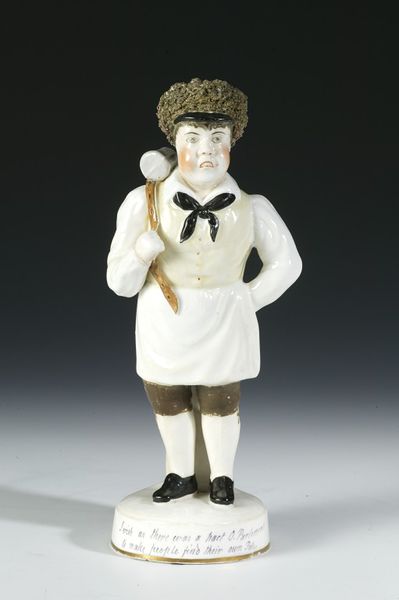 |
| John Liston Playing Sam Swipes at the Haymarket 1820 (V&A) |
 |
| Bust of John Wesley (Madelena.com) |
 |
| Death of the Lion Queen 1850 (madelena.com) |
It’s not evident to me what period my find is from, she was found on the Georgian mudbank amid shards of white salt glazed plates and early Worcester Porcelain, so I suspect she’s one of the early Georgian types, a hunch backed up by her roundness and similarity to the figures below produced around 1790.
 |
| Ralph Wood Figurines C.1790 Staffordshire (antiquepottery.co.uk) |
(thank you to V&A and Madelena Antiques for all the information on their websites which helped me piece this together).
Friday, 7 June 2013
A Spring Mudlark and My First Coin
Back on part time wages and back on the bus. Low mists of cow parsley edge the parks. Above, horse chestnuts are dressed with white candles. Trees still hold the lime green haze of spring before they deepen into the green of summer. This time I noticed the Council block's lawns with their daises and buttercups squared off with black railings. We pass traffic lights and lamp posts covered in flowers wrapped in cellophane, tributes to someone killed in a traffic accident. Then the streets narrow, the height of buildings increase and you'd no longer know it was spring. Just tarmac, glass, metal and stone - albeit rather grand.
There were so many people down on the foreshore, the Thames Discovery crew measuring, documenting and considering old archaeological features, a large group of kids, solitary souls, a gaggle of friends and kids with their families. I wasn't expecting to find much. I reckoned most stuff would have been scooped up after a series of low tides, a bank holiday weekend and half term.
It was a pleasure to meet 11 year old Kane and his mum Sarah, all the way down from Merseyside for a mudlark. Whilst his friends immerse themselves in PS3s, minecraft and youtube Kane's out digging in bottle dumps. Kane kept me company for a while telling me what he'd found in the past and what he'd like to find. Keen to find some Tudor pins, it was nice to be able to show him where to look and how to find them. Turned round and there was Florida Tom, back in England for 6 weeks of mudlarking. Very good to meet up with him again.
Fortunately Tom and Kane kept me mooching around one particular spot and just when I thought this was definitely my worst mudlark ever I found my first coin - well apart from a Russian Kopek and 2p - very excited. I didn't care that it was battered, thin and worn - it all added to its charm and it sparkled!
It's a George II copper farthing minted between 1734-1754. I can't make out whether the date is the 30s or 50s. A crown of leaves (laureate) tops George's head and he wears Roman military dress in the classical style. On the reverse is Britannia, the Latin name for Roman Britain, who first appeared on British coins in 1672 and was only omitted from the 2008 redesign, much to the annoyance of the Daily Mail.

Masses of fakes were also produced, the wording or 'legend' was often different so the counterfeiters could escape prosecution. Given I can't make out whether it reads GEORGIUS.II.Rex and on the reverse BRITAN NIA no idea whether it's a genuine or not - quite like the idea it might be a fake. I wonder what it last bought?
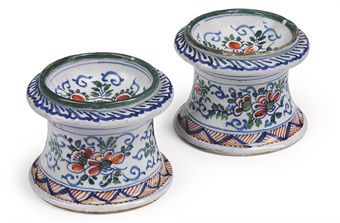
On my way back I found a couple of nice delft shards,
A couple of salts reckoned by Christies to be from 1720 and from Vauxhall, deploy similar colours and painting techniques to the one above.
My other vaguely interesting find I'll keep for a separate post. As I left it started to rain. Ran for the bus and just managed to get home in time to help husband and youngest pack for our imminent holiday, which went some way to appeasing my rather irritated husband - who wasn't too happy that I'd absconded down to the Thames.
There were so many people down on the foreshore, the Thames Discovery crew measuring, documenting and considering old archaeological features, a large group of kids, solitary souls, a gaggle of friends and kids with their families. I wasn't expecting to find much. I reckoned most stuff would have been scooped up after a series of low tides, a bank holiday weekend and half term.
It was a pleasure to meet 11 year old Kane and his mum Sarah, all the way down from Merseyside for a mudlark. Whilst his friends immerse themselves in PS3s, minecraft and youtube Kane's out digging in bottle dumps. Kane kept me company for a while telling me what he'd found in the past and what he'd like to find. Keen to find some Tudor pins, it was nice to be able to show him where to look and how to find them. Turned round and there was Florida Tom, back in England for 6 weeks of mudlarking. Very good to meet up with him again.
Fortunately Tom and Kane kept me mooching around one particular spot and just when I thought this was definitely my worst mudlark ever I found my first coin - well apart from a Russian Kopek and 2p - very excited. I didn't care that it was battered, thin and worn - it all added to its charm and it sparkled!
 |
| Mudlarking Find George II Copper Farthing |
It's a George II copper farthing minted between 1734-1754. I can't make out whether the date is the 30s or 50s. A crown of leaves (laureate) tops George's head and he wears Roman military dress in the classical style. On the reverse is Britannia, the Latin name for Roman Britain, who first appeared on British coins in 1672 and was only omitted from the 2008 redesign, much to the annoyance of the Daily Mail.

Masses of fakes were also produced, the wording or 'legend' was often different so the counterfeiters could escape prosecution. Given I can't make out whether it reads GEORGIUS.II.Rex and on the reverse BRITAN NIA no idea whether it's a genuine or not - quite like the idea it might be a fake. I wonder what it last bought?
 |
| George II Farthing (AH Baldwin and Sons) |
 |
| Mudlarking Find: Delft Shard |
 |
| Mudlarking Find Polychrome Delft Shard Early 1700s |
 |
| Delftware Salts possibly from Vauxhall 1720 (Christies) |
My other vaguely interesting find I'll keep for a separate post. As I left it started to rain. Ran for the bus and just managed to get home in time to help husband and youngest pack for our imminent holiday, which went some way to appeasing my rather irritated husband - who wasn't too happy that I'd absconded down to the Thames.
Friday, 31 May 2013
Hairbrush
I found the remains of a hairbrush a few months ago, almost didn't pick it up. It took me back to another word - the London cottage industry of brush drawing - which sounds more romantic than it evidently was.
Holes were drilled into the brush back and wire or string was looped through the holes. Bunches of bristles were pushed through each loop by hand and were folded and pulled back into the hole as the twine was pulled from behind. Apparently it could take a whole day to draw a brush in this way.


You can still see the twine sewn into the ridges at the back. On the reverse loops are just visible, nestling in each hole. The brush would have been finished with a back which was either stuck on with fish glue, the posher ones were screwed on. No screw holes in this one, so the commoner type I think. I can't work out if it's made of bone, horn or wood. Lovely comfy indentations for your thumb and forefinger, it would have been a rather cute hairbrush, I suspect from the 19th century.
As well as homeworkers the still in business GB Kent made their brushes in London from 1777, mainly employing women. An early visitor to their original factory observed 'bristles from Russia, Serbia, China and India; badger hair from Germany and the Balkans; whalebone from the Antarctic; fibres from Mexico, Brazil and Africa; beech, cherry, birch and sycamore from the English countryside and tropical timbers, ebony and satinwood from the forests of Ceylon, the West Indies, South America and Indonesia' (Executive Shaving Company)
All of which I imagine would have arrived via the Thames.
 |
| Homeworking brush drawer East End London 19th C (Society of Brushmaker Decendents) . |


You can still see the twine sewn into the ridges at the back. On the reverse loops are just visible, nestling in each hole. The brush would have been finished with a back which was either stuck on with fish glue, the posher ones were screwed on. No screw holes in this one, so the commoner type I think. I can't work out if it's made of bone, horn or wood. Lovely comfy indentations for your thumb and forefinger, it would have been a rather cute hairbrush, I suspect from the 19th century.
 |
| Drilling holes in the brush backs (brushmakers.com) |
All of which I imagine would have arrived via the Thames.
 |
| The Rhinebeck Panorama of London c. 1807 |
Subscribe to:
Posts (Atom)