Showing posts with label Pearlware. Show all posts

Saturday, 20 October 2012

Pratt Ware 1780s – 1840s.

How great to have a type of pottery called Pratt Ware. The few examples I’ve found probably aren’t strictly from Pratt Ware whose defining feature is relief moulding,  the forms were usually figures or jugs. Instead I’ve found tiny, tiny thin pottery shards hand painted in pratt colours, magnified in the photo below. They seem to come from both creamware and the blue tinged pearlware, both are present in shards below. I suspect they may all be from tea bowls or saucers. 
Mudlarking Finds: Creamware and Pearlware hand painted in pratt colours
There is something I just love about these pieces, the combination of the muddy greens,   browney oranges with flashes of cobalt blue and the snapshot of such detailed miniature hand painted designs crammed onto each of these small fragments.


In this period artists were constrained in the colours they could use. Only colours that could withstand the high kiln temperatures required to fire lead glaze were available to them, namely cobalt for blue, copper and lead for greens, manganese oxide and iron were mixed to produce brown, orange was produced by adding iron oxide to yellow oxide. But there is something even more specific about the tone of Pratt colours.

Their name derives from the pottery they became associated with, the Pratt pottery in Fenton Staffordshire, although this type of pottery was also churned out by many others in Staffordshire and in other areas of England and Scotland. I've found it almost impossible to track down images of table and teaware in pratt colours, although I've had more luck in finding the more 'official' pratt ware. 

Prattware jug, circa 1820 (Martyn Edgell)


The hand painted ware was phased out around 1840 as the cheaper and more popular transfer wares began to predominate
Prattware jug with the Kings initials GR, circa 1810 (Martyn Edgell)

Saturday, 13 October 2012

Tea Ware

Dedicated to Norma, queen of teakies.

Tea first introduced to London in the mid 17th century created demand for affordable, refined heat resistant cups and other equipment worthy of this expensive brew. Initially small handless Chinese porcelain tea bowls were imported.
In 1700 large saucers appeared. Some poured their drink into the saucers allowing the tea to cool and drank directly from these.  

Pieter Gerritsz Van Roestraeten. Chinese Tea Bowls, 17th century (on familiar things)

Fashionable family sitting around a tea table 1727 Richard Collins (V&A) 

The tea bowls I came across at my recent trip to the V&A were so much smaller than I’d imagined, due to the exorbitant cost of tea I suspect.
17th Century Chinese Export Porcelain Tea Bowl. 
In 1750 Robert Adams inspired porcelain tea sets in which tea cups had handles. Adams tea cups were taller than their base and came with a saucer – there began the English tea service set – with matching tea pot, sugar bowl, milk jug and even tea spoons. The English welcomed the handle having found the tea bowls rather messy and liable to burn their hands.

Throughout the 18th and 19th centuries demand for new and cheaper teaware grew apace, driven by the growing fashion of tea drinking. We see the rise and fall of several types of ceramic. Europeans began to produce their own version of porcelain. The first success in England was at the Chelsea Porcelain Manufactory in 1743- 5. In the 1750s Wedgwood perfected the production of fine stoneware ‘black basalt ware’, popular for around 50 years.  Stoneware is water proof, so no glaze was required.  The 1770s brought Wedgwoods’s refined red stoneware Rosso antico,  affordable cream ware, shortly followed by pearlware.
Bone china was developed in England in the 1800s, by Joseph Spode, another name which keeps popping up. It was lighter and cheaper than porcelain and apparently better at carrying bright colours. It became and remains the posh tea cup of choice. 


1820 Spode London shape ( from spode history blog)


I’ve found a number of shards with small circular ‘stands’ , sometimes with a tiny design in the base. I suspect these are the bases of tea bowls, two I think are pearlware because of their bluish tint, the other porcelain.


Mudlarking Finds: Pearlware and Porcelain Tea Bowl Bases

Mudlarking Finds:Tea Bowl Bases
Occasionally I find the shallow curve of what I assume are saucers. The two with transfer ware I suspect are creamware the older middle hand painted example pearlware.


Mudlarking Finds: Saucer Fragments
This last group of fragments I’m guessing are also from saucers. In each case the middle of the base. This time their design is not so ‘tiny in the middle’. Each has a stand beneath, the curve of which is shallower than the tea bowls. A mixture of pearlware and porcelain.


Mudlarking finds: Pearlware and Porcelain Saucer Fragments

Monday, 4 June 2012

Early English Plates: White Salt Glaze Stoneware, Creamware and Pearlware 1720- 1780

The history of English tableware is scattered across the Thames foreshore, something I’ve never been particularly interested in until I started wondering about the origins of the pottery I’d found.

As ever those modern looking ‘finds’ turn out to be quite old, so for anyone else interested in identifying pottery from the Thames and finding out about its history here goes..

In 1720 potters succeeded in producing the white pottery with a glossy sheen people had been hankering after. High stoneware kiln temperatures gave the kaolin clay durability. The first sets of matching tableware were produced and were far cheaper than porcelain alternatives. Less expensive plain white plates, sometimes with relief patterns were the most popular. They were considered very fashionable in their day.

Large amounts of the stuff was exported to the US and Europe, Staffordshire potters had begun an international industry. Whilst there was clear demand, the cost of producing stoneware prevented it from becoming widespread. Consequently potters sought to develop cheaper refined earthen wares.  Creamware was the first mass produced tableware from 1750. Iron oxide in the glaze gave it a yellow cream colour. Very functional, it was the first widely available ceramic that enabled you to cut food without chipping the glaze.  Again the centre of production was in Staffordshire (plus Yorkshire). Wedgewood came onto the scene in 1759 and although not the ‘inventor’, was at the forefront of developing both Creamware and Pearlware. Not satisfied with Creamware, Wedgewood’s letters reveal the search for ‘a white Earthenware body, and a colourless or white opaque glaze, very proper for Tea & other wares’, From 1775 Pearlware moved the industry one step closer. China clay was added to the creamware body and cobalt blue to the glaze, giving it a blue tint  and a whiter appearance– a blueing technique of course still used in our washing powders and clothes manufacture.


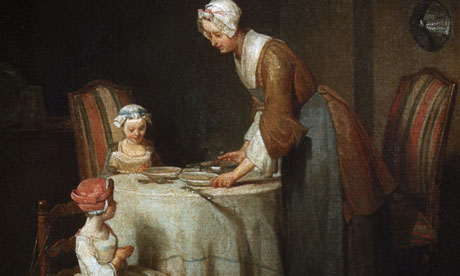
A detail from Grace at Table by Jean-Baptiste-Simeon Chardin (1740) Photograph: © Francis G. Mayer/CORBIS 

The introduction of the ceramic plates coincided with a change in table manners, I wonder if they were related?.  'The children learning their table etiquette in Chardin's 1740 painting are in the avant-garde of a cultural revolution. Cutlery, as opposed to eating with your fingers; sitting up straight in a high-backed chair; these were innovations in the way people defined themselves at table in 18th-century Europe'. (Jonathan Jones Guardian)
By 1750 white salt-glazed stoneware had caused the demise of the delftware industry and by 1760 the refined earthenwares, Creamware and Pearlware, were superceding white stoneware.

My initial impetus for returning to the Thames was to collect pottery for mosaic making, not something I’d ever done before I might add. Playing around with blue and white pottery, I soon realised that I’d need large amounts of white crockery to surround the interesting bits. A month ago I therefore collected a bag of white pottery, extremely abundant as I assume no one else bothers to pick this up. Now that I’ve found out a bit about the different types of ‘white’ pottery, I can see that virtually all the fragments I’d picked up were Creamware- which fits with its ubiquitousness. 

From the 1740s  block moulds were used, each imprinting one of several  standard patterns around the plate rim. I’ve found  a handful of these over the past 8 months. By far the most popular was the ‘barley’ or ‘basket’ design. My favourite is the feather pattern,  I haven’t yet spotted any of the  nicely named ‘dot, diaper and basket’.

Clockwise from top R, feather edge white stoneware salt-glaze, creamware, barley pearlware, barley white salt- glaze
When you see the different types of pottery side by side it’s easy to distinguish the creamware from the slightly grey stoneware. The two feather edged pieces illustrating this nicely above. I’ve found it quite hard to distinguish the White salt glaze stoneware from  Pearlware, eventually concluding the easiest way is to catch the salt glaze pitted ‘orange peel effect’ in the light. Although when together as the two barley pieces above show, you can see the pearlware does appear whiter than the stoneware. Apart from the blue and green ‘shell edged’ pottery, to be covered in the next post, I believe I’ve only found two  fragments of Pearlware, one shown below with rather crude enamel overglaze, the bluey tinge created by cobalt blue is really clear.

Thames Mudlarking: Close up of Pearlware Pottery Fragment with enamel overglaze  
Meanwhile my internet ordered box of mosaic materials sits in a corner whilst I'm preoccupied with classifying, sorting, researching, documenting and pondering my finds. Not to mention the still frequent trips to that intriguing river with all its secrets.  It’s going to take a while to get this mudlarking thing out of my system.