Showing posts with label Roman. Show all posts

Saturday, 7 September 2013

Roman Tegula

Tegula is the twin of Imbrex the two types of tile which made up the Roman roof, a design nicked from the Greeks and still in use in Rome today.

I presume most of the red tiles you see on the Thames foreshore are medieval and they certainly are if they have one or two holes in them. But perhaps I'm wrong and many of the tile pieces are Roman for me it's just impossible to differentiate.

The Thames foreshore is littered with tiles. 
If the tile has a return like the one below it and it is found where Roman London lay, it may be a Roman tegula. 
Tom's mudlarking find Roman Tegula. 
This find was one of Florida Tom's gifts to me. Later that day I found another. Funny how you spot things once their image and identity is imprinted in your brain. 


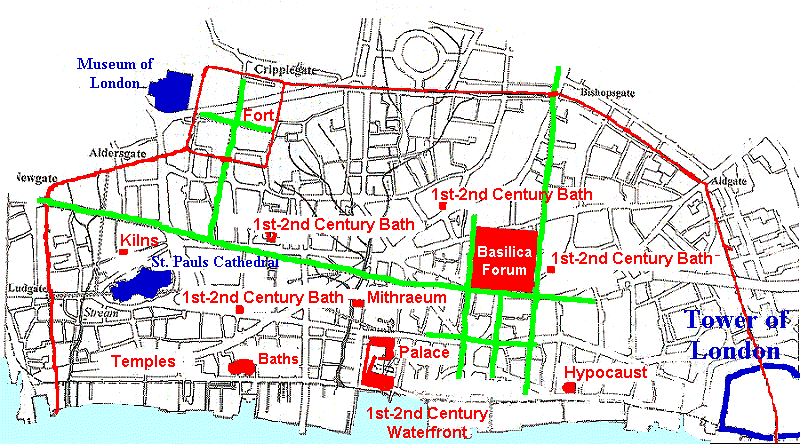
Roman Londinium superimposed over modern London (Romanobritain.org)
The tegulae were laid in overlapping fashion. Some were just plain flat tiles, others had raised edges on each side (like the ones I've found) preventing the water from seeping between the join and channeling the water to the bottom of the tile. Later tegulae were a v shape whereby the edges converged slightly each becoming a funnel which slotted into the one below forming a continuous channel. 

The imbrex were semi circular and were place over the joins between tegulae. If well laid the result was a fully waterproof roof. 


tegula (a) imbrex (b) (wiki)
The roofing area was usually surrounded by antefixa and these were frequently decorated, now that would be a nice find. 
Roman Roof with Antefixa (Grahams Potted History) 

Friday, 17 May 2013

Samian Ware

You always find something special. Find of the day this time was my first Roman samian ware - nearly 2000 years old. This small piece of pottery was just sitting, upside down on the pebbles. As I turned it over I caught lettering in the middle of the bowl. Liking things with writing I knew it would be plopped into my bag. I assumed it was stoneware but as I looked more closely the lettering had a Roman look, so felt a little excited. What's weird is that it looks so modern, almost machine made, similar to the stuff churned out in Staffordshire from the late 18th Century. 
Mudlarking Find: Base of Roman Samian Ware 

Samian Ware(British Museum) 

Base (British Museum) 


I subsequently learnt that 'samian' potters often stamped their name in the base of their bowls. The next day my youngest helped me decipher the name TAVRICIM rising up from the base of my find, which as V's = U's in Latin is Tauricim. I found one mention in a 1895 reference book from the Musee Lyon 'inscriptions antiques'. Next to his or her name is 'Sainte-Colombe' a town in Western France - perhaps the potter was based here. 

Mudlarking Find:  Roman Samian Ware with Potters Stamp TAVRICIM. 
Samian ware or terra sigillata as it is sometimes referred to was first produced at the end of the  first century BC in Italy. By the mid 1st century AD, Gaul (modern day France & western Germany) had become the major producer. This pottery was produced and exported in vast quantities  throughout Europe and remained very popular for 250 years. At some point it was also produced on a smaller scale in Britain at Colchester and possibly London.  I can't quite comprehend how massive this industry was. There were 600 potters alone in La Graufesenque, one of the major sites of production in Gaul. The remains of one kiln measured 11.3m by 6.8m, the height an estimated 7 metres. With up to 9 internal storeys dismantled each time, the capacity is estimated at 30,000 - 40,000 vessels.  I wonder if Samian ware was the first mass produced fine table ware ever? It was refined but relatively cheap and used mainly for the presentation of food or display in its own right. 
Principal terra sigillata kiln sites(potshard.net) 
Samian ware can be plain or decorated. They look so modern because they were made in moulds. They shrank as they dried enabling fairly easy removal from the moulds. Their orangey glossy look is due to a bit of slip dipping, after which they were fired. Seemingly all rather controlled and organised there were standardised shapes and matching sets. 

South Gaulish Samian Ware showing standardisation of size (wiki)  
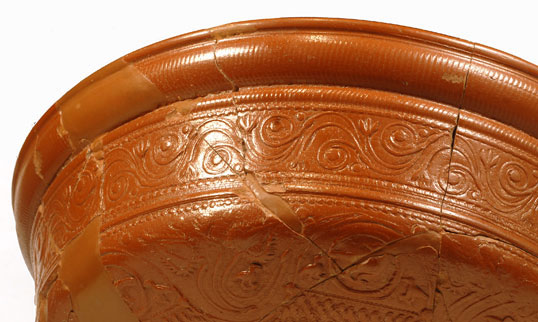
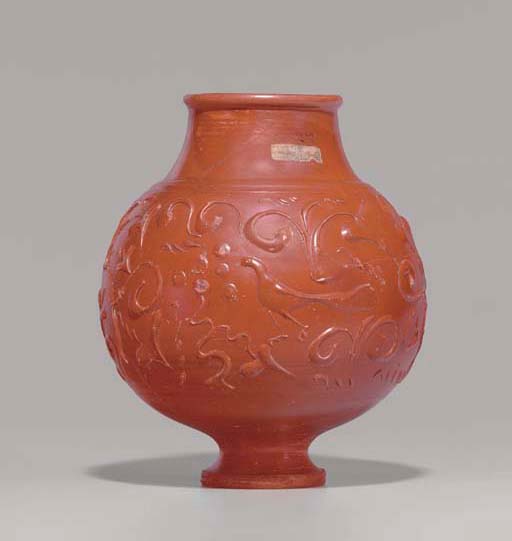
The decorated pieces are rather lovely. Animals and  figures depict myths and legends,  popular hunting or erotic scenes. Some fuse classical designs with native 'Gaul' traditions. As with those 19th century hunting jugs, particular designs are associated with individual potteries. The style of decoration changed over time, beginning with bands of decoration with a rather formal, precise style and ending with larger more freestyle designs. 
Decorated Samian Ware (Museum of London) 

Roman Barbotine Vessle 2nd C AD (Christies) 
Its longevity means there is tons of this stuff buried beneath us. A number of different classification systems arise from the years archaeologists have spent sorting, sifting, categorising and labelling this stuff. The potters stamps and decorative motives enable dating to within 20 years in some cases, hence samian ware with the right clues like clay pipes surrenders the date of a layer of finds. 

The rest of this particular day was characterised by tea bowls, I found yet another armorial pipe and this time coveted shard after shard of debased blue stoneware which I'm amassing with some notion of mosaic making. I was able to return Brian's 'piggy' glass seal, say goodbye to our lovely French ex archaeologist who is moving the States. I was lucky to meet Jim just before I left,  a follower of the blog,  who is over for a three week trip to the UK from the States with frequent mudlarking forages when he and his wife have time. I didn't quite remember Jim from followers on the blog, so it appears that wordpress followers don't show up on blogger. Interesting how many Americans make their way across the pond to do a bit of mudlarking.   

Friday, 26 October 2012

Roman Box Flue Tiles AD 43- 410

The last few posts have been dominated by the Georgians, so time to go back to the very old. Over the last year I've slowly built up a small collection of largish chunks of tile with rather attractive, simple indented patterns. It was time to work out what they were from. 
Mudlarking Finds: Large Chunks from Roman Box Flue Tiles 
Satisfyingly old, the Portable Antiquities Scheme database helped me identified their origin, Roman box flue tiles. Took me a little while longer to work out what this meant. They were used in Roman Baths and villas. Essentially a hollow box with two open ends, made of clay. They were placed one on top of the other in the walls and  carried hot air from the under floor hypocaust system into the roof and then outside, heating the inside walls on the way. 
Roman Bath House showing Box Flue Tiles rising in the wall (University of  Leicester) 


The box tiles had grooves cut into them on one side 'keying' so that more 
wall plaster could adhere to the tile, thereby improving the strength of the 
bond with the wall. Now I look more closely at my finds I can detect traces of 
white mortar, but perhaps I'm imagining. Patterns were applied to wet clay 
with a roller stamp or a comb. It's strange the patterns are so beautiful and 
carefully applied given they'd be completely hidden in the wall. The same 
patterns have been found at different locations in England, suggesting that 
tile makers moved around. 


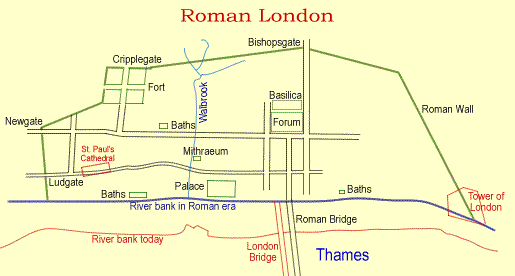
What's interesting is the difference between the tile fragments. There seem to be three sets. The first have diagonal deep cut grooves similar to the pattern in the picture above. A combed pattern seems an apt description for the second set. The last tile is rather different, thinner with shallow wide indentations. I'm rather excited on discovering that there was a bath house not far from where I found these tiles, perhaps they originated from this? But then again why don't they have the same design? I guess the Thames may well have mixed things up along the foreshore after 2,000 years. A map (from Britain Express) and reconstruction (from Museum of London) of Roman  London below. 


Friday, 2 March 2012

Mudlarking on the Thames: How it all started

I spent my teenage years rather envious of those who had an absorbing passion, believing I just wasn't that type of person. To my surprise, scouring the Thames foreshore for fragments of long ago discarded objects, has me in its grip. 


Thames foreshore
A birthday treat Thames Explorer Trust guided walk started me off in September 2011. Returning home to party, I couldn't resist laying out my finds,  Roman pottery,  green glazed medieval chunks, earthenware Tudor pot handle, a section of a Tudor nit comb, pieces of tin glazed delft pottery from the 1600s, shards of blue and white Victorian pottery and the ubiquitous clay pipes.  I was hooked.


First finds Mudlarking on the Thames foreshore. L-R Roman, medieval, Tudor pot handle, Tudor nit comb, delft, Bellarmine both 1600s, combed slip ware, clay pipe, Victorian blue and white & glass bottle.