Showing posts with label Stoneware. Show all posts

Saturday, 3 May 2014

Martincamp Ceramic Flasks

This broken bit of pottery has been on the blog before, but it wasn't until the finds id session organised by Thames Discovery earlier this year that I finally found out what it was. Nigel Jeffries from the Museum of London Archaeology immediately recognised it as the neck of a Martincamp flask, amusingly Nathalie Cohen from Thames Discovery captured the moment here., with Nigel animated in his enthusiasm and me all eyes and ears and geekily taking notes! 
Mudlarking Find: Stoneware Martincamp Flask
This stuff is named after the village of Martincamp in Normandy France, although it’s thought these vessels were produced across a larger area in northern France, allegedly just for export. Unsurprisingly it's a type of 'Normandy Stoneware'. 

The won’t stand up flask was made on a potter’s wheel. The neck was made separately and then attached over the crudely made hole in the flask as seen below, which I'd always been a bit perplexed by. 


The internal messiness is rather at odds with the rather polished outward appearance. 

Stoneware Martincamp Flask 1501-1600 (Museum of London) 
The flasks would have been covered in a wicker casing, similar to the bottle in Lubin Baugin's painting below ca. 1610–1663. Apparently they were used as water bottles by field workers and soldiers, slung over their backs using a strap attached to the wicker. It's surmised that a wicker base would have enabled the bottle to stand up. I wonder if the roundness of the bottle made it stronger, like an egg. At the very least a nifty design with no easily bashable edges and wicker padding to boot. They were also much cheaper than glass. 

Le Dessert de Gaufreetes, Lubin Baugin, ca. 1610–1663 (Louvre)

One of the 'signs' of a Martincamp canteen is the rings around the neck. Are these really caused by the imprint of the wicker or are they the potters throwing rings? As I finally cleared away my finds, which had crept onto every surface in the shed, I spotted what looked like another neck of a Martincamp flask, this time earthenware. Still, I suspect if not rare they are a fairly uncommon find along the Thames - but perhaps I'm wrong?

Mudlarking finds:  Martincamp Flask Necks 
There are apparently three diabetes type categories for these vessels (John Hurst 1986)

  • 1475-1500 off white fabric often with buff surfaces and a flattened profile (Type I) 
  • 1500- 1600 dark brown stoneware with a more globular form with one side slightly flattered and the other side breast shaped (Type II) 
  • 1600-1700 earthenware usually a low fired orange colour, but can be fired to near stoneware and appear reddish orange. (Type III)
1501-1600 (Museum of London) 

So my type II from the beginning of the post was knocking around when London looked like this, 
Anton van den Wyngaerde 1543

the century when England was ruled by our most famous Monarchs Henry VIII and Elizabeth I, the time of Shakespeare, the Spanish armada, and when potatoes came to Britain. It was the period when London became established as a great port which was accompanied by a trebling of the London population from 60,000 in 1500 to 190,000 in 1600, the average size of a London borough today. 


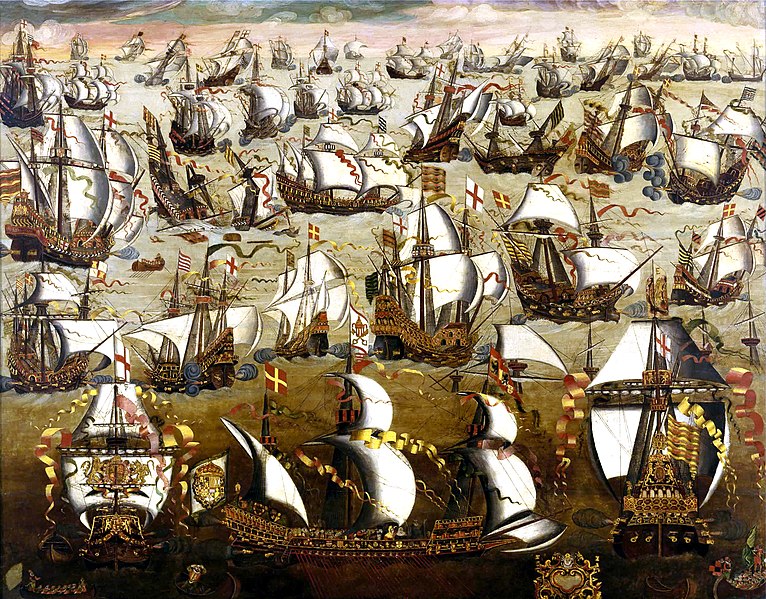
Spanish Armada and English ships in August 1588, by unknown painter (English School, 16th century) Wiki

Saturday, 25 May 2013

German Stoneware Mineral Bottle

I put down the first piece of stoneware I found, thinking the little bit of writing wasn't worth it. A few minutes later found a similar larger shard with a lot more, I went back ten feet to retrieve the discarded piece and as I suspected they slotted together. A fortnight later I found the missing middle fragment in the same place. 
Mudlarking Find  Georg Kreuzber Stoneware Bottle
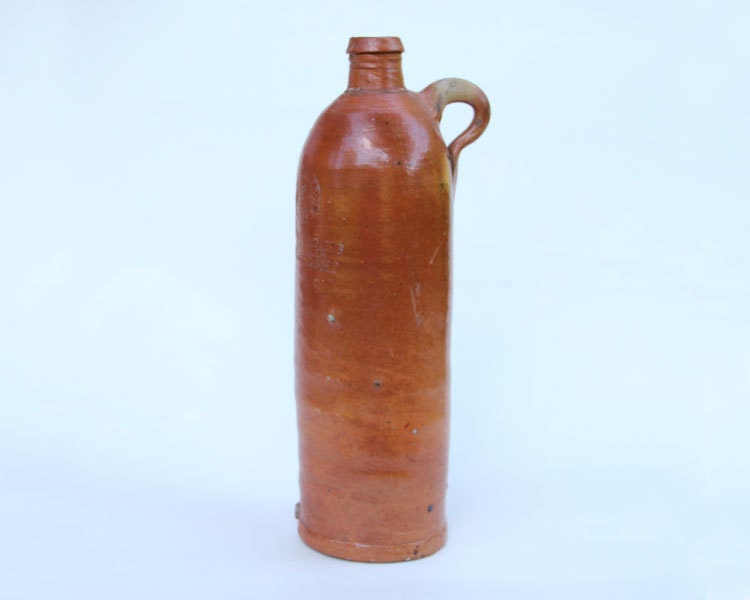
Not an old find, Victorian and mildly interesting. It's German and probably held mineral water. Produced for Georg Kreuzber, a wine merchant from Ahrweiler who in 1850s began bottling mineral water from the Apollinaris spring .By 1860 40,000 bottles had been dispatched across the globe. The refinery shut in 1878. 

The rather crude and imperfect incised stamp has a circular inscription 'Apollinaris-Brunnen  M-W'. Inside appears a boaty logo and below 'Georg Kreuzberg, Ahrweiler, Rheinpreussen'. 

A clearer picture of the logo on another bottle 
Georg Kreuzberg Mineral Bottle (Etsy) 
There seem to be quite a few German mineral water bottles scattered along the Thames and a number of different companies. Others have suggested these bottles contained gin and this type continued to be produced until the 1890s. I tracked down a picture of one with the label intact. Exported to the States seemingly from London with their offices at 19 Regent Street, this rather salty mineral water must have been a hit. 

Georg Kreuzberg looks like a man about town. He developed the springs in the area, building the first bath house with hotel attached at Bad Neuenahr hot spring. He had a penchant for sequoia and started a bit of civic planting, some of the redwoods still stand today. 

old postcard with Georg Kreuzberg and dedication of Neuenahrer Hot Spring in 1858

Friday, 3 May 2013

R. White London Stoneware Bottles

A month ago, I found a large piece of stoneware pottery. As I bent down and flipped it over I was pleased to see writing and a picture underneath. 'R.Whites' sits above a stamped plaque of St George and the dragon, their 19th Century logo. 


Mudlarking Find R White trademark logo on Stoneware bottle  Circa 1894
As we stopped to show each other our finds another mudlarker said he'd spotted another Whites bottle and suggested I picked it up on my way back, so I did


Mudlarking Find: R Whites London Stoneware bottle 
In the 1840s Robert and Mary White started selling their home made ginger beer from a barrel in Camberwell in South London , made with 'the finest Jamaica Ginger and Refined Sugar only.. and cannot be surpassed for its warming and invigorating properties'. Their business grew rapidly. Their produce range expanded to include lemonade and mineral water and by 1869 R Whites had 5 factories and 16 depots in the Midlands and London. 

At some point they could afford to promote their brand via stoneware bottles. The lettering reminds me of J Bourne, covered in this earlier post and I think I read somewhere the bottles were produced in Bourne potteries. The bottles would have been recycled and reused, the ritual captured in an old London school kids rhyme

'R. White's ginger beer goes off pop; a penny on the bottle when you take it to the shop!'. 


R Whites Price List 1888 (British Library) 

Testaments from a court case at the old Bailey in 1894 give a glimpse into the stoneware bottles journey, or perhaps it refers to the glass bottles which came later. 


ALEXANDER SMITH , unlawfully selling two bottles of gingerbeer to which a trade mark was falsely applied. 

MR. HORACE AVORY. Prosecuted.
GEORGE SURTELL . I am an inspector of the Mineral Water Bottle Exchange Company, which was formed for the purpose of restoring bottles to mineral water manufacturers—if bottles get into wrong hands they are sent to the Exchange, sorted out and sent back to the original owners—on 29th July I found the prisoner standing with a barrow, on which was gingerbeer, in Acorn Street, Bishopsgate—I bought from him these two bottles of gingerbeer, each bearing the trade mark of R. White—I called the prisoner's attention to the trade mark—he said, "I make my own gingerbeer. I have brought bottles to the Exchange. I am also a dealer"—I examined the rest of the stuff on his barrow and found about seven dozen of gingerbeer, four dozen bearing the trade mark of R. White, and the remainder bearing the names of other well-known makers—two days afterwards I went to 58, Wentworth Street, a private house where the prisoner lives in one room—I saw a tub in the back yard and about ten dozen empty bottles, all bearing the names of different makers—I heard the prisoner before the Magistrate claim to be tried by a jury.
Cross-examined by the prisoner. I told the man with me to give you the money, and he gave you 2d.
HENRY CLEMENTS . I am a foreman to R. White and Sons, Limited, of Camberwell, one of the principal mineral water manufacturers in London—I produce the certificate of registration of their trade mark, "R. White," which appears on these bottles—I was with Surtell on 29th July when these two bottles were bought—they are White and Sons property; they are never sold—I have not examined the gingerbeer in the bottles, but by the way the bottles are corked I can tell they were not filled by White and Sons—these two bottles came from the prisoner's barrow—another man was standing there with a barrow at the same time; I purchased six bottles of him, and proceedings were also taken against him.
The prisoners statement before the Magistrate: "I wish Mr. White would protect his bottles a little better; I clean them for him and use them, and save them from being destroyed."
The prisoner in his defence stated that Messrs. White would not receive back their bottles if they were greasy; that he bought old stuff, and when he had enough of these bottles he sent them back.
HENRY CLEMENTS . Re-examined). We do not buy these bottles back; they are not allowed to be bought or sold.
GEORGE SURTELL . Re-examined). We allow twopence per dozen for bottles brought to the Exchange.
GUILTY .— Discharged on recognisances.

(Old Bailey On Line)

Over the years the company was merged, taken over and in the 1960s absorbed into Britvic, but R Whites lemonade lives on

Friday, 15 March 2013

Jasperware 1775 - today

I've only found one weeny bit of Jasperware on the Thames foreshore. Apart from transferware it's the only pottery I was familiar with before this mudlarking thing started. Displayed in the South London suburban houses of my youth,  I knew it as 'Wedgwood' rather than Jasperware. Three decades later I haven't quite overcome my youthful allergy to it. 


Mudlarking Find: Jasperware  stoneware 
I can now at least appreciate the technical achievement. A type of refined matt stoneware, developed by Josiah Wedgwood in 1775 in his search for the secrets of porcelain. 

He named it after the stone 'jasper', the white version,  the 'base' colour of this pottery. The stoneware was then stained with oxides, either pale blue, dark blue, green, brown, black or yellow. The oxide permeated throughout in the early versions and is termed 'solid'. Costs were later cut by dipping so only the surface was coloured. 
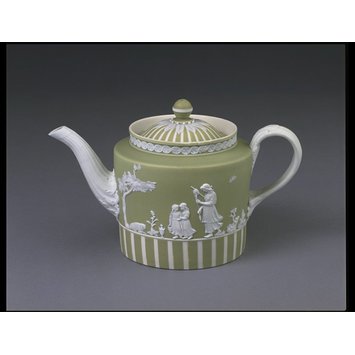
1789-1795 Jasperware Teapot (V&A) 

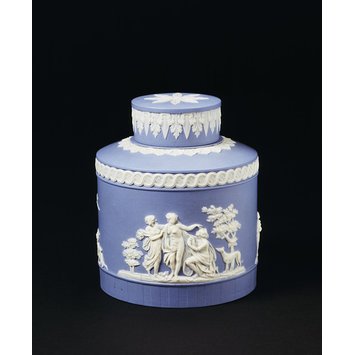
Contrasting neoclassical bas- relief designs made this his trademark design and a wide range of products were produced, cameos, vases, portrait medallions and  tableware. 


Tea Canister 1795- 1800 (V&A) 
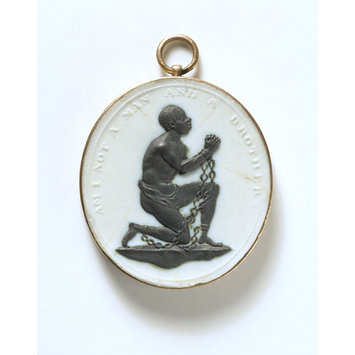
Incredibly popular, it was quickly imitated by others including Adams. It began to go out of fashion around 1811. In later years when I learnt that Wedgwood had been an advocate of the abolishion of slavery, giving large amount of money to the  cause and producing and distributing the equivalent of antislavery 'badges', his goods were suddenly imbued  with virtue.
Anti Slavery Medallion 1787 (V&A) 

Friday, 18 January 2013

Blacking Pots 19th Century

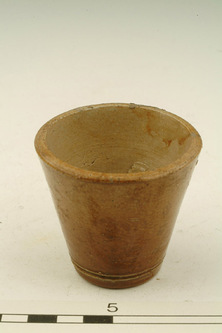
Took me a little while to find out what this small salt glazed stoneware vessel was.Tapping stoneware drinking or  goblet into google failed to  flash up a twin. It was 'ink' that did it. The excellent Museum of London seems the only site to give this little object its voice and they have done it so brilliantly I can't do better than quote their account 


Mudlarking Find: Blacking Pot

Blacking Pot 1835-1895 (Museum of London) 

' Such pots traditionally contained blacking paste. Blacking ink was widely used in the 19th century for the cleaning and polishing of boots and shoes, floors and doorsteps. The most famous and successful blacking factory in London was Robert Warren's located at 30, the Strand. In the 1830s Warrens' was selling blacking liquid in bottles and blacking paste in pots of three different sizes, priced 6d, 12d and 18d each 'in every town in the Klngdon'. Many firms were set up as rivals to Warren's, attempting to cash in on the success and emulate the 'secret' recipe of the firm. One of these was run by James Lambert at Hungerford Stair who employed the 12 year old Charles Dickens to work in the factory. Dickens never recovered from the humiliation of having been sent to work in the factory due to his father's financial problems. He described his work as 'to cover the pots of paste-blacking;first with a piece of oil paper, and then with a piece of blue paper;to tie them round with a string' and then to clip the paper close and neat, all round, until it looked as smart as a pot of ointment from an apothecary's shop. When a certain number of grosses of pots had attained this pitch of perfection, I was to past on each a printed label; and then go on again with more pots'. (Museum of London)
A Midshipman Blackening his boots 1825 (National Maritime Museum, Greenwich, London)

Wednesday, 19 September 2012

Rosso Antico and Red Stoneware

Perhaps it's not surprising that a Wedgwood pottery shard distinguishes itself so markedly on the foreshore. They are clearly so well made, the markings so precise, so refined. 


Mudlarking Find: Red Stoneware 
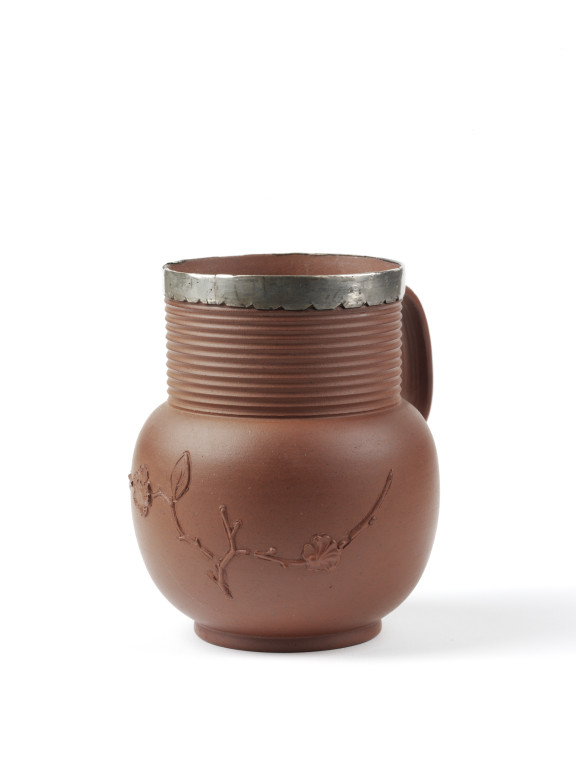
I've only found one piece of a handle from what I think is Rosso Antico, not an Italian wine as google would have it, but unglazed red stoneware produced by Josiah Wedgwood from 1760s. He was not the first to produce red stoneware, John Dwight in the 1670s made imitations of the red porcelain Chinese imports which appeared in London from the 1660s. The Elers brothers began producing a sophisticated red stoneware in 1693 in Staffordshire, later moving to Chelsea in London, once their production secrets had been discovered by other potters in the area. Both ended production by 1700. Now that I look at the photos my shard is closer in colour to the browney Elers jug below, than the redder Rosso Antico of Wedgwood - so clearly identification not for the amateur here. Last Friday visited the V&A British Ceramics collection for the first time and none of the red unglazed stoneware held the handle markings seen on shard above, the items below were also tiny, so much smaller than I'd imagined. 
Red Stoneware Elers Brothers 1690 -9 (V&A) 


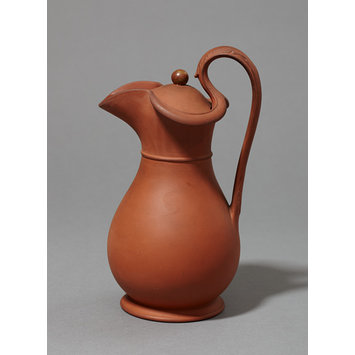
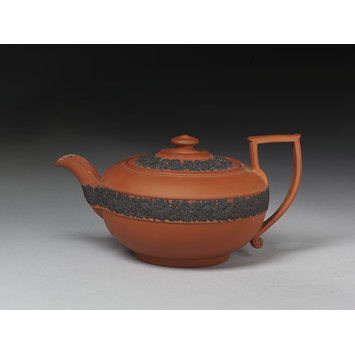
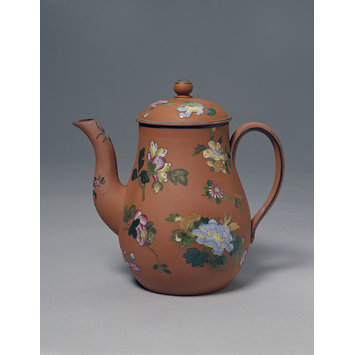
Rosso Antico means 'antique red'. The objects manufactured were teaware, jugs, dishes and vases. Wedgwood went on to decorate the red forms with intricate black clay patterns and classical scenes, alternatively with enammeled pictures. 
Wedgwood Rosso Antico Jug Late 18th C or early 19th C 
Wedgwood Ross Antico Teapot 1810-20 (V&A) 
Wedgwood was never very keen on Rosso Antico believing it was just too close to redware which anyone could produce and therefore didn't fit with his aspiration to produce premium pottery of distinction. He therefore only made it sporadically, production ceased in 1940. 


Wedgwood Rosso Antico Coffee Pot 1815 (V&A) 

Friday, 3 August 2012

Hunting Jugs and other English Stoneware

From 1750s English potters began making salt glazed brown stoneware vessels,  mainly mugs and bottles with 'sprigs',  pictures rising from the clay. Originating from potteries on the south bank of the Thames,  from Mortlake in the west to Vauxhall in the East. Some types are referred to as Fulham type stoneware others Lambeth type.

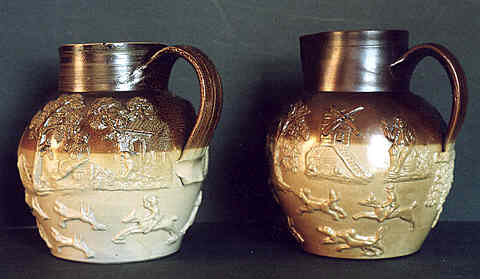
Among the most  popular vessels were the hunting jugs, or toby jugs, used for serving or storing ale and produced from the 18th to early 20th century. I do remember these jugs from my childhood, perhaps from a display cabinet or perched on a high shelf in one of my grandparent’s houses. I can still feel the glimmer of distain for what I thought were rather tastless, gaudy, rather scary monsters – how things change. Perhaps I'm confusing the ones below with the toby jugs made in the shape of a face. 

As the name suggests, a lively hunting scene runs around the bottom section of the jug, with either a hare, deer or fox chased by hounds and huntsmen on horseback. The same series of pastoral scenes, a tree, a windmill, a farmyard, and later ‘Toby’ Fillpott are emblazoned on the upper section. Philip Mernick's website reveals whilst the same scenes were depicted, different potteries used their own designs and therefore specific ‘sprigs’ can be traced to individual potteries, either Kishere or Sanders in Mortlake, the Vauxhall pottery, Doulton and Watts, Stiff and Sons or Stephen Green in Lambeth.

Hunting Jugs (mernick.org.uk)
Several months ago I found a fragment from a hunting jug, the nearest similar sprig I can find is attributed to the Kishere pottery, but as you can see not an exact match.
Thames Mudlarking Find:  Hunting Jug Fragment 
Kishere Pottery Hunting Jug  1797-1843
(Museum of London ) 
I’ve also found a couple of sprigs in plaques, which I’m guessing are from other forms of stoneware, After spending  far too long trying to find something similar on the web, to no avail,  I’ve given up and so posting now to stop me wasting any more time surfing. 

Thames Mudlarking Find Stoneware Plaque
Thames Mudlarking Find Saltglaze Windmill Scene

Friday, 6 July 2012

Black Basalt Stoneware 1760s – 1800

These shards are clearly so much more refined and sophisticated than the often found coarse pottery fragments on the Thames foreshore.


Black Basalt Pottery Shards Found Mudlarking on the Thames
I found a piece of black basalt on my second ever mudlarking trip. When I asked our Thames Discovery guide what it was he simply responded ‘Wedgewood’ and indeed it probably is.
Some writers use black basalt interchangeably with Egyptian black, others draw clear distinctions.

‘ Josiah Wedgewood pioneered the development of black basalt ware in the late 1760s, creating an exceedingly hard form of vitreous stoneware that required no external glaze. This new material improved upon an earlier form of Staffordshire earthenware known as Egyptian Black, which had been stained with iron oxide to create a black finish. Not only did Wedgewood’s new material offer greater durability and sheen than its predecessor, it proved far more suitable for creating finely detailed ornamentation. Black basalt ware consisted of Staffordshire clay, ground glass slag, manganese oxide and calcined ochre that had been mixed together and fired at a temperature slightly lower than that of hard paste porcelain. Wedgewood accentuated the shiny appearance of this material by applying a varnish, re-firing it and then polishing it with a cloth dipped in milk.’ Stephan Osdene at materialculture

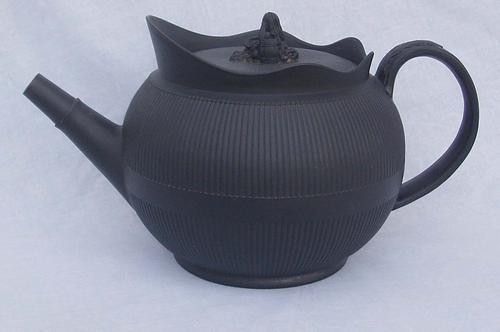
Wedgewood Style Black Basalt Teapot 1800 (bid or buy) 
Black Basalt is named after the volcanic rock, basalt, which was widely used at the time in the manufacture of vases, candlesticks and busts of historical figures. Wedgewood’s quest was partly inspired by the desire to emulate the Etruscan black pottery pieces called ‘buchero onto’ that were being excavated at Pompeii at the time and hence neo classically inspired. The range of goods was impressive, vases, lamps, ink stands, candlesticks, ewers (a vase shaped jug which is often decorated),  plaques and tableware. The  tea and coffee ware with its cups, milk jugs, tea pots and sugar bowls was the most popular.   Their capacity to withstand boiling water being poured directly  into them without cracking made them popular on two fronts function and design.

Black Basalt was a huge hit in its day, Wedgewood’s first major commercial success. In the height of its popularity in 1790-1800, selling out more quickly than it could be produced. After Wedgewood, many factories began to produce black basalt ware, notably Spode and Neale, some even copied his designs.

Friday, 22 June 2012

Derbyshire Stoneware Ink Bottle

I don't often find glass or pottery with writing on. Over the last few months mudlarking these are probably the best examples. Nice to find sufficient writing to help trace precise origins. ‘VITREOUS STONE BOTTLES WARRANTED NOT TO ABSORB J.BOURNE PATENTEE DENBY & CODNOR PARK POTTERIES NEAR DERBY’ was stamped onto these 150 ink bottles, produced by a Derbyshire pottery between 1833 – 1850


Large fragments of Derbyshire Stoneware Ink Bottle 1833-1850

The Bourne company was set up in 1806 by William Bourne, a local entrepreneur,  who heard about the exceptional clay found  during construction of a Derbyshire  road. He purchased some of the land and started production in 1809. He appointed his son Joseph to run the pottery. The "J. Bourne & Son" mark was not used until about 1850.

The clay used in making the stoneware bottles was a coarse, sandy and heat-resistant quality. When fired at a high temperature it became very hard, dense and non-absorbent. These bottles are referred to as salt-glazed pottery; salt glazing was a popular method of decorating stoneware in the mid 1800's. Common salt was thrown onto the kiln fires when the embers were at their hottest. The salt vapor combined with the surface of the pot to produce a shiny brown surface coating. The process for producing these salt-glazed wares was patented as noted by the stamp at the base of the bottle below the J. Bourne & Son company name.


The complete Ink Bottle from Museum of London 

Sunday, 17 June 2012

Debased Scratched Blue & White Stoneware 1765- 1795

I keep thinking I'm going to run out of things to blog about, but every week there seems to be another type of pottery or object to investigate. 

Over the last 8 months I’ve collected a handful of this stuff, gradually clocking it was different from the other blue and white china I’d been picking up. I kept it in my Westerwald pottery box,  realising it was similar but not quite the same. Took me a while to track down what it is, as there aren’t many pictures on the web, but persistence paid off.
 Debased Scratched Blue White Stoneware Pottery Shards Found Thames Mudlarking 
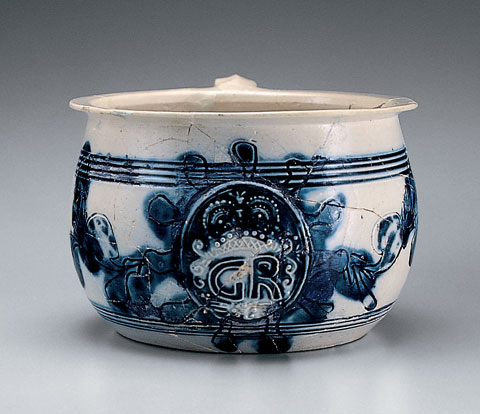
In the 18th century the not so well off found porcelain too expensive, delft ware too fragile. There was a market for cheaper alternatives; German Westerwald decorated grey stoneware filled part of this gap. Some say English potters sought to compete with these products by creating a similar looking but this time white stoneware, rather unfortunately retrospectively named ‘debased' scratched blue stoneware.  I’m yet again struck by the modern looking design of old pottery, in this case  free flowing, incised decoration with quite messy splashes of cobalt blue which bleed over the incised lines,  thus emulating Westerwald to some degree. The products seem to be quite limited, mugs, jugs and chamber pots.  Decorated with sprays of leaves (technical name apparently is foliate) amusingly the chamber pots frequently boasted  spig-moulded raised medallions with the cipher of George III and sometimes a picture of his  profile. Apparently this blue stoneware was only fashionable for  one decade from 1765, with chamber pots remaining popular for a longer period – I wonder why. This flash in the pan appearance doesn’t quite square with how frequently I find this stuff  which seems about as often as I find Westerwald– strange, maybe it was more of a must have or cheaper product hence its prevalence.
Chamber Pot Debased Scratch Blue White Stoneware (Colonial Williamsburg Foundation)


Georgian Debased Scratched Blue Mug (Denhams) 
Debased Scratched Blue Jug (ebay)

Monday, 4 June 2012

Early English Plates: White Salt Glaze Stoneware, Creamware and Pearlware 1720- 1780

The history of English tableware is scattered across the Thames foreshore, something I’ve never been particularly interested in until I started wondering about the origins of the pottery I’d found.

As ever those modern looking ‘finds’ turn out to be quite old, so for anyone else interested in identifying pottery from the Thames and finding out about its history here goes..

In 1720 potters succeeded in producing the white pottery with a glossy sheen people had been hankering after. High stoneware kiln temperatures gave the kaolin clay durability. The first sets of matching tableware were produced and were far cheaper than porcelain alternatives. Less expensive plain white plates, sometimes with relief patterns were the most popular. They were considered very fashionable in their day.

Large amounts of the stuff was exported to the US and Europe, Staffordshire potters had begun an international industry. Whilst there was clear demand, the cost of producing stoneware prevented it from becoming widespread. Consequently potters sought to develop cheaper refined earthen wares.  Creamware was the first mass produced tableware from 1750. Iron oxide in the glaze gave it a yellow cream colour. Very functional, it was the first widely available ceramic that enabled you to cut food without chipping the glaze.  Again the centre of production was in Staffordshire (plus Yorkshire). Wedgewood came onto the scene in 1759 and although not the ‘inventor’, was at the forefront of developing both Creamware and Pearlware. Not satisfied with Creamware, Wedgewood’s letters reveal the search for ‘a white Earthenware body, and a colourless or white opaque glaze, very proper for Tea & other wares’, From 1775 Pearlware moved the industry one step closer. China clay was added to the creamware body and cobalt blue to the glaze, giving it a blue tint  and a whiter appearance– a blueing technique of course still used in our washing powders and clothes manufacture.


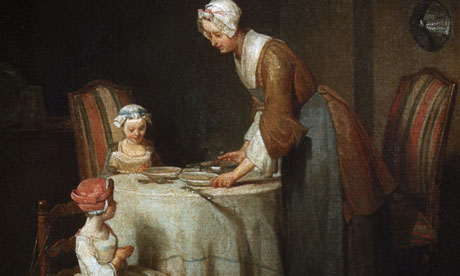
A detail from Grace at Table by Jean-Baptiste-Simeon Chardin (1740) Photograph: © Francis G. Mayer/CORBIS 

The introduction of the ceramic plates coincided with a change in table manners, I wonder if they were related?.  'The children learning their table etiquette in Chardin's 1740 painting are in the avant-garde of a cultural revolution. Cutlery, as opposed to eating with your fingers; sitting up straight in a high-backed chair; these were innovations in the way people defined themselves at table in 18th-century Europe'. (Jonathan Jones Guardian)
By 1750 white salt-glazed stoneware had caused the demise of the delftware industry and by 1760 the refined earthenwares, Creamware and Pearlware, were superceding white stoneware.

My initial impetus for returning to the Thames was to collect pottery for mosaic making, not something I’d ever done before I might add. Playing around with blue and white pottery, I soon realised that I’d need large amounts of white crockery to surround the interesting bits. A month ago I therefore collected a bag of white pottery, extremely abundant as I assume no one else bothers to pick this up. Now that I’ve found out a bit about the different types of ‘white’ pottery, I can see that virtually all the fragments I’d picked up were Creamware- which fits with its ubiquitousness. 

From the 1740s  block moulds were used, each imprinting one of several  standard patterns around the plate rim. I’ve found  a handful of these over the past 8 months. By far the most popular was the ‘barley’ or ‘basket’ design. My favourite is the feather pattern,  I haven’t yet spotted any of the  nicely named ‘dot, diaper and basket’.

Clockwise from top R, feather edge white stoneware salt-glaze, creamware, barley pearlware, barley white salt- glaze
When you see the different types of pottery side by side it’s easy to distinguish the creamware from the slightly grey stoneware. The two feather edged pieces illustrating this nicely above. I’ve found it quite hard to distinguish the White salt glaze stoneware from  Pearlware, eventually concluding the easiest way is to catch the salt glaze pitted ‘orange peel effect’ in the light. Although when together as the two barley pieces above show, you can see the pearlware does appear whiter than the stoneware. Apart from the blue and green ‘shell edged’ pottery, to be covered in the next post, I believe I’ve only found two  fragments of Pearlware, one shown below with rather crude enamel overglaze, the bluey tinge created by cobalt blue is really clear.

Thames Mudlarking: Close up of Pearlware Pottery Fragment with enamel overglaze  
Meanwhile my internet ordered box of mosaic materials sits in a corner whilst I'm preoccupied with classifying, sorting, researching, documenting and pondering my finds. Not to mention the still frequent trips to that intriguing river with all its secrets.  It’s going to take a while to get this mudlarking thing out of my system. 

Monday, 28 May 2012

Westerwald Stoneware Pottery


Whilst I love the really old finds, I’m getting a bit fed up again of all the browns on the blog, so time for some pretties.

Over the last 8 months I’ve amassed a small collection of Westerwald pottery shards. Whilst they are less prevalent than Tudor green glaze,  blue and white china, slipware or even delft, I usually spot a piece of Westerwald on each visit to the Thames.

The most pleasing finds have relief or incised decoration, impressed circular flower heads, medallions, coats of arms, hand drawn zig zags and outlines highlighting  what appear to be petals or leaves. The modern appearing shiny cobalt blue glaze, often against a grey background, belies their age. One find has manganese purple alongside the blue, a rare find. Apparently this colour was only used between 1650 – 1680 and again briefly in the final quarter of the 19th century. Cobalt blue and manganese were the only two colours which could withstand the extreme temperatures required in stoneware kilns.  

Westerwald Stoneware Pottery Fragments Found Mudlarking on the Thames 

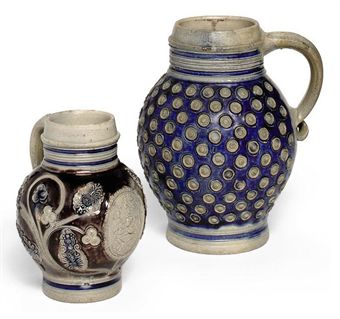
Westerwald Stoneware Jugs 1700 Christies 

More common are larger shards from the rims of tankards, with their distinctive lines of cobalt blue amid a series of circular raised tracks.

Westerwald Pottery Shards from tankards found Mudlarking on the Thames

18th Century Westerwald Stoneware Winebottle and salt glazed mugs from Reeham and Dansie auctioneers

Westwerwald is a region of Germany east of the Rhine, where the stoneware pottery industry was well established at end of the 16th century. Its golden age was in the 17th century and remained buoyant in the 18th and 19th centuries.

Jugs, tankards, mugs and chamber pots were the primary products, particularly popular between 1675-1775 and imported to London in great quantities until the end of the 19th century.  So best guess is that these shards are from between 1675- 1900 – a  rather irritatingly wide range.
Westerwald pottery shard from Thames Foreshore