Showing posts with label metal. Show all posts

Monday, 3 February 2014

Hammered Coins

Finally I seem to be getting the knack of finding the small and metal. It's true what the other mudlarkers say, you just need to get down on your knees and search small patches of foreshore. It was the first time I'd brought along proper knee pads and  this time I made myself search for a couple of hours. Previously I'd got a bit bored, preferring the ambling of beach combing. I'm also shocked by how difficult I find the systematic searching (with my eyes) between all the pebbles and muck. It takes a lot of  concentration. I often find myself drifting off and not really looking, similar to reading the words in a book but not taking in the meaning.

I was rewarded though with this tiny (around 1cm) paper thin medieval silver penny. The surround has disappeared, either eroded over time or slivers of the valuable silver were snipped, a common practice in this era. The surround holds the writing used to date these coins, so I suspect this one is impossible to date. I believe it could be anything from 1300-1500. 

This one is rather worn but you can just make out the crown, face and hair on the left.

Mudlarking find medieval silver penny


I met Nick, mudlarker for 35 years, on the foreshore yesterday who kindly tried to id the coin for me. Apparently up until Henry VIII they didn't go in for likenesses, so a stylised crowned and wavy haired king stares out from the front on all of them. A cross sections the reverse, three dots cluster in each section  (or pellets as they called by the numismatists). In this instance there is a rose shape with a dot in the middle, the 'proper' term is quatrefoil which means 'four leaves' - what a surprise. 

Coins with quatrefoil seem to be less common. I've found a few similar coins on the net and posted a couple below, one is from Richard II another Edward IV, another Henry IV and V and quite a few from Henry VI, so clearly the flower thing doesn't help much in dating. 

Henry V1 1421- 1471 - Silver Hammered Penny (ebay) 
It's difficult to estimate the value of a penny in today's money. However, according to Wiki answers 6 pennies bought you a sheep in medieval times. A penny would buy you roughly what  £10-£15 will buy in today's money. 

Richard II  (1367- 1400) silver hammered penny (historyincoins) 
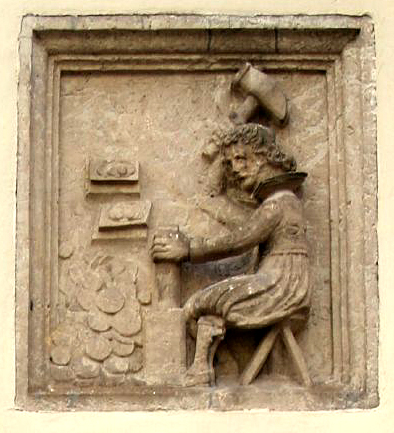
Hammered coins were produced by hammermen or moneyers who belonged to one of the medieval guilds. They placed thin metal on one die which was usually embedded into  some kind of stand and then whacked it with another. The dies were metal and engraved with the image to be transposed onto the coin.

Detail from a wall in  Rostock (Wiki) 
In the early medieval period each large town had their own moneyer, but as time went on fewer and fewer cities minted coins, until eventually they were all minted at the Tower of London. By the middle of the 17th century hammered coins were no long made, as machined made milled coins became the new currency.  

Friday, 27 September 2013

Cloth Seals

Embodied in these small slivers of lead is so much of England's past and Thames history. Cloth represented 90% of England's exports in the 16th Century and was the main export until the industrial revolution. London controlled 75-80% of this export trade, the Thames its conduit.

Cloth made up a large proportion of London’s £1 million export trade in 1560. It must have been linked with the livelihoods of many, many Londoners and funded so much of London's landscape.

Cloth seals were used across Europe from the late 14th century – the early 19th century as a means of identification, quality control and were part of state administration. The seals were attached to cloth by weavers, dyers or ‘alnagers’, crown officials who assessed whether the goods were of requisite quality and that tax had been paid. 

Blank cloth seals were caste in stone moulds
Stone Cloth Seal Mould (Bagseals.org)

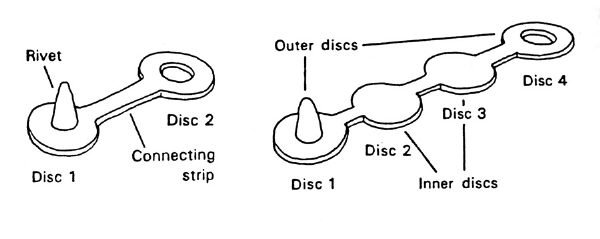
Cloth seals were usually two discs (occasionally four) joined by a thin strip. One disc had a rivet, the other a hole. The   discs were folded together over the edge of the cloth, and hammered together with a die, which imprinted information onto the lead disc.
 
2 and 4 part cloth seals (office of history and archaeology Alaska) 

It’s the intricate designs on so many of the cloth seals which make them appealing. These can include the date and region of production or inspection, touchingly personal maker’s marks or symbols indicating alnage. The latter included heads of royalty, the crown, coats of arms, griffins or lions rampart. Alnage was abandoned in 1724 and sealing was abolished in 1889.

I haven’t found many cloth seals so far, but I’m now on a bit of a mission. I’ve found one I suspect is an alnager’s with a very small and faint crown at the top and either a letter or number below


Other examples of alnager’s cloth seals, all of which will be 300+ years old,  can be found below
Elizabeth I Alnage Cloth Seal 1558 onwards (bagseal gallery)
George I Alnage Cloth Seal 1714 onwards (bagseal gallery)
17th C Alnage cloth Seal (http://proteus.brown.edu)

The other one I’ve found I recon has a makers mark on it
 Mudlarking Find: Cloth Seal

I found a few other pictures of seals with makers marks.
Cloth Workers Personal Cloth Seal  18th or 19th C (Bagseal Gallery) 
Cloth Workers Personal cloth seal 1775-1825 (Bagseal Gallery)

Sometimes you can see the texture of the cloth on the reverse, as in this case


Most of the cloth seals found in the UK come from the Thames foreshore, most commonly from the late 15th to early 19th centuries.  One theory is that many dropped off textiles during the finishing processes of shearing, dyeing and fulling carried out in the many riverside workshops along the Thames. There was a concentration of dye houses along Thames Street, between Cannon Street and Southwark Bridge. In one study of seals found along the Thames, they identified seals from 24 different counties together with imported seals and many from London dyers.

The beauty of these Thames finds is that the tiny detailed imprints are often perfectly preserved due to the Thames anaerobic mud, whereas the lead found buried in other locations is often so badly corroded that no surface detail remains.

There are a few sites which are helpful in identifying cloth seals, including one put together by Stuart who generously offers to identify your finds, here. Also LM has found loads of cloth seals on the Thames and her potted history is also worth a read here.

It’s taken me a couple of years of mudlarking and the help of mudlarking friends to start spotting lead cloth seals along the Thames foreshore. The trick is to go slowly and scan between the stones and other debris, ‘look through them’ as one friend advised. Once you set your heart on finding a particular type of find, you usually start spotting them and don’t forget to take them down to the finds officer at the Museum of London.

Monday, 23 September 2013

Another Mudlark and the Thames Festival

Unexpectedly both the youngest and husband were off on separate weekends away. Suddenly I was a free agent. Summer had closed and London was bathed in its familiar grey. Everyone was back in town the roads were crammed with traffic and tubes were chocca. But the city was weekend empty just the occasional group of blokes clad in orange day glo directing juggernauts to the latest corporate building site. 

I bounced down to the foreshore in my last time shiny new posh boots, which I'd finally got round to buying two years after I starting this mudlarking thing. They make life so much easier down there, wish I'd got some before. 


Met up with  LM and we quietly mudlarked away for the new few hours. 

Well chuffed with my first ever thimble find. I think it's mid 17th - late 18th century as it has a waffle pattern of indentations on the top.  The dipples are very regular so it must have been machine made. A good thimble identification site is here.


Mudlarking Find: Mid 17th - 18th Century Thimble

Not sure what this is, it's 7.5cm long and 3.5cm wide. Could be made of lead but not certain. If it was a medieval fish weight I'd be very pleased, but it doesn't quite match the pictures I've found of these, another find to take to  the Finds Officer at the Museum of London. 

Metal Mudlarking Find. 
Medieval Fish Weights (time line auctions)

and I also rather like this top of a clay stopper, probably because I've found nothing similar before. 
Mudlarking Find: Clay stopper
Plus in 10 minutes picked up one or two pipe stems for my mosaic. 

Mudlarking Finds: Clay Pipe Stems & a few pipe bowls.
As we sat in the pub later we sifted and cooed through our finds, both our partners are rather bewildered by our continued fascination with the same old things we keep finding, so it's nice to find another soul who can find endless pleasure in revisiting their finds. 

I was free to spend the evening mooching around the Thames festival. I'm so disappointed they no longer run  banqueting tables down the middle of Southwark bridge, it was so brilliant to feast together with loads of other people, a very unLondon like social event - I blame it all on that man Boris. I wanted to seek out a couple of Thames films, managed to track down 'Portrait of a River' but whilst interesting it didn't match up to the films I'd seen at the Estuary Exhibition. Then ambled back towards Tower bridge to see 1513 A Ship's Opera, billed as 'a moving, operatic concerto of ships’ steam whistles, bells, horns, hooters, sirens and cannon as the centrepiece of the 2013 Thames Festival' I was intrigued. It wasn't quite as spectacular as I'd imagined it might be, but interesting none the less although mainly just a lot of hooting and tooting. Rather gorgeous though to see Tower Bridge opening and lit up and the Tower of London pooled with light. I took a very unprofessional little film on my phone, mainly to show my family, but thought I'd also bung it here. 


Ended up waiting for my bus at London bridge station which has been transformed from the Victorian dive into modernity with the Shard rising up from the bus station forecourt. Mad. 

Friday, 7 June 2013

A Spring Mudlark and My First Coin

Back on part time wages and back on the bus. Low mists of cow parsley edge the parks. Above, horse chestnuts are dressed with white candles. Trees still hold the lime green haze of spring before they deepen into the green of summer. This time I noticed the Council block's lawns with their daises and buttercups squared off with black railings. We pass traffic lights and lamp posts covered in flowers wrapped in cellophane, tributes to someone killed in a traffic accident. Then the streets narrow, the height of buildings increase and you'd no longer know it was spring. Just tarmac, glass, metal and stone - albeit rather grand.

There were so many people down on the foreshore, the Thames Discovery crew measuring,  documenting and considering old archaeological features, a large group of kids, solitary souls, a gaggle of friends and kids with their families. I wasn't expecting to find much. I reckoned most stuff would have been scooped up after a series of low tides, a bank holiday weekend and half term. 

It was a pleasure to meet 11 year old Kane and his mum Sarah, all the way down from Merseyside for a mudlark. Whilst his friends immerse themselves in PS3s, minecraft and youtube Kane's out digging in bottle dumps. Kane kept me company for a while telling me what he'd found in the past and what he'd like to find. Keen to find some Tudor pins, it was nice to be able to show him where to look and how to find them. Turned round and there was Florida Tom, back in England for 6 weeks of mudlarking. Very good to meet up with him again. 

Fortunately Tom and Kane kept me mooching around one particular spot and just when I thought this was definitely my worst mudlark ever I found my first coin - well apart from a Russian Kopek and 2p - very excited. I didn't care that it was battered, thin and worn - it all added to its charm and it sparkled!


Mudlarking Find George II Copper Farthing


It's a George II copper farthing minted  between 1734-1754. I can't make out whether the date is the 30s or 50s. A crown of leaves (laureate) tops George's head and he wears Roman military dress in the classical style. On the reverse is Britannia, the Latin name for Roman Britain, who first appeared on British coins in  1672 and was only omitted from the 2008 redesign, much to the annoyance of the Daily Mail. 


Masses of fakes were also produced, the wording or 'legend' was often different so the counterfeiters could escape prosecution. Given I can't make out whether it reads  GEORGIUS.II.Rex and on the reverse BRITAN NIA no idea whether it's a genuine or not - quite like the idea it might be a fake. I wonder what it last bought? 


George II Farthing (AH Baldwin and Sons) 
On my way back I found a couple of nice delft shards,


Mudlarking Find: Delft Shard


Mudlarking Find Polychrome Delft Shard Early 1700s
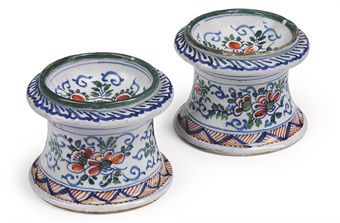
A couple of salts reckoned by Christies to be from 1720 and from Vauxhall, deploy similar colours and painting techniques to the one above. 
Delftware Salts possibly from Vauxhall 1720 (Christies) 

My other vaguely interesting find I'll keep for a separate post. As I left it started to rain. Ran for the bus and just managed to get home in time to help husband and youngest pack for our imminent holiday, which went some way to appeasing my rather irritated husband - who wasn't too happy that I'd absconded down to the Thames.

Friday, 19 April 2013

St Giles Without Cripplegate

This was the find I was so pleased with a couple of months ago, I suspected it would lead me on an interesting journey & so it did.


It's a button, solid copper possibly originally silvered and likely to be a livery button, part of a uniform. The inscription ‘Firmin’s London’ on the back dates it to 1897 – 1904. The premier button maker Firmins was established in 1655, ended up supplying royalty and still holds contracts with the military in the UK and beyond to produce their buttons and badges.


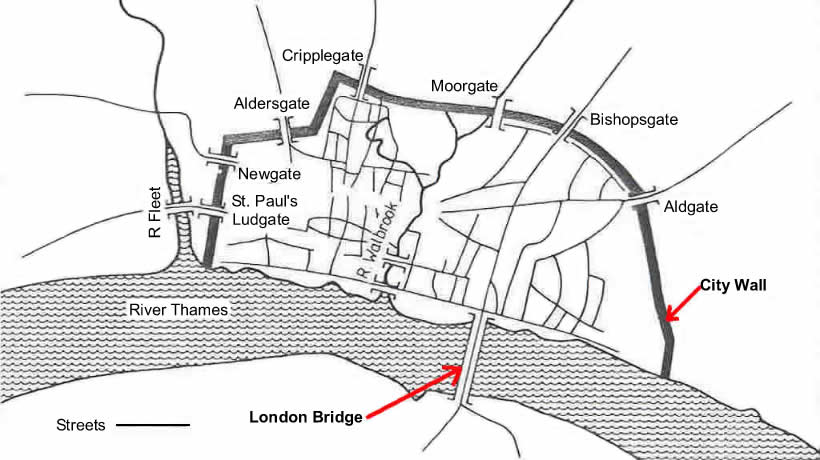
Depicted on the front of the button is the now demolished Cripplegate, one of 7 gates set in the London wall, this one gave access to Islington. It began as a gate in a Roman Fort built in 126 AD, its northern and western walls were incorporated into the first London wall built a little later by the Romans. Cripplegate was rebuilt in medieval times, modified thereafter and finally pulled down in 1760 so the street could be widened. Controversy surrounds its name. It could be from ‘crepal’ the Anglo-Saxon term for an underground passage or covered way, others believe it originated from a monk’s claim that disabled beggars were cured as the body of St Edmund the Martyr was carried through the gate in 1010 on its way to Bury St Edmunds. It’s the more romantic later tale which people seem to have adopted, the only just perceptible person in the gateway on the button has crutches. 
Location of the old London gates (blarblarblarchitecture.com)

When I first entered the clear as anything words circling the button ‘St Giles Cripplegate without’ into google, up popped a church with the same name. We finally made it down there with Jen and Tian last week. Quite a find in itself, an old gem sitting amid the posh Barbican estate and surrounded by city high rises.


St Giles Without Cripplegate Church


Certainly a church with a history, over 1,000 years of it, imprinted on a stone tablet within the Church.
The 1000 Year History of St Giles Cripplegate
It tingles with 17th century names even I am familiar with, Oliver Cromwell married here,  Milton author of Paradise Lost is buried here and John Bunyan author of  Pilgrims Progress attended the church. The Church was damaged by fire during the Blitz in 1940 which decimated the surrounding area, hence the building of the Barbican.
Cromwell
Milton


St Giles without Cripplegate a lone survivor in 1955 (colinspics)
As the name suggests the Church was built outside the walled city of London and the name ‘St Giles without Cripplegate’ is both the name of the Church and one of 25 wards in the City of London.


Inside the Church we met David Freeman who kindly showed us around. The exact same design on the button appeared on silver ‘badges’ and also topped a staff displayed in the Church. 

Cripplegate 
Perhaps the button belonged to a parish official, an Alderman, Ward Beadle the oldest elected office in the City of London or a Ward Clerk.


The Parish Beadle with Staff 1820-3 David Wilkie (Tate) 
It’s amazing where a Thames find can take you, David took out his large bunch of keys and guided us through locked gates and into the Barbican estate for a special tour of the remaining sheets of London wall that would have nudged up against Cripplegate  – brilliant!

Remains of the London Wall at Cripplegate 

More remains of the London Wall 

Friday, 7 December 2012

Lead Tokens

Lead tokens were used in Britain from the late 13th century to the mid 19th century. Until the 1500s most tokens were made of pewter and tended to be small sometimes as little as 11mm. From 1500 size increased to 15-17mm and up to 25mm in the 19th century.

I thought I'd found a led token, but it turned out it was a 19th century cloth seal, I'll update with pictures when I hopefully find one.

Each token was made and used in a specific geographical area, as such there is no uniformity or standard conventions and tokens with a diverse range of markings were produced. They appear to have had a number of functions.

The production of coinage was controlled by the monarchy. From medieval times high production costs meant there was little incentive to produce 'small change', leading to a shortage of smaller denominations, a situation which persisted for centuries. The smallest coin was a fathing, equivalent to a few days wages. Ordinary citizens needed lower value coins for everyday living, so local communities came up with local solutions and created their own unofficial currencies in the form of lead tokens.

Their underground status means there are few records of who made them or how they were used. It is summised that some were used as money, others were used as passes and some could only be exchanged for specific goods or services. Attempts to prohibit their use in the 16th century seem to have had little success, Sir Robert Cotton, lobbied for action in his paper entitled " T h e Manner how the Kings of England have supported their Estates," addressed to King James in 1611
" The benefit of the King will easily fall out, if he restrain retailers of victuals and small wares from using their own tokens ; for, in and about London, there are above three thousand  who,one with another,cast yearly five pounds apiece of leaden tokens, whereof the tenth
remaineth not to them at the year's end, and when they renew their store that amounteth to above .£15,000 ; and all the rest of this realme cannot be inferior to the city in proportion. For the prejudice, since London, that is not the twenty-fourth part in people of the kingdom,
had in it, as found by a late enquiry by order of the late queen, above 800,000, so falleth out to be two pence each person in the entire state ; may be nothing either of loss, by the first  uttering being so easy, nor burthen any with too great a mass at one time, since continual use will disperse so small a quantity into so many hands ; but, on the other side, will be of necessary use and benefit to the meaner sort, except the retailers, who made as much advantage formerly of their own tokens, as the King shall now ; for the buyers hereafter shall not be tynd to one seller and his bad commodities, as they are still, when the tokens
hereafter made current by authority, shall leave him the choice of any other chapmen ; and to the poor, in this time of small charity, it will be of much relief, since many are like to give a  farthing almes, who will not part with a greater sum."  British Num Society

Friday, 1 June 2012

Nails Found Mudlarking on the Thames

When I got home I laid out the bunch of nails,  I had this time bothered to pick up from the Thames foreshore, I was touched by their quirkiness and imperfect beauty.

Nails found Mudlarking on the Thames 
The pointy ones will have been made between 1700-1800. Each one will have been handmade by nailers or blacksmiths. Heating an iron rod, they would achieve the point by hammering each  side. The nail was then  inserted into an anvil or nail header and the top hammered into a head. ‘Roseheads’ a shallow tent like head with 4 panels were the most common, others were adorned with broad butterfly heads or  L heads.

Handmade Nail with Rosehead found Mudlarking on the Thames 
Nail making machines were  invented in the US at the end of the 18th century. Nails with no point, but a tapered sawn off end are not handmade, instead made in one of these machines.

By the first part of the 20th century most nails were made from steel and the process was fully mechanised. A more detailed description can be found at history of nails

As my good friend Maddy says, we tend to  take everything for granted, never considering how they are made, so removed from their manufacture. Gazing at these small objects, for a moment, offsets this 21st century mentality.

Monday, 14 May 2012

Pins found Mudlarking on the Thames.

Mudlarking, for me, has essentially been beach combing, wandering along the banks of the Thames, looking at the ground for things that catch my eye. I’ve wondered for while, what I’d find if I just sat down and looked closely at one patch. Last Friday I did just that, as I waited for my sister to join me.  I chose a slightly more muddy section, where erosion was uncovering pottery fragments from their centuries old resting place.  

I’ve been rather amused that my mudlarking to date has been quite’ gendered’, no digging or getting dirty for me. Only finding and probably looking for pottery, quintessential domestic remains. The boys on the foreshore invariably have their detectors, I assume metal their primary interest, coins, tokens, buttons, keys, buckles, musket balls, canon balls and badges.

Scanning my selected patch  I found my first metal find – pins – a wry smile about their domestic origins. I’d seen the guys on Mudmen uncovering pins on the foreshore, so I was half looking for these and there they were, not exactly in their hundreds but quite numerous.

17th ? Century Pins found Mudlarking on the Thames Foreshore
Amazingly old, web searches suggest pins found on the Thames foreshore are from the 14th – 17th centuries. Incredibly they were all handmade as pin machines weren’t in use until the early 19th century. The  main body, the ‘shank’, was usually  made of thin brass wire. The pins heads  made separately from a spiral of thinner brass gauge, affixed to the shank and then dipped into molten lead/tin  to solder. Longitudinal grooves in a pinner’s bone, held the shafts whilst they were being filed to a point.

16th Century Pinner's Bone  with grooves at top where pins were laid for sharpening, from Portable Antiquities Scheme
Pins were used to hold clothes in place and used extensively in ruffs, skirts, veils and partlets. They were  expensive. A 1563 warrant gives the prices ‘lviij m [58,000] small velvet and hed pynnes at xx d [20 pence] m [per 1,000]’.  The industry was deemed so important that in 1483 Parliament passed a law prohibiting imports. In the next century they were imported in large quantities from France until John Tilsby established his Gloucestershire business, employing over 1,500 people. London pin makers formed their own corporation in 1636.

Ordinary people would have a small number of pins, the wealthy thousands. Janet Arnold documents the pin purchases from Elizabetht I over 6 months
"Item to Roberts Careles our Pynner for xviij [18] thousand great verthingale Pynnes xx [20] thowsand great Velvet Pynnes and nyne thowsande smale hed Pynnes and xix [19] thowsand Small hed Pynnes all of our great warderobe"

Pins were carefully looked after and sharpened periodically. They were extracted after use so as not to tarnish the fabric and placed in a pincushion. The portrait of Countess of Southampton shows her pincushion on  the dressing table.


Countess of Southampton's Dressing Table with Pin Cushion 1590. From It's About Time