Showing posts with label coins. Show all posts

Monday, 3 February 2014

Hammered Coins

Finally I seem to be getting the knack of finding the small and metal. It's true what the other mudlarkers say, you just need to get down on your knees and search small patches of foreshore. It was the first time I'd brought along proper knee pads and  this time I made myself search for a couple of hours. Previously I'd got a bit bored, preferring the ambling of beach combing. I'm also shocked by how difficult I find the systematic searching (with my eyes) between all the pebbles and muck. It takes a lot of  concentration. I often find myself drifting off and not really looking, similar to reading the words in a book but not taking in the meaning.

I was rewarded though with this tiny (around 1cm) paper thin medieval silver penny. The surround has disappeared, either eroded over time or slivers of the valuable silver were snipped, a common practice in this era. The surround holds the writing used to date these coins, so I suspect this one is impossible to date. I believe it could be anything from 1300-1500. 

This one is rather worn but you can just make out the crown, face and hair on the left.

Mudlarking find medieval silver penny


I met Nick, mudlarker for 35 years, on the foreshore yesterday who kindly tried to id the coin for me. Apparently up until Henry VIII they didn't go in for likenesses, so a stylised crowned and wavy haired king stares out from the front on all of them. A cross sections the reverse, three dots cluster in each section  (or pellets as they called by the numismatists). In this instance there is a rose shape with a dot in the middle, the 'proper' term is quatrefoil which means 'four leaves' - what a surprise. 

Coins with quatrefoil seem to be less common. I've found a few similar coins on the net and posted a couple below, one is from Richard II another Edward IV, another Henry IV and V and quite a few from Henry VI, so clearly the flower thing doesn't help much in dating. 

Henry V1 1421- 1471 - Silver Hammered Penny (ebay) 
It's difficult to estimate the value of a penny in today's money. However, according to Wiki answers 6 pennies bought you a sheep in medieval times. A penny would buy you roughly what  £10-£15 will buy in today's money. 

Richard II  (1367- 1400) silver hammered penny (historyincoins) 
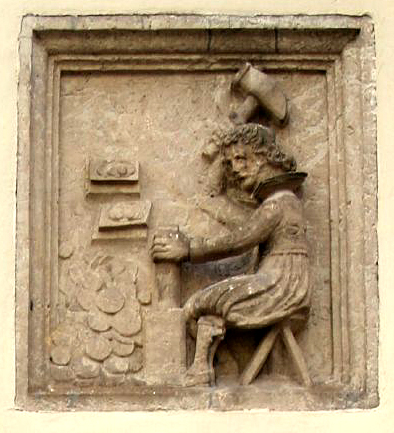
Hammered coins were produced by hammermen or moneyers who belonged to one of the medieval guilds. They placed thin metal on one die which was usually embedded into  some kind of stand and then whacked it with another. The dies were metal and engraved with the image to be transposed onto the coin.

Detail from a wall in  Rostock (Wiki) 
In the early medieval period each large town had their own moneyer, but as time went on fewer and fewer cities minted coins, until eventually they were all minted at the Tower of London. By the middle of the 17th century hammered coins were no long made, as machined made milled coins became the new currency.  

Friday, 7 June 2013

A Spring Mudlark and My First Coin

Back on part time wages and back on the bus. Low mists of cow parsley edge the parks. Above, horse chestnuts are dressed with white candles. Trees still hold the lime green haze of spring before they deepen into the green of summer. This time I noticed the Council block's lawns with their daises and buttercups squared off with black railings. We pass traffic lights and lamp posts covered in flowers wrapped in cellophane, tributes to someone killed in a traffic accident. Then the streets narrow, the height of buildings increase and you'd no longer know it was spring. Just tarmac, glass, metal and stone - albeit rather grand.

There were so many people down on the foreshore, the Thames Discovery crew measuring,  documenting and considering old archaeological features, a large group of kids, solitary souls, a gaggle of friends and kids with their families. I wasn't expecting to find much. I reckoned most stuff would have been scooped up after a series of low tides, a bank holiday weekend and half term. 

It was a pleasure to meet 11 year old Kane and his mum Sarah, all the way down from Merseyside for a mudlark. Whilst his friends immerse themselves in PS3s, minecraft and youtube Kane's out digging in bottle dumps. Kane kept me company for a while telling me what he'd found in the past and what he'd like to find. Keen to find some Tudor pins, it was nice to be able to show him where to look and how to find them. Turned round and there was Florida Tom, back in England for 6 weeks of mudlarking. Very good to meet up with him again. 

Fortunately Tom and Kane kept me mooching around one particular spot and just when I thought this was definitely my worst mudlark ever I found my first coin - well apart from a Russian Kopek and 2p - very excited. I didn't care that it was battered, thin and worn - it all added to its charm and it sparkled!


Mudlarking Find George II Copper Farthing


It's a George II copper farthing minted  between 1734-1754. I can't make out whether the date is the 30s or 50s. A crown of leaves (laureate) tops George's head and he wears Roman military dress in the classical style. On the reverse is Britannia, the Latin name for Roman Britain, who first appeared on British coins in  1672 and was only omitted from the 2008 redesign, much to the annoyance of the Daily Mail. 


Masses of fakes were also produced, the wording or 'legend' was often different so the counterfeiters could escape prosecution. Given I can't make out whether it reads  GEORGIUS.II.Rex and on the reverse BRITAN NIA no idea whether it's a genuine or not - quite like the idea it might be a fake. I wonder what it last bought? 


George II Farthing (AH Baldwin and Sons) 
On my way back I found a couple of nice delft shards,


Mudlarking Find: Delft Shard


Mudlarking Find Polychrome Delft Shard Early 1700s
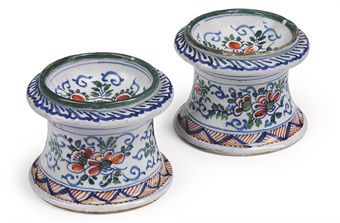
A couple of salts reckoned by Christies to be from 1720 and from Vauxhall, deploy similar colours and painting techniques to the one above. 
Delftware Salts possibly from Vauxhall 1720 (Christies) 

My other vaguely interesting find I'll keep for a separate post. As I left it started to rain. Ran for the bus and just managed to get home in time to help husband and youngest pack for our imminent holiday, which went some way to appeasing my rather irritated husband - who wasn't too happy that I'd absconded down to the Thames.