Showing posts with label 19th Century. Show all posts

Friday, 3 August 2012

Hunting Jugs and other English Stoneware

From 1750s English potters began making salt glazed brown stoneware vessels,  mainly mugs and bottles with 'sprigs',  pictures rising from the clay. Originating from potteries on the south bank of the Thames,  from Mortlake in the west to Vauxhall in the East. Some types are referred to as Fulham type stoneware others Lambeth type.

Among the most  popular vessels were the hunting jugs, or toby jugs, used for serving or storing ale and produced from the 18th to early 20th century. I do remember these jugs from my childhood, perhaps from a display cabinet or perched on a high shelf in one of my grandparent’s houses. I can still feel the glimmer of distain for what I thought were rather tastless, gaudy, rather scary monsters – how things change. Perhaps I'm confusing the ones below with the toby jugs made in the shape of a face. 

As the name suggests, a lively hunting scene runs around the bottom section of the jug, with either a hare, deer or fox chased by hounds and huntsmen on horseback. The same series of pastoral scenes, a tree, a windmill, a farmyard, and later ‘Toby’ Fillpott are emblazoned on the upper section. Philip Mernick's website reveals whilst the same scenes were depicted, different potteries used their own designs and therefore specific ‘sprigs’ can be traced to individual potteries, either Kishere or Sanders in Mortlake, the Vauxhall pottery, Doulton and Watts, Stiff and Sons or Stephen Green in Lambeth.
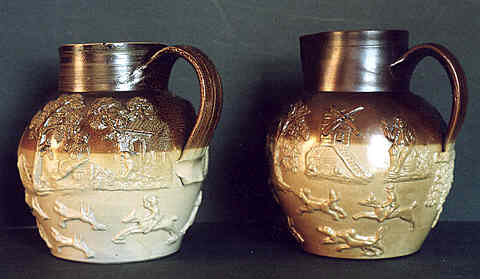
Hunting Jugs (mernick.org.uk)
Several months ago I found a fragment from a hunting jug, the nearest similar sprig I can find is attributed to the Kishere pottery, but as you can see not an exact match.
Thames Mudlarking Find:  Hunting Jug Fragment 
Kishere Pottery Hunting Jug  1797-1843
(Museum of London ) 
I’ve also found a couple of sprigs in plaques, which I’m guessing are from other forms of stoneware, After spending  far too long trying to find something similar on the web, to no avail,  I’ve given up and so posting now to stop me wasting any more time surfing. 

Thames Mudlarking Find Stoneware Plaque
Thames Mudlarking Find Saltglaze Windmill Scene

Sunday, 29 July 2012

Spongeware or Spatterware 1840- 1920

One website clearly states Scotland was the origin, another  Staffordshire. Some say 1775 others 1840. Whatever its roots, it’s claimed it was made in great quantities, several people imply most spongeware was exported either to the states or Canada. As the name suggests decoration was applied to whiteware with a sponge.  It tends to be referred to as Spatterware in the States. I seem to have found only the very basic type of spongeware,  the cheapest available in the form of teaware or bowls, most popular from 1840 – 1875.
Spongeware Pottery Shards found Mudlarking on the Thames. 
The main colours were blue, red, green, purple and yellow. I’ve only found blue and interestingly black, to which I’ve found no reference. It’s been quite a task tracking down pictures of the original objects, they clearly weren’t treated as precious family heirlooms. Now I compare the fragments I've found with the originals below I'm questioning whether they are in fact spongeware, but if not what could they be? There is one shard in the picture above which I later realised was an imposter. 

Spongeware Tea Cup 1830 - 1850  

Spongeware Sugar Bowl (ebay)

Monday, 2 July 2012

Mocha Ware 1792- 1850


Another type of pottery looking far more modern than the period it was made. Pretty common on the Thames foreshore, at least one piece being found on most mudlarking trips.
Mocha wear pottery shards found Mudlarking on the Thames 
It took me a while to find this pottery on the internet and a while longer its name. It seems to be called ‘Mochaware’, a type of dipped ware decorated with slip. The feature which sets it apart  is clearly the fuzzy, blotting paper, sea weed like decorations. The technical name is ‘dentric’ (tree like or branching). They were thought to resemble the natural geological markings on moss agate known as ‘Mocha Stone’ (pictured below), imported from Arabia through the port of Mocha (al Mukha in Yemen) – hence the name. Apparently geological patterns were rather popular in this period.

Moss Agate (from theimage.com)
Mochaware was produced in potteries throughout Britain. It was the cheapest decorated ware available. I’ve read that most British production was exported, but clearly it was still a popular item in domestic market, in London at least. Usually used for kitchen ware, but also evidently chamber pots, one of only two images I can find of this type of mocha wear. 

Mocha wear chamber pot (from artistheanswer) 
Clearly a new technique, it was achieved by dripping a coloured acidic solution into wet alkaline slip. The colour would instantly disperse into the random dentric markings. The bodies were creamware or pearlwear, later heavier and thicker whiteware bodies were used.

The main type of mochaware I’ve found has been the yellow bodies with blue dentric markings. I’ve read this is also called ‘yellow wear’. I’ve found a few other bits of mocha which I’ll cover in a future post, hoping to pick up a few more examples on my mudlarking wanderings. 

Friday, 22 June 2012

Derbyshire Stoneware Ink Bottle

I don't often find glass or pottery with writing on. Over the last few months mudlarking these are probably the best examples. Nice to find sufficient writing to help trace precise origins. ‘VITREOUS STONE BOTTLES WARRANTED NOT TO ABSORB J.BOURNE PATENTEE DENBY & CODNOR PARK POTTERIES NEAR DERBY’ was stamped onto these 150 ink bottles, produced by a Derbyshire pottery between 1833 – 1850


Large fragments of Derbyshire Stoneware Ink Bottle 1833-1850

The Bourne company was set up in 1806 by William Bourne, a local entrepreneur,  who heard about the exceptional clay found  during construction of a Derbyshire  road. He purchased some of the land and started production in 1809. He appointed his son Joseph to run the pottery. The "J. Bourne & Son" mark was not used until about 1850.

The clay used in making the stoneware bottles was a coarse, sandy and heat-resistant quality. When fired at a high temperature it became very hard, dense and non-absorbent. These bottles are referred to as salt-glazed pottery; salt glazing was a popular method of decorating stoneware in the mid 1800's. Common salt was thrown onto the kiln fires when the embers were at their hottest. The salt vapor combined with the surface of the pot to produce a shiny brown surface coating. The process for producing these salt-glazed wares was patented as noted by the stamp at the base of the bottle below the J. Bourne & Son company name.


The complete Ink Bottle from Museum of London 

Sunday, 10 June 2012

Blue and Green 'Shell Edged' Pearlware 1780- 1840


Over the months I've noticed quite a few pieces of pottery with mainly blue but sometimes green crinkly edges. Eventually tracked down the name, once I have this the story is quite easy to piece together. I can’t better others descriptions of this pottery.

'Shell-edged decoration first appeared on creamwares. Later, shell-edge became the most common type of decoration found on pearlware. Colours applied to the rims were usually blue or green with red being less common. The earlier examples of the shell-edged decoration are generally well painted, with the brush strokes being drawn in from the edge, which creates a feathery appearance. In later examples (usually after 1800 or 1805), it was common to sweep the brush along the edge laterally, producing a stripe’ St Mary's University

Different brush strokes nicely illustrated in the photographs of my Thames mudlarking finds below, with the green piece showing the lazier more efficient edging ‘line’ and the blues showing the careful brushing downwards. You can see the bluish tinge in the ‘white’ attributable to the cobalt blue added to the glaze, so characteristic of Pearlware. 


Thames Mudlarking finds 'Shell Edged' Pearlware 1780- 1840
'The 18th century saw the development of a style of tableware, which combined handsome colour and smooth texture of plain Creamware with a moulded and often tinted edging, intended to draw the eye to the food being served. The most popular edging pattern proved to be one, which imitated the random yet rhythmic structure of a scallop shell and Shell Edge Ware produced in vast quantities by potteries throughout England. Inspired by original designs in Leeds Pottery’s 18th century pattern books this new range of Shell Edge dinnerware rekindles the spirit of the Age of Elegance'.world wide shopping


'Such wares were always termed simply 'edged' in potters' invoices and price lists. Next to plain undecorated creamware they were the cheapest items offered for sale and thus although very serviceable, tended to be purchased by consumers at the lower end of the income scale. They were cheap to make and cheap to buy. As time passed many variants of 'shell edge' developed, some with quite elaborately moulded borders'.The potteries

British shell-edged earthenware was produced and exported in such large volumes between 1780 and 1860 that it appears to have been used in almost every American household. In terms of quantity, being the least expensive English earthenware available with color decoration, shell-edged ware was in fact one of the most successful developments in ceramic production during the 18th and 19th centuries.

Enoch Wood’s Burslem pottery works shipped 262,000 pieces in a single consignment. The surviving invoices of American merchants are especially telling: shell-edged products accounted for 40-70% of dinnerware sold in America between 1800 and the eve of the Civil War in 1861, despite the introduction of a number of more fashionable styles during this period.Odyseey marine exploration 2011

Saturday, 31 March 2012

Clay Pipes

Segments of pipe stems are so easy to find mudlarking on the Thames. Bowls are less common but you are certain to find at least one on any foreshore walk. They range in date from 1580 – early 1900s. They can be dated by the size and shape of the bowl and size of the hole in the stem. The older ones have smaller bowls as tobacco was originally very expensive. The finds I've kept are below, dated using a identification chart to scale. They were the fags of their day, came packed with tobacco, were smoked only a few times and then thrown away. 


Top row  1610-1710,  middle  1700 - 1800, bottom 1820-40 found Mudlarking on the Thames
Clay Pipe Smoking 1600's
Some older pipes have very ornate decoration. I'm still searching for one of these. The most ornate to date is a simple diagonal leaf pattern on the seam. 


Clay Pipe from 1820-40  with diagonal leaf pattern along seam


A Reuters Article reveals ‘ A Museum of London study of skeletal remains excavated from a Victorian cemetery in Whitechapel, east London, found most people had "notches" in at least two, and often four, front teeth made through the habitual holding of pipe stems. Osteological analysis of 268 adults buried between 1843 and 1854 found that some disfigurement had occurred in 92 percent of adults exhumed, while wear associated with habitual use of pipes was evident in 23 percent. "In many cases, a clear circular "hole' was evident when the upper and lower jaws were closed," said Donald Walker, human osteologist at Museum of London Archaeology Service. Males were affected far more frequently than females. The study, published to coincide with national No Smoking Day in Britain, also found a number of young adult skeletons had tell-tale notches, suggesting pipe-smoking may have begun in childhood.’ It wasn’t until 1881 when James Bonsack invented a cigarette rolling machine that pipes began to replaced.

Saturday, 24 March 2012

Willow Pattern Fragments

Willow Pattern 1780- present. 
The Willow Pattern was first produced in 1780-90, from Thomas Turners Factory in Shropshire from an engraving by Thomas Minton or from Josiah Spode’s factory in Staffordshire.

It combined elements from standard Chinese designs, willow tree hanging over three figures on a bridge, fence, bridge , boat, the pagoda teahouse with orange tree, island and two birds. The design was popular and copied by other factories.

In 1849, the willow pattern became associated with the tale first published in ‘The Family Friend’. English in origin it had no links to China, but captured the public imagination for the next hundred years.

I’m not adept enough to identify which shards are from willow patterns, but have clustered found elements from Thames foreshore over the last 5 months, which look as though they originate from this design. 
A Mandarin, grown fat and rich from bribes in his duties as a customs officer for the Emperor, planned an alliance between his beautiful young daughter and an old but wealthy aristocrat. On discovering his daughter was in love with his secretary, Chang, the son of a poor fisherman, the Mandarin flew into a rage and locked Koong-se inside a small house,


 surrounded by a fence to prevent the lovers from continuing their association.

As is the way with all romances, at least in fiction, love finds a way and the lovers met in secret to make their plans – on the day appointed, they began their escape, sheltering in a gardener's cottage temporarily until their absence was discovered. Recovering his wits, Chang leads Koong-seout through a back door and they cautiously make their way across the bridge,


but are spotted by the Mandarin who gives chase. Reaching the other side, the lovers make use of a small rowing boat to attempt to cross the waters and reach refuge on a small island. But the Mandarin and his household are gaining on them, in faster boats propelled by stronger oarsmen. Seeing their desperate plight, the gods take pity on the young people and turn them into birds who soar away to freedom(from http://ruby-lane.hubpages.com/hub/Willow-Pattern-Pottery-These-Lovers-Flew-Away)

Segments of orange trees

 and willow trees & the only bit of boat I’ve found.


Full willow pattern (Photo from http://www.teapartydiva.com/willow-pattern-china-history/)