Friday, 25 January 2013

Mudlarking Double

A low low tide brought out the mudlarkers. Even London's first snow didn't deter. I linked up with familiar faces on the Georgian mud bank. Andrew pulled out an almost complete Worcester jug that he'd found a few weeks ago and asked us to look out for the missing shard. Later he kindly handed me a large bag full of Worcester shards, 'spares' from his 20 years mudlarking. 
Andrew's Worcester Jug found Mudlarking
Andrew and Brian pointed out that there was an even lower tide the next day, just too tempting to resist, I scuttled down again the following day squeezing an hour in before I met my husband for our exploring 'secret London' walk in the city. There was no way he was coming down to the Thames on a cold and snowy day, even a flask of coffee couldn't tempt. 

These 300+ year old Bartmann beards seem to be coming my way at the moment. What appears at first glance a pottery accident are intentional daubs of cobalt blue. Satisfyingly I came across a match in the Museum of London's collection, I still don't quite 'get' the effect. 
Mudlarking Find: Bartmann Beard with splashes of blue glaze
Frechen stoneware bottle  15551-1700 (Museum of London) 
Two favourite finds are stoneware, I think. Unnervingly both look freshly cast, suggesting the Thames has just released them from its preserving muddy embrace. Two hours pursuing them on google failed to reveal their identity - enough was enough and I gave up the chase. 

The first is 9cm tall. The potter has decorated the vessel with ribbing as they pulled up the clay on the wheel. The flared base has been lightly thumbed to decorate, a more restrained version of the German Raeren and Siegburg jugs and beakers from the 14th - 19th C.The straight sides are confusing me somewhat, as these old jugs and drinking vessels tend to be bulbous, is it a tumbler?  Covered in a rather handsome brown mottled glaze. Rather messy brush stokes hidden on the base make it all rather human, suddenly collapsing the centuries. 

Mudlarking Find stoneware beaker?
The second is slightly taller and I suspect a pot handle. Wheel made spiralling up inside. Whilst not perfect it's rather refined and covered in the confident swish swash brush stokes that applied the glaze, I like the fact you can see it gunking up in places.

Mudlarking Find: Stoneware handle
Mudlarking Find: Stoneware pot handle


A few other pieces I thought were worth putting up are a delftware swirl and  an earthenware pottery lid with small white relief flowers


Mudlarking Find: Delftware swirl

Mudlarking Find: Small earthenware lid
Update 
I came across the picture below on this pinterest site, apart from the dog it's exactly the same, from a Staffordshire glazed redware armorial teapot circa 1740 - 1745, with white slip sprigs. 


Lastly my first butterflies, one porcelain courtesy of Brian's sharp eyes,  strangely a rather finely drawn Worcester insect and a transfer swift and a nice chunk of incised Westerwald fired up with cobalt blue below. 
Mudlarking Finds: Birds Butterflies and insect. 
Mudlarking Find: Incised Westerwald 

Friday, 18 January 2013

Blacking Pots 19th Century

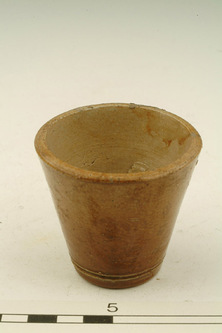
Took me a little while to find out what this small salt glazed stoneware vessel was.Tapping stoneware drinking or  goblet into google failed to  flash up a twin. It was 'ink' that did it. The excellent Museum of London seems the only site to give this little object its voice and they have done it so brilliantly I can't do better than quote their account 


Mudlarking Find: Blacking Pot

Blacking Pot 1835-1895 (Museum of London) 

' Such pots traditionally contained blacking paste. Blacking ink was widely used in the 19th century for the cleaning and polishing of boots and shoes, floors and doorsteps. The most famous and successful blacking factory in London was Robert Warren's located at 30, the Strand. In the 1830s Warrens' was selling blacking liquid in bottles and blacking paste in pots of three different sizes, priced 6d, 12d and 18d each 'in every town in the Klngdon'. Many firms were set up as rivals to Warren's, attempting to cash in on the success and emulate the 'secret' recipe of the firm. One of these was run by James Lambert at Hungerford Stair who employed the 12 year old Charles Dickens to work in the factory. Dickens never recovered from the humiliation of having been sent to work in the factory due to his father's financial problems. He described his work as 'to cover the pots of paste-blacking;first with a piece of oil paper, and then with a piece of blue paper;to tie them round with a string' and then to clip the paper close and neat, all round, until it looked as smart as a pot of ointment from an apothecary's shop. When a certain number of grosses of pots had attained this pitch of perfection, I was to past on each a printed label; and then go on again with more pots'. (Museum of London)
A Midshipman Blackening his boots 1825 (National Maritime Museum, Greenwich, London)

Friday, 11 January 2013

Imari Porcelain

Over the last year I’ve collected six pieces of porcelain with lines etched in red. Looking closely you spot trails of paintbrushed gold. You can just see the gold line gliding through the middle of the branch below on the left shard.  The red and gold are over glazed and contrast strikingly with the chunkier splashes of under glazed cobalt blue.
Mudlarking Find: Imari Porcelain

Mudlarking Finds: Imari Porcelain shards


Surprisingly they could be 350 years old. Initially made in Arita, Japan  and exported from the port of Imari, between 1650 – 1750. There are many subcategories, the shards pictured above I suspect are Kinrande Imari.

Imari porcelain was exported by the Dutch East India Company and became popular when Chinese Porcelain was difficult to source due to the chaos at the end of the Ming Dynasty in 1644 and subsequently by the decision of the Qing Dynasty to cease trading between 1656-1684. Quite something to think these small fragments may have been carried by these enormous old, old ships below 
Dutch Ships 1685 by Isaac Sailmaker (National Maritime Museum)
Export from Japan ceased when China opened for business again, as Japan couldn’t compete with China’s low labour costs. China cashed in on the popularity of Imari in Europe and replicated the designs. This pattern is most common in export porcelain in the early Qing dynasty period from 1662-1722.  I've also read there was a surge in Imari imports into England in late 19th century when all things Japanese were in fashion. 
Chinese Imari Tea Caddy (Antiques now) 

Chinese Imari Style (Aspire Auctions)

Friday, 4 January 2013

Mudlarking on a Winters Day

Expectations were low. Wind whipped our house before I left, which together with a waterlogged Britain mitigated against a low tide. I caught the bus in the dark. Twinkly Christmas lights decking the Muslim Turkish and Kurdish restaurants guided my way to the tube. 


The city was deserted. A low grey London sky sat above the glassy Thames as it slipped out quickly and  silently, no sign of the wind back home. As much as I like bumping into people and having a chat it is lovely when you're down there completely on your own. 

After just 5 minutes I knew it was going to be a good day for finds. Another day characterised by lettering on stoneware. Most of it not very old and frustratingly google shot blanks, the only one I can identify is the bottom right 19th C J.Bourne ink bottle covered in an earlier post
Mudlarking Finds: Writing on mainly Stoneware
Other satisfying pieces are peopled transferware and another salt glazed stoneware Bartmann Beard, this time made neat with a rather cute little tie. His face is rendered in so many ways, suggesting there were dozens of potteries making Bartmann Jugs in Germany between 1550- 1700, they used many different moulds or that designs were developed over time, I spent an idle hour collecting different images on a dedicated board on my pinterest site
Mudlarking Finds: Transfer People
Mudlarking Find: Another Bartmann Beard 
Stumbled across an unusual number of pipes with longish stems 
Mudlarking Finds: Clay Pipes T-B 1640-60 ,1700-70, 1690-1720
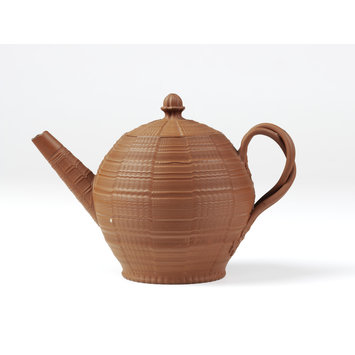
The last find of note is the spout of a Georgian  Red Stoneware teapot, beautifully crafted with intricate zig zag patterns and so smooth and precise it must have been engine turned. 
Mudlarking Find: Stoneware Spout 
Red Stoneware Teapot by Thomas Barker 1770-80 (V&A) 

  • S


After an hour and a half I’d had my fill and wanted to be back with the family, in the warm, eating toast, perhaps they won’t even notice I’ve been out.

Friday, 28 December 2012

Colander 1480- 1650

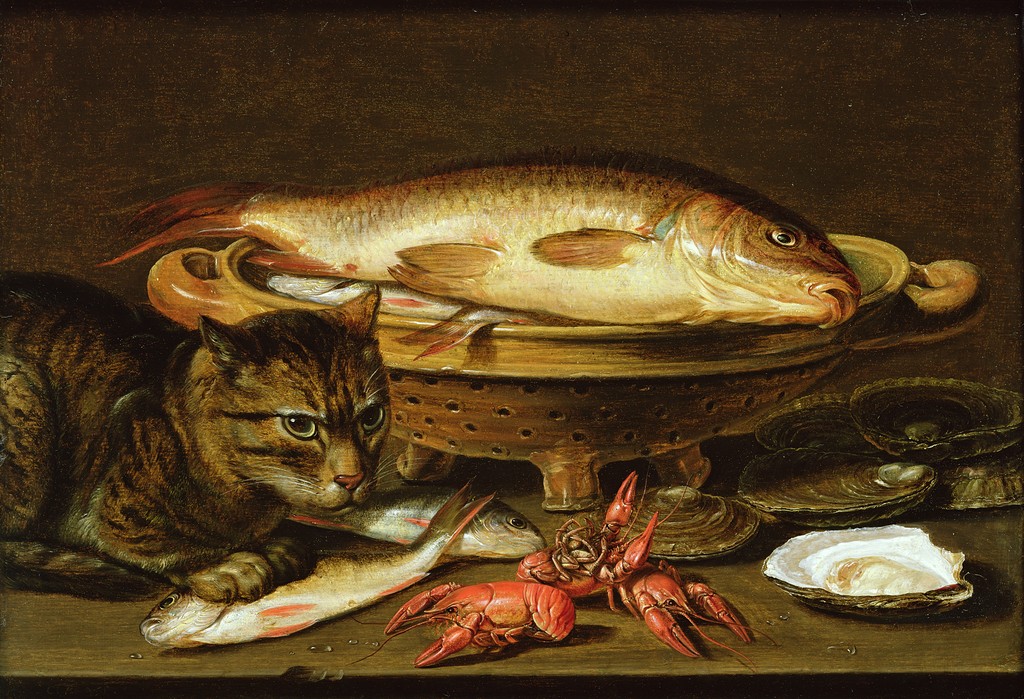
Hesitated before picking up the piece below with holes, now I'm really pleased that I bothered. Below I've carefully  propped it up with a very green English Tomato which was to hand ripening on our windowsill to better illustrate its origin. The shard is as big has my hand and has a shiny brown glaze on the inside and traces of a thin glaze on the outside. It took me a while to work out it was from a colander and that the little protrusion was in fact a foot - it was only when I came across the still life painting below that the penny dropped. 
Mudlarking Find: 16th Century Earthenware Colander
It is probably redware, the texture is quite rough and you can spot large inclusions in the clay. The holes are uneven. I've read that pottery in the 16th century was expensive and only owned by the well to do, the rest using vessels and cooking equipment made of leather, wood or pewter. I wonder how common colanders were? Were they must have kitchen equipment for those who could afford them? 

Still Life with Earthenware colander by Flemish Clara Peeters 1589- 1657
I can't end this post without reference to my surprise that this old still life was painted by a woman. Very little is known about her but she must have been pretty remarkable to have made it in 16th century. Apparently the painting is full of symbolism which is lost on our 21st century sensibilities, the fish represents Christ and are placed in the position of a cross, although I've read elsewhere is just represents abundance and has no moral or other subtext.  

Friday, 21 December 2012

Worcester Porcelain – Dr Wall Period 1751-1783

I had a few moments before I had to leave. The lapping low tide was intermittently granting access to a mud plateau littered with white ceramic shards. Most were undecorated creamware but  a few patterned pieces caught my eye, which I quickly scooped up. Later I noticed two displayed hatched crescent marks– a lead just too tempting to resist, so onto google images. It took no time to work out they originated from the first period of Worcester Porcelain Factory, referred to as ‘Dr Wall’. One very similar to the bottom of the coffee mug (rosecroft antiques) pictured below, but now they are adjacent, I suspect mine is from a tea bowl or cup. 
Mudlarking Finds: Worcester Hatched Crescent
Worcester coffee Mug & Saucer 1780


Worcester Hatched Crescent
Whilst I'd heard of Worcester, no idea where is was - England’s West Midlands and in the 1750s home to the impressive Dr Wall. A doctor, founder of Worcester Royal Infirmary, champion of Malvern water and such a talented artist David Garrick jumped on chairs at Wall’s home to get a closer look at his paintings. In 1751 Dr Wall persuaded a group of 13 business men to pump prime the Worcester Porcelain Factory, a precursor of Royal Worcester and key player in the history of ceramics.

Dr Wall artist unknown (BBC) 
Porcelain had been produced in China since 200 and imported to Britain in large quantities from 16th century. It took until 1710 for Europeans to master the art of production in Meissan Germany. The race was on to develop  British porcelain. It’s said that Dr Wall and apothecary William Davis experimented at Davis shop and discovered a way to make soft paste porcelain, later bringing additional technical expertise by  purchased their rival Benjamin Lund’s Bristol porcelain business in 1752. Securing a supply of soapstone from Cornwall clinched their success. When added to the mix soapstone rendered the finished product heat resistant -  other porcelain cracked on contact with hot water. Business canny and continuing to aim for best in class in 1756 they secured the services of Robert Hancock arguably the most talented copper plate engraver of his time.
Their target was the middle market. Products were tea and table wares. In 1754 they accessed the London market via a warehouse in Aldergate Street and large quantities of Worcester products were decorated in London by James Giles. Initially designs were hand painted. It is claimed Worcester were the first to introduce transfer printing to porcelain and from the 1770s most of their designs were transfer printed. Decorated in blue and white with Chinese and Japanese themes and from the mid 1750s with flowers in the flowing German style popular at this time.  They also produced more expensive coloured enamelled sets. They became the largest producer of blue and white Porcelain, so many of the porcelain shards found on the foreshore must originate from this company. 
I wonder if the other porcelain shards I found nearby are Worcester? German flowing flower style?
Mudlarking Finds: Porcelain Shards - Worcester?


Pattern on reverse of one shard


For some time I've wanted to match designs on my mudlarking fragments to their original patterns and even better linking these to developments in design over the centuries. Apart from the willow pattern up until now I’ve had no success. This time to my delight I thought I’d found the remains of the parrot pecking fruit design, associated with the aforementioned Robert Hancock, this shard has the hatched crescent on its reverse. Sadly on a closer look it's not an exact match, which wiped the very pleased with myself expression off my face. 
Mudlarking Find: Worcester Porcelain not the Parrot Eating Fruit Pattern

Parrot Pecking Fruit Pattern Worcester Mug 1775 (Steppes Hill Farm) 

Update
Ha, found it, the shard above (albeit upside down)  is from the 'fruit sprig' pattern, pic below - smug again. 

Worcester mug  with the “ Fruit Sprigs” pattern Circa 1770 (cathcartsantiques.com)

Friday, 14 December 2012

Mudlarking - another day's finds

A couple of weeks ago I unexpectedly found myself on the Thames foreshore. We'd forgotten the youngest had an INSET day so one of us had to stay at home, partly to ensure the French project got done. Our attempt to catch the bronze exhibition was yet again postponed. I'd been going stir crazy at home for the last four days so was grateful to be the one let out. 

Had a really enjoyable mooch despite the rain. An early find was a medieval tile enlivened by the animal that had walked across it 600+ years ago. A Museum of London archaeologist leading a foreshore school group kindly worked out it had decorated the front of a house. Now, I was just going to say the paw print was a dogs as I couldn't be bothered to check out paw prints on google. Passed around like after eight mints after our ‘in the shed’ Sunday lunch, the Millers decided it was definitely not a dogs. Between them they ruled out  cat, rat, squirrel so at the moment we’re left with rabbit. I spent a few minutes on google looking at paw prints but I’m not sufficiently motivated to trawl. Perhaps my animal loving sister who spent her youth plaster casting footprints as we walked around Britain can help us out - Laura?
Mudlarking Find: Medieval tile with paw print
Half the Millers Id Crew Sunday Lunching in the disco shed. 
The archaeologist suggested another find was a Victorian bell – metal seems to be coming my way now. Since Tania Covo suggested I can always pass on surplus ceramic finds for her to craft into more wonderful Thames Jewellery, handfuls of small shards of porcelain, pearlware and creamware found their way into my bags. There is something so satisfying about finding a house, people or animals framed in a shard. The craftsmanship appreciated more when a tantalising fragment of pattern is rescued. 

Mudlarking Find: Small Victorian Bell 


Mudlarking Finds: Houses 

Mudlarking Finds: Flowers
Mudlarking Finds: Patterns
I don't often find a new type so nice to pick up these two shards, which the expert ceramic mudlarker had pointed out to me a fortnight ago. Unfortunately I've forgotten their provenance and no luck on google so far. 

I  left the foreshore bathed in sun and blue sky and made my way to the wonderful  Museum of London. They have a knack of displaying just enough to give a real feel for each period without overwhelming you. Wonderful selection of medieval pots. 
Medieval Pottery 13th-14th Century (Museum of London)