Friday, 29 March 2013

Other Mudlarking Blogs

Work has consumed me for the last month, back to work full time and silly hours, so there has been little time for mudlarking, researching or writing, so this week I thought I'd promote three of my favourite mudlarking 'blogs' 

Moonflygirl

I was lucky enough to bump into Tania on one of my first mudlarking trips.  Now I'm not one for jewellery, but I make an exception for Tania's. She transforms pottery shards she finds along the Thames into the most beautiful ear rings, cuff links, bracelets and pendants.  With an astute eye she manages to choose just the right snippet of shard, slightly quirky and tantalising, always leaving you wondering what the larger pattern looked like and what once loved object they originated from. Click here for a link to  Tania's blog  and she sells her work here. I know some mudlarkers don't like the idea of people using the stuff they find for art, but I love the fact she produces beautiful things from  remnants of  our buried  grandmothers treasures, before they are washed away for ever. 


London Mudlark


Not strictly a blog, but a facebook 'page', I just love this site, it's a brilliant mix of the the things Lara finds mudlarking, tit bits about the Thames & London, good links and  she even recommends books! One of my favourites are her 'spot the find' photos. Photo by photo you slowly zoom in until her latest find is circled, it's great fun. You can find her site here, and click like to join. 

I've learnt a lot from her blog and she writes beautifully. I haven't yet met Lara down on the foreshore but hope I'll bump into her some day. 


Thames Mudlarking: Finds and Thoughts


Chafing dish 
This is Shane's blog, like me fairly new to mudlarking, I always enjoy seeing what he's found, he mudlarks in so many places along the Thames and always carefully documents where his latest finds come from.

I particularly like the flipcard view of his blog here, a good way to see all his finds and helpful when it comes to identifying yours. 


London Mudlarker

I thought I'd also mention my pinterest site. Created to bung pictures I come across during my internet trawling, as I try to figure out what I've picked up on my latest trip. It's also become a handy way to categorise my finds. 

Others might find it useful as a quick way of identifying what they've found. The link is here.


Friday, 22 March 2013

Chafing Dish

Once home, I knew I’d be determined to search until I found out what this piece of broken pottery was. I thought that strange little knob on the shard’s rim must give something away – and so it did.
Mudlarking Find: Rim Section of a Chafing Dish
The shard is quite big, its length 12cm. Yellow lead glaze covers the inside, a splash of green glaze under the handle where copper had been added looks almost accidentally placed.

Wheel made and well made with a deep robust rim and a stub protruding at right angles, all that remains of the handle. The knob rising from the rim above the handle has a small hole right through the middle, possibly where a stick had been placed before firing so this key part of the design kept its shape and place during firing.  I worked out fairly quickly  this shard came from a chafing dish, the only pottery boasting those rim knobs. Not sure where it was produced, it looks similar to the one below produced in Surrey/Hampshire borders or perhaps it was imported from France?
Chafing Dish 1550- 1700 Surrey Hampshire Ware (Museum of London) 
I immediately assumed it was a cooking vessel, similar to a pipkin or skillet.The description of the chafing dish in this picture throwing me somewhat ‘Diego Velazquez portraying an old woman poaching eggs in a glazed earthenware chafing dish over charcoal’ (Wiki) 
Diego Velazquez Woman Cooking Eggs 1618 (National Gallery of Scotland) 
I now reckon the earthenware pot, is just an earthenware pot and the chafing dish is beneath. So if I’m right – the chafing dish held the charcoal coals and not the food. Several chafing dishes I’ve tracked down seem to have holes or slits at the bottom, presumably to keep the coals bathed in oxygen and burning.
Chafing Dish Surrey Hampshire Boarders 1550- 1700 (Museum of London) 
Plates where placed on top, resting on the 4-8 knobs around the rim, to warm food or to cook food which required this type of gentle treatment. I’m assuming the gaps allowed hot air and fumes to escape, at the same time prevented the plates from overheating. They seem to be referred to as braziers in the States.

A recipe from the 1545 ‘New Booke of Cokerye’ mentions them
ake a dyche of rosewater and a dyshe full of suger, and set them upon a chafyngdysh, and let them boyle, then take the yolkes of vii or ix egges newe layde and putte them therto everyone, and so let them harden a lytle, and so after this maner serve them forthe and cast a little synamon and sugar upon them. (blogs.plimoth.org)

Like the skillet they seem to have been introduced from early Tudor times around 1480. A device that could be brought to the table to keep food warm, as described rather vividly in Wiki

‘ In 1520, Hernan Cortez reported to Charles V the manner in which Montezuma was served meals in  Tenochtitlan (now Mexico)
"He was served in the following manner: Every day as soon as it was light, six hundred nobles and men of rank were in attendance at the palace, who either sat, or walked about the halls and galleries, and passed their time in conversation, but without entering the apartment where his person was. The servants and attendants of these nobles remained in the court-yards, of which there were two or three of great extent, and in the adjoining street, which was also very spacious. They all remained in attendance from morning until night; and when his meals were served, the nobles were likewise served with equal profusion, and their servants and secretaries also had their allowance. Daily his larder and wine-cellar were open to all who wished to eat or drink. The meals were served by three or four hundred youths, who brought on an infinite variety of dishes; indeed, whenever he dined or supped, the table was loaded with every kind of flesh, fish, fruits, and vegetables that the country produced. As the climate is cold, they put a chafing-dish with live coals under every plate and dish, to keep them warm..." Gareth Dean, Medieval York 2008:140.

Friday, 15 March 2013

Jasperware 1775 - today

I've only found one weeny bit of Jasperware on the Thames foreshore. Apart from transferware it's the only pottery I was familiar with before this mudlarking thing started. Displayed in the South London suburban houses of my youth,  I knew it as 'Wedgwood' rather than Jasperware. Three decades later I haven't quite overcome my youthful allergy to it. 


Mudlarking Find: Jasperware  stoneware 
I can now at least appreciate the technical achievement. A type of refined matt stoneware, developed by Josiah Wedgwood in 1775 in his search for the secrets of porcelain. 

He named it after the stone 'jasper', the white version,  the 'base' colour of this pottery. The stoneware was then stained with oxides, either pale blue, dark blue, green, brown, black or yellow. The oxide permeated throughout in the early versions and is termed 'solid'. Costs were later cut by dipping so only the surface was coloured. 
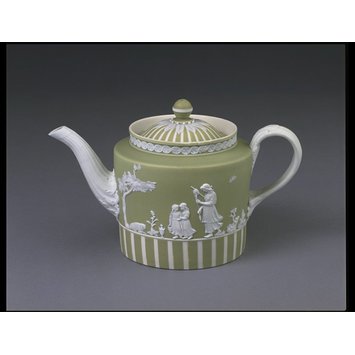
1789-1795 Jasperware Teapot (V&A) 

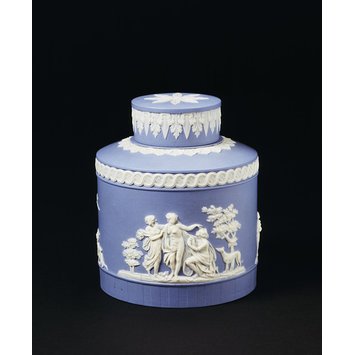
Contrasting neoclassical bas- relief designs made this his trademark design and a wide range of products were produced, cameos, vases, portrait medallions and  tableware. 


Tea Canister 1795- 1800 (V&A) 
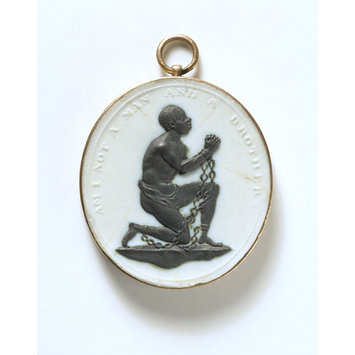
Incredibly popular, it was quickly imitated by others including Adams. It began to go out of fashion around 1811. In later years when I learnt that Wedgwood had been an advocate of the abolishion of slavery, giving large amount of money to the  cause and producing and distributing the equivalent of antislavery 'badges', his goods were suddenly imbued  with virtue.
Anti Slavery Medallion 1787 (V&A) 

Friday, 8 March 2013

Mudlarking at Greenwich

I’ve been meaning to get down to Greenwich for ages for a mudlark and got my chance with my sister Laura a couple of weeks ago. Find of the day has to be the best clay pipe I’ve found so far, with roses on one side and thistles on the other, no doubt representing England and Scotland. The pipe makers letters are in relief on the foot possibly a J and an A.


Mudlarking Find: Rose and Thistle Clay Pipe
I believe these highly decorated clay pipes were produced from the 1850s onwards. Rose and thistle pipes seem to have been made across the UK and I’ve found references to pipe makers in Portsmouth and Scotland who made them. Greenwich University mention that a rose and thistle pattern (sadly no picture) was made by a pipe maker in Deptford, just round the corner from this find, perhaps it originated there?

The Greenwich shore we visited is so different from the ones we usually graze. Much more beach like with large patches of sand and shingle. The same occasional piles of animal bones are found,  which always seem to congregate with lumps of coal and river rounded bricks.


We met a delightful man who has been metal detecting for years. He explained that up until a few years ago the beach was covered in mud. The mud has been washed away by the Thames clippers, which continue to erode the remaining mud banks, washing all that history into the Thames. Good job there are a few mudlarkers who regularly sweep this stuff up and take anything important to the Museum of London. This guy was full of interesting snippets of information and finally revealed he had found the Rochester cuff link , among the top 50 archaeological finds discovered by members of public and featured in this recent TV series. 

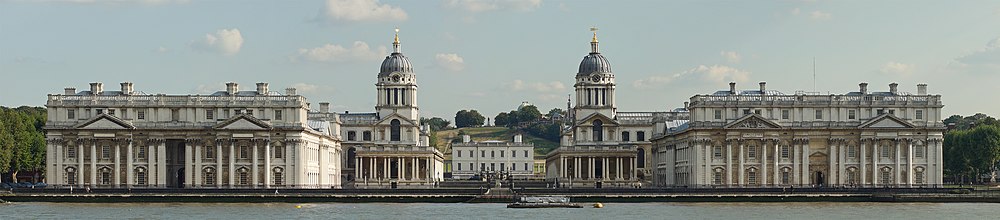
What a place to mudlark though, those beautiful Wren buildings as a backdrop and classical music wafting about the place from the poshly named Trinity Laban Music Conservatoire.

Wren's Buildings at Greenwich (Wiki) 
 We came across several small pieces of bellamines, those German saltglazed stoneware jugs from Tudor and Stuart times.
German or English Salt Glazed Stoneware Relief Patterns 1550 - 1700
And only the second piece of gravel and slipware I’ve found, probably made in Staffordshire
Mudlarking Find: Shard from a Slip and gravel  Jug 


Slip and Gravel jug 1840 (Martyn Edgell) 

And that was it really. We finished off our morning with the perfect post mudlarking meal, traditional pies with mashed potato,  parsley gravy and hot tea.
The Perfect Post Mudlarking Lunch
Then it was on with the rest of our day. Like two excited teenagers we grabbed the front seats on the DLR train and journeyed  to Bank through that fascinating but bewildering array of pools and towers of glass and steel that make up docklands. We treated ourselves to a cream tea in the stunning 1860 Gamble Room at the V&A, the first museum cafe in the UK.


Then over to the Natural History Museum to see the wildlife photography exhibition, as wildlife is to my sister what smashed bits of pottery are to me. As we left, the afternoon light on the buildings whispered spring and was so beautiful I just had to take a pic. Great to be a tourist in your own city. 
The Natural History Museum and the V&A in spring sunlight

Friday, 1 March 2013

Skillet 1550- 1700

This was my favourite find from mudlarking trip a month or so ago. It was the completely pleasing tiny foot that did it. Roughly but somehow carefully and perfectly rendered. Soot still stains the flat base and licks the sides. The inside painted with shiny glaze, made green by the addition of copper.  The whole piece is only 4cm long, the complete vessel must have been strangely tiny. 
Mudlarking Find: Section of a  Tudor skillet. 
I'm guessing this comes from an earthenware skillet. Introduced in Tudor times and  placed on the charcoal burning stoves that begun to be used from the 16th century. Apparently it represents when cooking became more refined, necessitating smaller vessels.
Skillet 16th Century (Bridgeman Art Culture History)


Skillets are mentioned in this recipe from Hampton Court 1485- 1603

'Take a little faire warme water, as much sack, and take half flower half bread, mingle them altogether: then take five or six egges and break therein whites and all, a little nutmeg, pepper and salt and cut in appells very small then take a faire skillet with suet and let it boyle on the fire and so put the batter in it.'

Friday, 22 February 2013

Mudlarking in the snow

It was rather bizarre, mudlarking as snowflakes glided down. As I scoured the upper bank suddenly a tall guy whooshed down the stairs towards me, turning sharply to clamber up to search the section of wall he was looking for, ‘found it’, a geocacher delighted with another kind of find.

Deborah joined me half an hour in, for her first mudlark. Find of the day was so good, it’ll have a post all of its own, when I’ve had a chance to get back to its roots.

An early find was this rather fine medieval shard, picked up because of its incisions. Looking at it side on, I worked out it is probably the bottom of a strap handle attached to a jug. There are three small indentations on the glazeless reverse, which fit the tips of my fingers perfectly, where the likely female potter had strengthened the body of the jug as she smoothed and merged the handle 500+ years ago.
Mudlarking Find: Section of strap handle

Side view of handle showing diagonal join


Reverse showing three finger indentations 
Previous white clay handles I’ve found before have been
stabbed’, as described in this previous post. I suspect the incisions mark where the handle began to break away from the base and as with stabbing had two functions, decorative and prevented the clay from fracturing by enabling water to be released from the thicker sections of the jug as it was fired. It could well be Surrey whiteware produced 1240 – 1500, but I’ve failed to find a jug from these medieval pottery producing areas which has similar slashes – so perhaps it is from somewhere else? I wonder if it came from a one of these lovely baluster jugs.
Kingston ware Baluster Jug 1240 - 1360 (British Museum) 
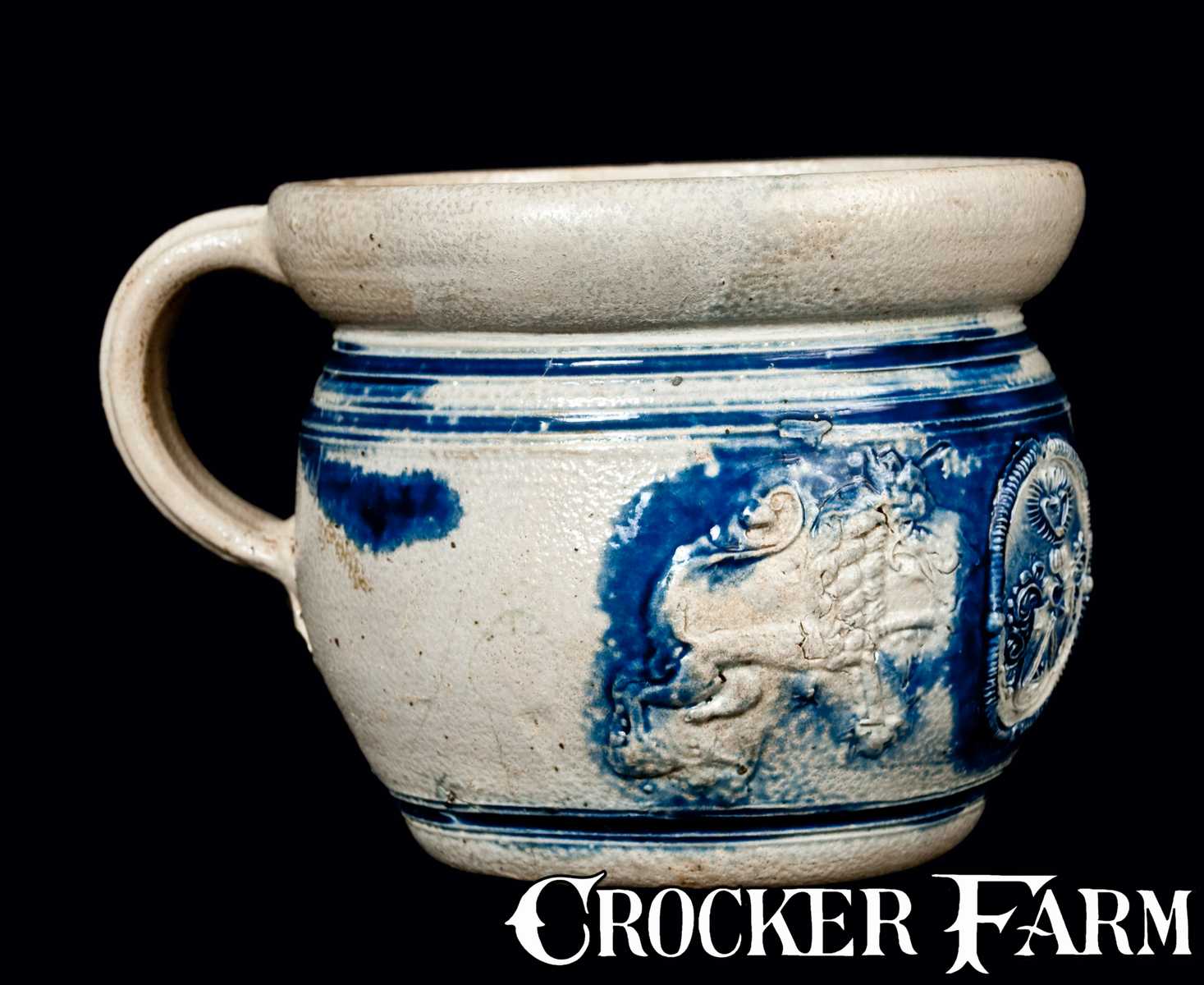
This next piece is only 300+ years old. When I picked it up, I could see the bubbly relief bits and suspected they belonged to a Westerwald animal. It took me ages to work it out when I got home. As I look at it now it all seems rather obvious. A lion, its bush ended thin tail on the top left swishing into the cobalt blue. Beneath its body. The blobs are its mane, his face badly rendered but you can make out the crescent of its mouth swallowing the blue, with a single sharp tooth top and bottom.
Mudlarking Find: Westerwald Rampant Lion 
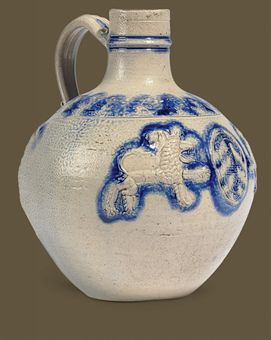
It’s likely he is one of two lions who supported a large medallion on the front of an imported German Westerwald chamber pot, popular for over 100 years, between 1630s – 1750s. Alternatively he could have been doing the same thing on a jug. Amusingly these animals seem to be referred to as 'rampant' in the antiques trade. 
17th C Westerwald Camber Pot  (Croker Farm) 

Westerwald Salt glazed Jug 1656 (Christies) 
Another pressed copper alloy button, this time with the inscription  O H ? Attneave Farringdon St EC. My google searching got me only so far, an existing street near Farringdon Street was renamed Attneave Street in 1895 probably after Alfred Attneave a Clerkenwell vestryman according to one source. Alternatively it could refer to a company name, in the census of 1881 there were 5 people with the surname Attneave in Clerkenwell.
Mudlarking Find: Copper Alloy Button 
The Georgian mudbank is giving up quite a bit of red stoneware at the moment. This time a rather fine teacup handle. It wasn’t until 1750 that teacups were produced with handles and red stoneware reached its popularity between 1750-1760, so reasonable to assume it’s from around this time. Quite possibly from Staffordshire whose potters were producing copies of the popular Chinese Yixing red stoneware teapots which were first imported to Britain in 1669. Covered in an earlier post on Rosso Antico
Mudlarking Find: Red  Stoneware  teacup handle
I haven’t bothered to pick up the bakewell tart like Staffordshire Combed Slipware for ages, but this large, big as your hand piece was just too yummy.
Mudlarking Find: Staffordshire Combed Slipware 1690-1830
A large piece of what I assume is English porcelain was also swishing about in the low tide, perhaps Worcester or Caughley but I can’t find a pattern match.
Mudlarking Find: English Porcelain 
Other finds are chucked together below, the usual mixture of slipware, hand painted pearl ware, Chinese export porcelain, delft, transferware, banded ware, white salt glaze,  and yet more sections of clay pipes with makers initials either side of their feet, this time P/S  and W/W. 

Mudlarking Finds: The rest. 
Our morning was finished off with a cup of tea and cake in the Tate restaurant where we shared our finds. Our view couldn't have been more spectacular looking across to St Pauls  through the falling snow. The cold hadn't put Deborah off and she's keen to come down again, although I should remember Deborah can deal with anything, even her broken rib on this trip. Off with the boots and on with the shoes with just enough time to walk along the Southbank, over Westminster Bridge for a meeting in Whitehall I had to attend on my day off. As we were ushered in to a room to wait to be summonsed, had just enough time to pull out a few of my treasures to show my colleague, amused by the juxtaposition

Saturday, 16 February 2013

Chinese Export Porcelain 1556 - today

I think I can now deduce what shards are Chinese or Japanese porcelain. Their cross sections are dense like stoneware and very white. They don’t tend to stain, so despite being hundreds of years old look new. The blue and white decoration is slightly blurred, subdued and a lighter blue than transferware- a bit dreamy.
Mudlarking Finds: Chinese Export Porcelain with hand drawn flowers
Pretty common on the foreshore I can never pass them by and pick up 2-3 pieces on each visit.
These shards were usually hand painted with deceptively modern patterns. 
Mudlarking Finds: Dreamy porcelain
China was the first nation to discover the art of making porcelain possibly as early as 1300.
In the 16th Century Portugal began trading with China, importing Ming Dynasty blue and white porcelain, heralding the 300 year European love affair with porcelain. The Chinese began making porcelain specifically for the European market hence the term Chinese Export Porcelain and the first European port opened in Canton in 1556. Porcelain was a handy bit of cargo,  placed in the ships hulls it provided ballast and  was unaffected by water, allowing the more vulnerable silks, teas and furniture to be stored higher up.

In the early 1600s the Dutch captured two Portuguese ships laden with porcelain and other goods. The cargo was auctioned off, the buyers of this ‘white gold’ the European elite including the Kings of France and England. The Porcelain craze had begun – among those who could afford it. It is hard to imagine how wondrous it must have been. Nothing like it had been seen  before. The only pottery had been course earthenware. Chunky German stoneware was the  most refined. Westerwald wasn’t on the scene until the late 17th century and I believe delftware of this time was rather crude. These gleaming, smooth, white painted beauties began to replace the aristocracy's silver tableware.

Homage is paid in the 17th century Dutch still life paintings with Chinese export porcelain sometimes placed centre stage. 
Pieter Gerritsz van Roestraten  1627-1698 (It's About Time) 
England and Holland began trading with China themselves, with each country's East Indian Company playing pivotal roles. In the middle of the 17th Century, civil war in China caused trade to shift to Japan. Porcelain trade was re-established with China again in the late 17th Century.

There are a bewildering array of types, Kraak, Famile Vert, blanc de chine, famille rose and patterns canton, mandarin, rose medallion, encre de chine, Fizhugh and bird and butterfly, all associated with particular periods.
Kraak Porcelain Bowl  1573-1620 (Pater Gratia Oriental Art) 
Kraak Porcelain Saucer 1575 - 1615 (Pater Gratia Oriental Art)
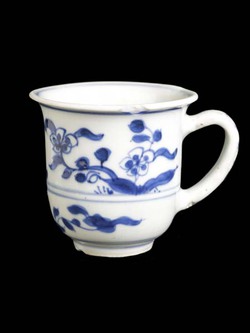
Over time Chinese potters produced European forms and designs ewers, mugs, candlesticks, sugar bowls and milk jugs. Wooden models were sent so they could learn how to produce these unfamiliar objects. European motifs Christian imagery, heraldry, classic mythology were used.
Chinese Export Porcelain Coffee Mug 1750 (Museum of London) 
1690 Porcelain Mug made for the English Market (Michael Pashby Antiques) 
By the late 18th century imports from china were declining as English ceramic innovation and mass production took over.