Friday, 14 June 2013

Staffordshire Figurines 1775 onwards

I’d expected to come across a head of a china figure at some point but didn’t consider it could be a torso. I still do wonder why on earth I picked this broken old thing up. It’s a specimen of things I could never stand - china figurines, but things always seem rather more interesting when you ease them out of the mud and want to figure out what they are and the story they have to tell.  


Staffordshire figurines were produced from 1775 onwards in ‘the potteries’ a collection of six towns Burslem, Tunstall, Hanley, Fenton, Longton and Stoke, now all subsumed into Stoke on Trent.

Press moulds were used, the worker’s finger print can be seen clearly inside my find, left as they pressed the clay into the mould. Earlier figures were made with back and front moulds with features and colour all the way round. Enamel colours were painted onto the glazed figures by hand, fixed by another firing at lower temperatures, occasionally gilt was then added before a final firing.

After 1840 figures tended to be slip caste in one mould and flat backed so they could sit flush with the wall atop mantelpieces.

The emphasis was on cost. The figurines were churned out cheaply and quickly using child and women’s labour for 12 hours a day 6 days a week. There were dozens of potteries producing them. Virtually no one bothered to imprint maker’s marks.  Many potteries went out of business in this highly competitive market and sold on their moulds and stock. Therefore it’s rare you can trace particular figures to specific potteries.

What’s interesting about the figurines is the insight they provide into popular taste. They offered the middle classes an affordable alternative to the expensive porcelain figures produced by the Meissen pottery in Germany and Chelsea and Derby factories in England.

It seems the Victorians were particularly mad about these figurines. Perhaps more people had greater disposable income as the industrial revolution kicked in and production costs declined so they were within reach.

The early Georgian figurines tended to represent biblical or classical figures or romantic representations of rural life.

In Victorian times, the celebrities, venerated and events of their day were quickly caste. Likenesses were copied from prints. Purchase and display was a way of communicating your erudition, cultivation, humour and how with it you were, perhaps equivalent to the facebook likes, shares and retweets of today.

Actors and comedians seem to have been their celebrities, almost all of whom are forgotten now. Below is John Liston, apparently one of the greatest comedians of all time, he was the first comic actor to command a higher salary than a tragedian, earning the vast sum of  £60-£100 a week in 1820.  
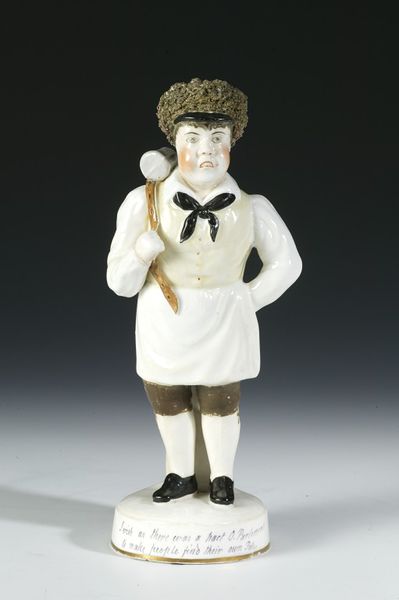
John Liston Playing Sam Swipes at the Haymarket 1820 (V&A) 
Busts of politicians, clergy and Shakespeare were produced.

Bust of John Wesley (Madelena.com) 
Scenes of intrigue were represented, such as Stanfield Hall, where local notable Isaac Jeremy met his end at the hands of an illegitimate gentleman farmer’s son James Rush, as were dramatic events, such as 17 year old Ellen Bright’s death by tiger in 1850.

Death of the Lion Queen 1850 (madelena.com) 
It’s not evident to me what period my find is from, she was found on the Georgian mudbank amid shards of white salt glazed plates and early Worcester Porcelain, so I suspect she’s one of the early Georgian types, a hunch backed up by her roundness and similarity to the figures below produced around 1790.
 
Ralph Wood Figurines C.1790 Staffordshire (antiquepottery.co.uk) 
(thank you to V&A and Madelena Antiques for all the information on their websites which helped me piece this together). 

Friday, 7 June 2013

A Spring Mudlark and My First Coin

Back on part time wages and back on the bus. Low mists of cow parsley edge the parks. Above, horse chestnuts are dressed with white candles. Trees still hold the lime green haze of spring before they deepen into the green of summer. This time I noticed the Council block's lawns with their daises and buttercups squared off with black railings. We pass traffic lights and lamp posts covered in flowers wrapped in cellophane, tributes to someone killed in a traffic accident. Then the streets narrow, the height of buildings increase and you'd no longer know it was spring. Just tarmac, glass, metal and stone - albeit rather grand.

There were so many people down on the foreshore, the Thames Discovery crew measuring,  documenting and considering old archaeological features, a large group of kids, solitary souls, a gaggle of friends and kids with their families. I wasn't expecting to find much. I reckoned most stuff would have been scooped up after a series of low tides, a bank holiday weekend and half term. 

It was a pleasure to meet 11 year old Kane and his mum Sarah, all the way down from Merseyside for a mudlark. Whilst his friends immerse themselves in PS3s, minecraft and youtube Kane's out digging in bottle dumps. Kane kept me company for a while telling me what he'd found in the past and what he'd like to find. Keen to find some Tudor pins, it was nice to be able to show him where to look and how to find them. Turned round and there was Florida Tom, back in England for 6 weeks of mudlarking. Very good to meet up with him again. 

Fortunately Tom and Kane kept me mooching around one particular spot and just when I thought this was definitely my worst mudlark ever I found my first coin - well apart from a Russian Kopek and 2p - very excited. I didn't care that it was battered, thin and worn - it all added to its charm and it sparkled!


Mudlarking Find George II Copper Farthing


It's a George II copper farthing minted  between 1734-1754. I can't make out whether the date is the 30s or 50s. A crown of leaves (laureate) tops George's head and he wears Roman military dress in the classical style. On the reverse is Britannia, the Latin name for Roman Britain, who first appeared on British coins in  1672 and was only omitted from the 2008 redesign, much to the annoyance of the Daily Mail. 


Masses of fakes were also produced, the wording or 'legend' was often different so the counterfeiters could escape prosecution. Given I can't make out whether it reads  GEORGIUS.II.Rex and on the reverse BRITAN NIA no idea whether it's a genuine or not - quite like the idea it might be a fake. I wonder what it last bought? 


George II Farthing (AH Baldwin and Sons) 
On my way back I found a couple of nice delft shards,


Mudlarking Find: Delft Shard


Mudlarking Find Polychrome Delft Shard Early 1700s
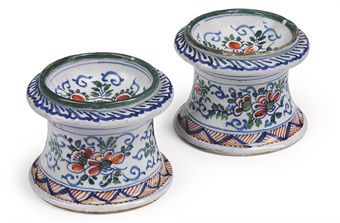
A couple of salts reckoned by Christies to be from 1720 and from Vauxhall, deploy similar colours and painting techniques to the one above. 
Delftware Salts possibly from Vauxhall 1720 (Christies) 

My other vaguely interesting find I'll keep for a separate post. As I left it started to rain. Ran for the bus and just managed to get home in time to help husband and youngest pack for our imminent holiday, which went some way to appeasing my rather irritated husband - who wasn't too happy that I'd absconded down to the Thames.

Friday, 31 May 2013

Hairbrush

I found the remains of a hairbrush a few months ago, almost didn't pick it up. It took me back to another word - the London cottage industry of brush drawing - which sounds more romantic than it evidently was. 
Homeworking brush drawer East End London 19th C (Society of Brushmaker Decendents) . 

Holes were drilled into the brush back and wire or string was looped through the holes. Bunches of bristles were pushed through each loop by hand and were folded and pulled back into the hole as the twine was pulled from behind. Apparently it could take a whole day to draw a brush in this way. 


You can still see the twine sewn into the ridges at the back. On the reverse loops are just visible, nestling in each hole. The brush would have been finished with a back which was either stuck on with fish glue, the posher ones were screwed on. No screw holes in this one, so the commoner type I think. I can't work out if it's made of bone, horn or wood. Lovely comfy indentations for your thumb and forefinger, it would have been a rather cute hairbrush, I suspect from the 19th century.
Drilling holes in the brush backs (brushmakers.com)
As well as homeworkers the still in business GB Kent made their brushes in London from 1777, mainly employing women. An early visitor to their original factory observed 'bristles from Russia, Serbia, China and India; badger hair from Germany and the Balkans; whalebone from the Antarctic; fibres from Mexico, Brazil and Africa; beech, cherry, birch and sycamore from the English countryside and tropical timbers, ebony and satinwood from the forests of Ceylon, the West Indies, South America and Indonesia' (Executive Shaving Company) 

All of which I imagine would have arrived via the Thames.
The Rhinebeck Panorama of London c. 1807

Saturday, 25 May 2013

German Stoneware Mineral Bottle

I put down the first piece of stoneware I found, thinking the little bit of writing wasn't worth it. A few minutes later found a similar larger shard with a lot more, I went back ten feet to retrieve the discarded piece and as I suspected they slotted together. A fortnight later I found the missing middle fragment in the same place. 
Mudlarking Find  Georg Kreuzber Stoneware Bottle
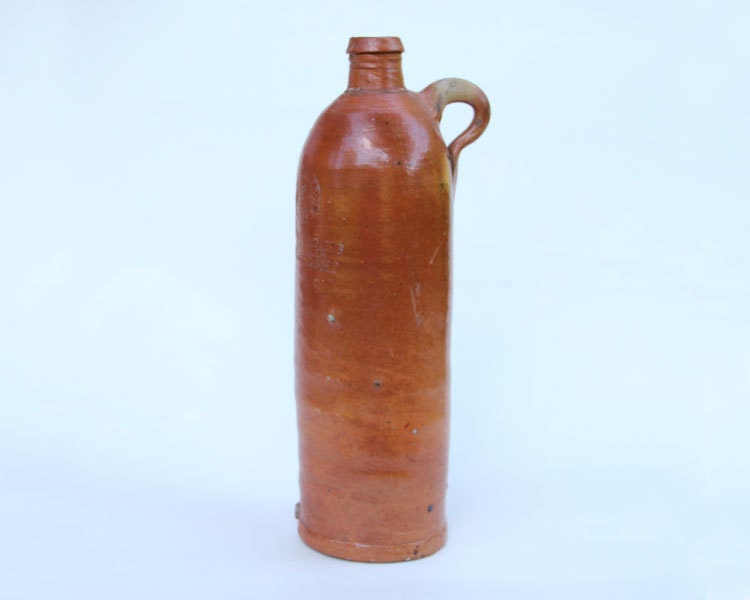
Not an old find, Victorian and mildly interesting. It's German and probably held mineral water. Produced for Georg Kreuzber, a wine merchant from Ahrweiler who in 1850s began bottling mineral water from the Apollinaris spring .By 1860 40,000 bottles had been dispatched across the globe. The refinery shut in 1878. 

The rather crude and imperfect incised stamp has a circular inscription 'Apollinaris-Brunnen  M-W'. Inside appears a boaty logo and below 'Georg Kreuzberg, Ahrweiler, Rheinpreussen'. 

A clearer picture of the logo on another bottle 
Georg Kreuzberg Mineral Bottle (Etsy) 
There seem to be quite a few German mineral water bottles scattered along the Thames and a number of different companies. Others have suggested these bottles contained gin and this type continued to be produced until the 1890s. I tracked down a picture of one with the label intact. Exported to the States seemingly from London with their offices at 19 Regent Street, this rather salty mineral water must have been a hit. 

Georg Kreuzberg looks like a man about town. He developed the springs in the area, building the first bath house with hotel attached at Bad Neuenahr hot spring. He had a penchant for sequoia and started a bit of civic planting, some of the redwoods still stand today. 

old postcard with Georg Kreuzberg and dedication of Neuenahrer Hot Spring in 1858

Friday, 17 May 2013

Samian Ware

You always find something special. Find of the day this time was my first Roman samian ware - nearly 2000 years old. This small piece of pottery was just sitting, upside down on the pebbles. As I turned it over I caught lettering in the middle of the bowl. Liking things with writing I knew it would be plopped into my bag. I assumed it was stoneware but as I looked more closely the lettering had a Roman look, so felt a little excited. What's weird is that it looks so modern, almost machine made, similar to the stuff churned out in Staffordshire from the late 18th Century. 
Mudlarking Find: Base of Roman Samian Ware 

Samian Ware(British Museum) 

Base (British Museum) 


I subsequently learnt that 'samian' potters often stamped their name in the base of their bowls. The next day my youngest helped me decipher the name TAVRICIM rising up from the base of my find, which as V's = U's in Latin is Tauricim. I found one mention in a 1895 reference book from the Musee Lyon 'inscriptions antiques'. Next to his or her name is 'Sainte-Colombe' a town in Western France - perhaps the potter was based here. 

Mudlarking Find:  Roman Samian Ware with Potters Stamp TAVRICIM. 
Samian ware or terra sigillata as it is sometimes referred to was first produced at the end of the  first century BC in Italy. By the mid 1st century AD, Gaul (modern day France & western Germany) had become the major producer. This pottery was produced and exported in vast quantities  throughout Europe and remained very popular for 250 years. At some point it was also produced on a smaller scale in Britain at Colchester and possibly London.  I can't quite comprehend how massive this industry was. There were 600 potters alone in La Graufesenque, one of the major sites of production in Gaul. The remains of one kiln measured 11.3m by 6.8m, the height an estimated 7 metres. With up to 9 internal storeys dismantled each time, the capacity is estimated at 30,000 - 40,000 vessels.  I wonder if Samian ware was the first mass produced fine table ware ever? It was refined but relatively cheap and used mainly for the presentation of food or display in its own right. 
Principal terra sigillata kiln sites(potshard.net) 
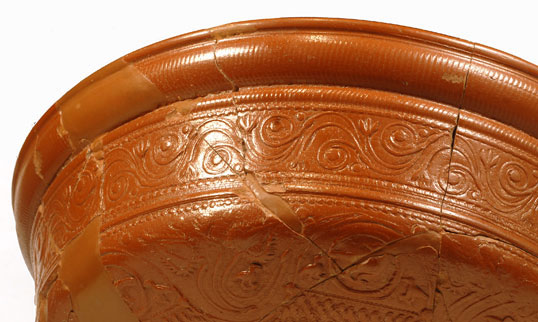
Samian ware can be plain or decorated. They look so modern because they were made in moulds. They shrank as they dried enabling fairly easy removal from the moulds. Their orangey glossy look is due to a bit of slip dipping, after which they were fired. Seemingly all rather controlled and organised there were standardised shapes and matching sets. 

South Gaulish Samian Ware showing standardisation of size (wiki)  
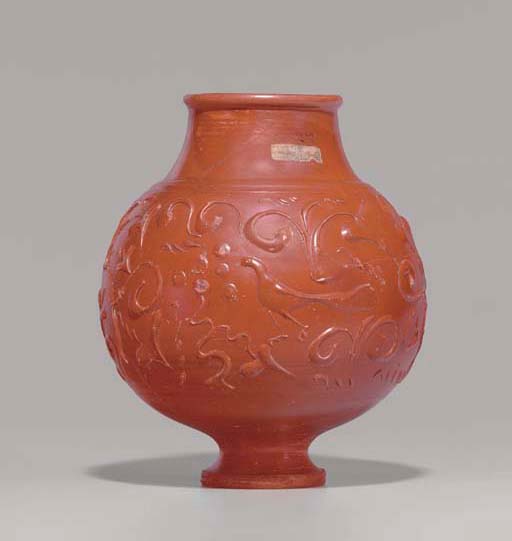
The decorated pieces are rather lovely. Animals and  figures depict myths and legends,  popular hunting or erotic scenes. Some fuse classical designs with native 'Gaul' traditions. As with those 19th century hunting jugs, particular designs are associated with individual potteries. The style of decoration changed over time, beginning with bands of decoration with a rather formal, precise style and ending with larger more freestyle designs. 
Decorated Samian Ware (Museum of London) 

Roman Barbotine Vessle 2nd C AD (Christies) 
Its longevity means there is tons of this stuff buried beneath us. A number of different classification systems arise from the years archaeologists have spent sorting, sifting, categorising and labelling this stuff. The potters stamps and decorative motives enable dating to within 20 years in some cases, hence samian ware with the right clues like clay pipes surrenders the date of a layer of finds. 

The rest of this particular day was characterised by tea bowls, I found yet another armorial pipe and this time coveted shard after shard of debased blue stoneware which I'm amassing with some notion of mosaic making. I was able to return Brian's 'piggy' glass seal, say goodbye to our lovely French ex archaeologist who is moving the States. I was lucky to meet Jim just before I left,  a follower of the blog,  who is over for a three week trip to the UK from the States with frequent mudlarking forages when he and his wife have time. I didn't quite remember Jim from followers on the blog, so it appears that wordpress followers don't show up on blogger. Interesting how many Americans make their way across the pond to do a bit of mudlarking.   

Friday, 10 May 2013

Another mudlarking haul

Ironically find of the day is another George III armorial pipe covered in this recent post, this time perfectly preserved. The crown tops the coat of arms, each element is perfect it in its minuteness, the three English lions roaring on top of each other with the Scottish lion on its tippitoes slightly to the right,  Irish harp, fleur de lys and so it goes on... the soot from the last lick of flames  200 years ago staining the front rim. 

Mudlarking find: Clay Pipe with George III Coat of Arms  

George III Coat of Arms used between 1760 - 1801
The lion and the unicorn caress the shield from the sides. Amazingly detailed, you can even see the chains surrounding the unicorn on the right below.  


Delighted to find a relief moulded medallion of George III, who seems to dominate the days finds. He was knocking around from to 1760 - 1820 the first Hanoverian king whose first language was English. Another reminder to the Tories that Britain has always been an island of immigrants. I've been on the look out for one of these for ages. This one is from a jug, mug or perhaps even a chamber pot made from white stoneware disparagingly referred to as debased scratch blue, at its height of popularity between 1765- 95 and covered in this earlier post.  


Mudlarking Find: George III medallion on debased scratch blue stoneware

Debased Scratch Blue Jug (ebay) 
I had fun hunting down the origin of this lovely little piece, my guess -  an acorn cup from 16th century German Rhenish stoneware, fortunately for me captured in Flegel's still lives . 
Mudlarking Find: Acorn Cup 16th Century Cologne Stoneware

Detail from Still life below (hogsheadwine) 

George Flegel Still life with Stag beetle 1635
The potters from Cologne were keen on their relief acorns and oak leaves in the first half of the 16th century before they moved to Freshen, the Cologne bartmann jugs seem to be particularly refined. 

A yummy bit of hand painted delftware, a bit posher than the pieces I usually find and the first shard I've found with carefully drawn highlighting white lines in the centre of the leaves. Can't find a delft plate on the web which is similar to this. 
Mudlarking Find Delftware 1560-1750
Couldn't resist this tiny bird imprisoned in its shard 

Mudlarking find: Transferware bird 
or the hand painted flowers in the base of this Georgian tea bowl


Mudlarking Find: Hand painted flowers in the base of a tea bowl. 
One antique site suggests this distinctive floral decoration with tadpole leaves and barb-hook ends derives from Liverpool tinglazed earthenware, but was then replicated in both Leeds and Staffordshire and similar to those depicted below 


Miniature Toy Tea cups and Saucers 1785 -1800 (antiqueszone) 
The moral of this next story is never let me look at your finds, I got home to find the glass seal  Brian thought he had lost had found its way into my bag! So before it's returned I thought it might as well feature here.  It would have sat proudly on the front of a 100 year+ wine bottle, is it a pig or an elephant on the front? 
Brian's glass seal 17th - 19th Century

Friday, 3 May 2013

R. White London Stoneware Bottles

A month ago, I found a large piece of stoneware pottery. As I bent down and flipped it over I was pleased to see writing and a picture underneath. 'R.Whites' sits above a stamped plaque of St George and the dragon, their 19th Century logo. 


Mudlarking Find R White trademark logo on Stoneware bottle  Circa 1894
As we stopped to show each other our finds another mudlarker said he'd spotted another Whites bottle and suggested I picked it up on my way back, so I did


Mudlarking Find: R Whites London Stoneware bottle 
In the 1840s Robert and Mary White started selling their home made ginger beer from a barrel in Camberwell in South London , made with 'the finest Jamaica Ginger and Refined Sugar only.. and cannot be surpassed for its warming and invigorating properties'. Their business grew rapidly. Their produce range expanded to include lemonade and mineral water and by 1869 R Whites had 5 factories and 16 depots in the Midlands and London. 

At some point they could afford to promote their brand via stoneware bottles. The lettering reminds me of J Bourne, covered in this earlier post and I think I read somewhere the bottles were produced in Bourne potteries. The bottles would have been recycled and reused, the ritual captured in an old London school kids rhyme

'R. White's ginger beer goes off pop; a penny on the bottle when you take it to the shop!'. 


R Whites Price List 1888 (British Library) 

Testaments from a court case at the old Bailey in 1894 give a glimpse into the stoneware bottles journey, or perhaps it refers to the glass bottles which came later. 


ALEXANDER SMITH , unlawfully selling two bottles of gingerbeer to which a trade mark was falsely applied. 

MR. HORACE AVORY. Prosecuted.
GEORGE SURTELL . I am an inspector of the Mineral Water Bottle Exchange Company, which was formed for the purpose of restoring bottles to mineral water manufacturers—if bottles get into wrong hands they are sent to the Exchange, sorted out and sent back to the original owners—on 29th July I found the prisoner standing with a barrow, on which was gingerbeer, in Acorn Street, Bishopsgate—I bought from him these two bottles of gingerbeer, each bearing the trade mark of R. White—I called the prisoner's attention to the trade mark—he said, "I make my own gingerbeer. I have brought bottles to the Exchange. I am also a dealer"—I examined the rest of the stuff on his barrow and found about seven dozen of gingerbeer, four dozen bearing the trade mark of R. White, and the remainder bearing the names of other well-known makers—two days afterwards I went to 58, Wentworth Street, a private house where the prisoner lives in one room—I saw a tub in the back yard and about ten dozen empty bottles, all bearing the names of different makers—I heard the prisoner before the Magistrate claim to be tried by a jury.
Cross-examined by the prisoner. I told the man with me to give you the money, and he gave you 2d.
HENRY CLEMENTS . I am a foreman to R. White and Sons, Limited, of Camberwell, one of the principal mineral water manufacturers in London—I produce the certificate of registration of their trade mark, "R. White," which appears on these bottles—I was with Surtell on 29th July when these two bottles were bought—they are White and Sons property; they are never sold—I have not examined the gingerbeer in the bottles, but by the way the bottles are corked I can tell they were not filled by White and Sons—these two bottles came from the prisoner's barrow—another man was standing there with a barrow at the same time; I purchased six bottles of him, and proceedings were also taken against him.
The prisoners statement before the Magistrate: "I wish Mr. White would protect his bottles a little better; I clean them for him and use them, and save them from being destroyed."
The prisoner in his defence stated that Messrs. White would not receive back their bottles if they were greasy; that he bought old stuff, and when he had enough of these bottles he sent them back.
HENRY CLEMENTS . Re-examined). We do not buy these bottles back; they are not allowed to be bought or sold.
GEORGE SURTELL . Re-examined). We allow twopence per dozen for bottles brought to the Exchange.
GUILTY .— Discharged on recognisances.

(Old Bailey On Line)

Over the years the company was merged, taken over and in the 1960s absorbed into Britvic, but R Whites lemonade lives on