Showing posts with label Georgian 1714-1830. Show all posts

Friday, 14 June 2013

Staffordshire Figurines 1775 onwards

I’d expected to come across a head of a china figure at some point but didn’t consider it could be a torso. I still do wonder why on earth I picked this broken old thing up. It’s a specimen of things I could never stand - china figurines, but things always seem rather more interesting when you ease them out of the mud and want to figure out what they are and the story they have to tell.  


Staffordshire figurines were produced from 1775 onwards in ‘the potteries’ a collection of six towns Burslem, Tunstall, Hanley, Fenton, Longton and Stoke, now all subsumed into Stoke on Trent.

Press moulds were used, the worker’s finger print can be seen clearly inside my find, left as they pressed the clay into the mould. Earlier figures were made with back and front moulds with features and colour all the way round. Enamel colours were painted onto the glazed figures by hand, fixed by another firing at lower temperatures, occasionally gilt was then added before a final firing.

After 1840 figures tended to be slip caste in one mould and flat backed so they could sit flush with the wall atop mantelpieces.

The emphasis was on cost. The figurines were churned out cheaply and quickly using child and women’s labour for 12 hours a day 6 days a week. There were dozens of potteries producing them. Virtually no one bothered to imprint maker’s marks.  Many potteries went out of business in this highly competitive market and sold on their moulds and stock. Therefore it’s rare you can trace particular figures to specific potteries.

What’s interesting about the figurines is the insight they provide into popular taste. They offered the middle classes an affordable alternative to the expensive porcelain figures produced by the Meissen pottery in Germany and Chelsea and Derby factories in England.

It seems the Victorians were particularly mad about these figurines. Perhaps more people had greater disposable income as the industrial revolution kicked in and production costs declined so they were within reach.

The early Georgian figurines tended to represent biblical or classical figures or romantic representations of rural life.

In Victorian times, the celebrities, venerated and events of their day were quickly caste. Likenesses were copied from prints. Purchase and display was a way of communicating your erudition, cultivation, humour and how with it you were, perhaps equivalent to the facebook likes, shares and retweets of today.

Actors and comedians seem to have been their celebrities, almost all of whom are forgotten now. Below is John Liston, apparently one of the greatest comedians of all time, he was the first comic actor to command a higher salary than a tragedian, earning the vast sum of  £60-£100 a week in 1820.  
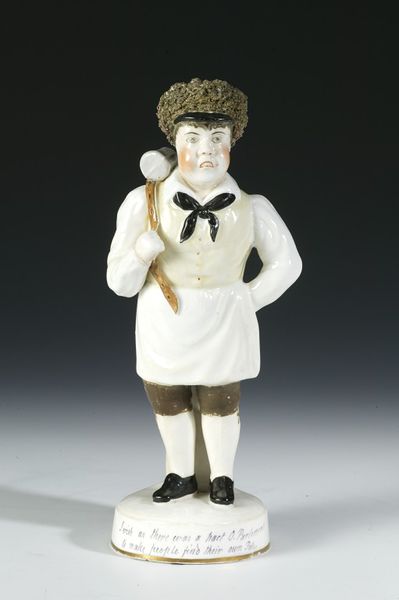
John Liston Playing Sam Swipes at the Haymarket 1820 (V&A) 
Busts of politicians, clergy and Shakespeare were produced.

Bust of John Wesley (Madelena.com) 
Scenes of intrigue were represented, such as Stanfield Hall, where local notable Isaac Jeremy met his end at the hands of an illegitimate gentleman farmer’s son James Rush, as were dramatic events, such as 17 year old Ellen Bright’s death by tiger in 1850.

Death of the Lion Queen 1850 (madelena.com) 
It’s not evident to me what period my find is from, she was found on the Georgian mudbank amid shards of white salt glazed plates and early Worcester Porcelain, so I suspect she’s one of the early Georgian types, a hunch backed up by her roundness and similarity to the figures below produced around 1790.
 
Ralph Wood Figurines C.1790 Staffordshire (antiquepottery.co.uk) 
(thank you to V&A and Madelena Antiques for all the information on their websites which helped me piece this together). 

Friday, 10 May 2013

Another mudlarking haul

Ironically find of the day is another George III armorial pipe covered in this recent post, this time perfectly preserved. The crown tops the coat of arms, each element is perfect it in its minuteness, the three English lions roaring on top of each other with the Scottish lion on its tippitoes slightly to the right,  Irish harp, fleur de lys and so it goes on... the soot from the last lick of flames  200 years ago staining the front rim. 

Mudlarking find: Clay Pipe with George III Coat of Arms  

George III Coat of Arms used between 1760 - 1801
The lion and the unicorn caress the shield from the sides. Amazingly detailed, you can even see the chains surrounding the unicorn on the right below.  


Delighted to find a relief moulded medallion of George III, who seems to dominate the days finds. He was knocking around from to 1760 - 1820 the first Hanoverian king whose first language was English. Another reminder to the Tories that Britain has always been an island of immigrants. I've been on the look out for one of these for ages. This one is from a jug, mug or perhaps even a chamber pot made from white stoneware disparagingly referred to as debased scratch blue, at its height of popularity between 1765- 95 and covered in this earlier post.  


Mudlarking Find: George III medallion on debased scratch blue stoneware

Debased Scratch Blue Jug (ebay) 
I had fun hunting down the origin of this lovely little piece, my guess -  an acorn cup from 16th century German Rhenish stoneware, fortunately for me captured in Flegel's still lives . 
Mudlarking Find: Acorn Cup 16th Century Cologne Stoneware

Detail from Still life below (hogsheadwine) 

George Flegel Still life with Stag beetle 1635
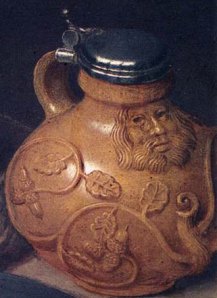
The potters from Cologne were keen on their relief acorns and oak leaves in the first half of the 16th century before they moved to Freshen, the Cologne bartmann jugs seem to be particularly refined. 

A yummy bit of hand painted delftware, a bit posher than the pieces I usually find and the first shard I've found with carefully drawn highlighting white lines in the centre of the leaves. Can't find a delft plate on the web which is similar to this. 
Mudlarking Find Delftware 1560-1750
Couldn't resist this tiny bird imprisoned in its shard 

Mudlarking find: Transferware bird 
or the hand painted flowers in the base of this Georgian tea bowl


Mudlarking Find: Hand painted flowers in the base of a tea bowl. 
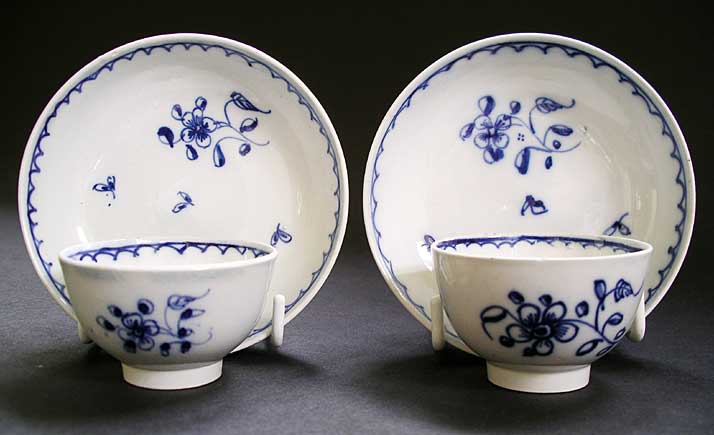
One antique site suggests this distinctive floral decoration with tadpole leaves and barb-hook ends derives from Liverpool tinglazed earthenware, but was then replicated in both Leeds and Staffordshire and similar to those depicted below 


Miniature Toy Tea cups and Saucers 1785 -1800 (antiqueszone) 
The moral of this next story is never let me look at your finds, I got home to find the glass seal  Brian thought he had lost had found its way into my bag! So before it's returned I thought it might as well feature here.  It would have sat proudly on the front of a 100 year+ wine bottle, is it a pig or an elephant on the front? 
Brian's glass seal 17th - 19th Century

Friday, 26 April 2013

Another Days Finds

Not the best day for finds, but here they are. Find of the day is a rather worse for wear clay pipe. It's taken me a long time to figure this one out as the details are so smudged out. Looked like it was a royal something with that preserved crown. I could make out three fleur de lys on the central shield, mottos circling and ribboned at the bottom and on the sides the buttocks and tails of a couple of animals presumably holding the whole thing up. 
Mudlarking Find Clay Pipe With Royal Coat of Arms
A couple of trips we just happened to plan for the next week helped out in my quest. As we entered the gates of Hampton Court with Janey and Megan I spotted the coat of arms on the gates of Hampton Court was a bit similar, and concluded the line and blobs on the bottom left of the pipe's shield were probably the woman's  curve on the Irish Harp and perhaps its top. 
Coat of Arms atop Hampton Court Gates
On our trip to the Victoria and Albert Museum with Gerry later that week, a great bunch of enthusiastic arty people were handing out drawing kits to kids so they could design their own coat of arms and on their stall was a book of heraldry. Interested in the mystery clay pipe from the Thames they worked out that it was probably the royal coat of arms, but which one? Having never been particularly interested in this previously, I didn't appreciate there was more than one. 

It's likely to be George III, the most recent monarch to include the French Fleur de lis, my history isn't good enough to throw light on why there is French  representation, it disappeared when George IV took the throne in 1820.  The red lion rearing in red border represents Scotland linked with England in the 1707 Act of union. My only reference point are the small paper flags  stuck into the sandcastles of our childhood. 
Royal Coat of Arms 1714- 1801 George II


The two beheaded rampant animals are probably the English Lion on the left and the Irish Unicorn on the right.  The writing is impossible to read, I assumed it would be Latin  but in fact its probably French. The words in the circle are likely to be 'Honi Soil Qui Mal Y Pense' 'Shamed be he who thinks evil of it' sometimes reinterpreted as 'Evil be to him who evil thinks'. 

George I  (middlesex-heraldry.org.uk) 
Decorated pipes became more common from the 1770s and the arms of George II were one of the common designs, so says one source anyway. 

Other finds are far more straight forward. A lovely pipe with minute perfectly rendered oak leaves running over the backbone of its bowl. 
Clay Pipe with Oak Leave 1830 -1900. 
Another Lion, this time it would have formed the centre of an armourial medallion on the side of german stoneware produced from between 1500- 1700. 
Mudlarking Find Lion from Freshen Stoneware 1485- 1700
Bartmann Jug with Lion and Crown Medallion Freshen 1551 - 1700 (Museum of London) 
My guess is the quickly hand painted top of a Chinese House which sat at the bottom of a bowl, is pearlware, but I could well be wrong. 


Mudlarking Find: Handpainted Chinese House decorating the bottom  of a  bowl
The next is definitely German Westerwald Stoneware, possibly from a small globular mug as shown below. The 400 year old rosettes in their sea of cobalt blue looking as though they were cast yesterday. 
Mudlarking Find:  Fragment of 17th C German Westerwald Stoneware 

17th Century Westerwald mug with moulded and applied rosettes (Crocker Farm) 
Finally my one of my favourites, naive hand painted delftware, the end of each leaf still marked by the brush that left it perhaps 400 years ago, maybe it wasn't such a bad day for finds after all.
Mudlarking Find: Delftware shard 1571-1800

Friday, 12 April 2013

Annular or banded ware 1770s-1840

You'd think it was pottery from the 1950s, with those bright parallel bands of colour, in fact its probably Georgian. There seems not to be a consensus in the pottery world about this stuff, the antiques dealers tend to describe it as mocha ware, the archaeologists as annular or banded ware. 
Mudlarking Finds Banded Ware Shards
I'm not altogether sure all the pieces I've found mudlarking above and below are in fact from banded slipware, but it's my best guess so far. 
Mudlarking Finds Annular or Banded Ware

Annual or banded ware, often not distinguished from Mochaware (Rufus Foshee Antiques) 
The earthenware base could have been pearlware, whiteware or creamware decorated with clay slips. The golden age of banded ware is characterised by vibrant, earthy colours. Colourants were added to watery clay, colbalt oxide for pale blues, copper oxides produced the olive greens, antimony and uranium yielded yellows and ochres, iron oxides resulted in tans and rusts, manganese was used for black and dark browns. Lead glaze amplified the earthiness of the colours. Apparently awareness of the toxicity of some of  these compounds resulted in several being phased out. So later banded ware produced in the 1850s tended to be duller using only blacks, blues, grey and whites. 
Older Banded Ware 1790-1800 (Woolhope Club) 

The more recent: 19th Century jug (louwersantiques.com) 

Annular ware was factory made, an early product of the industrial revolution and initially produced in Staffordshire. The products were mugs, jugs and bowls. Bands of slip were applied to the vessel as it was mounted horizontally onto a lathe. The introduction of engine turned lathes from the 1770s enabled a variety of geometric designs to be used, checks,dots, fluting, zigzags, chevrons, interrupted lines. 
Mudlarking Finds Checked Slipware 


Slipware Tankard 1800 (Martyn Edgell) 
Banding was often used with other decorative techniques such as the dentric seaweed patterns on mocha ware (covered in this earlier post) or marbleware. 
Mudlarking Finds Mocha ware shards
Mocha ware with slipware bands (Rufus Foshee Antiques) 
Banded ware was the cheapest pottery with colour around, unsurprisingly they were very popular and exported in large quantities to the States. In the 1830s they were referred to as 'Fancy ceramics' although potters referred to them as 'dipped'. 

Friday, 15 March 2013

Jasperware 1775 - today

I've only found one weeny bit of Jasperware on the Thames foreshore. Apart from transferware it's the only pottery I was familiar with before this mudlarking thing started. Displayed in the South London suburban houses of my youth,  I knew it as 'Wedgwood' rather than Jasperware. Three decades later I haven't quite overcome my youthful allergy to it. 


Mudlarking Find: Jasperware  stoneware 
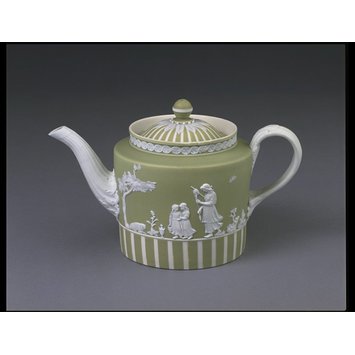
I can now at least appreciate the technical achievement. A type of refined matt stoneware, developed by Josiah Wedgwood in 1775 in his search for the secrets of porcelain. 

He named it after the stone 'jasper', the white version,  the 'base' colour of this pottery. The stoneware was then stained with oxides, either pale blue, dark blue, green, brown, black or yellow. The oxide permeated throughout in the early versions and is termed 'solid'. Costs were later cut by dipping so only the surface was coloured. 
1789-1795 Jasperware Teapot (V&A) 

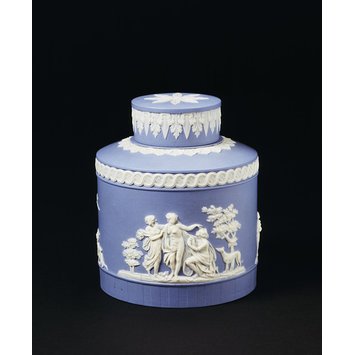
Contrasting neoclassical bas- relief designs made this his trademark design and a wide range of products were produced, cameos, vases, portrait medallions and  tableware. 


Tea Canister 1795- 1800 (V&A) 
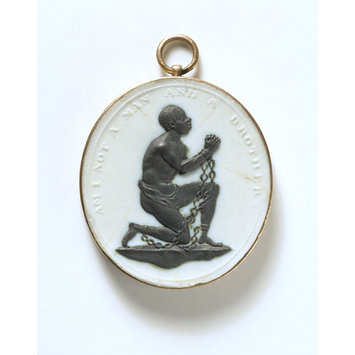
Incredibly popular, it was quickly imitated by others including Adams. It began to go out of fashion around 1811. In later years when I learnt that Wedgwood had been an advocate of the abolishion of slavery, giving large amount of money to the  cause and producing and distributing the equivalent of antislavery 'badges', his goods were suddenly imbued  with virtue.
Anti Slavery Medallion 1787 (V&A) 

Friday, 11 January 2013

Imari Porcelain

Over the last year I’ve collected six pieces of porcelain with lines etched in red. Looking closely you spot trails of paintbrushed gold. You can just see the gold line gliding through the middle of the branch below on the left shard.  The red and gold are over glazed and contrast strikingly with the chunkier splashes of under glazed cobalt blue.
Mudlarking Find: Imari Porcelain

Mudlarking Finds: Imari Porcelain shards


Surprisingly they could be 350 years old. Initially made in Arita, Japan  and exported from the port of Imari, between 1650 – 1750. There are many subcategories, the shards pictured above I suspect are Kinrande Imari.

Imari porcelain was exported by the Dutch East India Company and became popular when Chinese Porcelain was difficult to source due to the chaos at the end of the Ming Dynasty in 1644 and subsequently by the decision of the Qing Dynasty to cease trading between 1656-1684. Quite something to think these small fragments may have been carried by these enormous old, old ships below 
Dutch Ships 1685 by Isaac Sailmaker (National Maritime Museum)
Export from Japan ceased when China opened for business again, as Japan couldn’t compete with China’s low labour costs. China cashed in on the popularity of Imari in Europe and replicated the designs. This pattern is most common in export porcelain in the early Qing dynasty period from 1662-1722.  I've also read there was a surge in Imari imports into England in late 19th century when all things Japanese were in fashion. 
Chinese Imari Tea Caddy (Antiques now) 

Chinese Imari Style (Aspire Auctions)