Showing posts with label Clay pipes. Show all posts

Friday, 10 May 2013

Another mudlarking haul

Ironically find of the day is another George III armorial pipe covered in this recent post, this time perfectly preserved. The crown tops the coat of arms, each element is perfect it in its minuteness, the three English lions roaring on top of each other with the Scottish lion on its tippitoes slightly to the right,  Irish harp, fleur de lys and so it goes on... the soot from the last lick of flames  200 years ago staining the front rim. 

Mudlarking find: Clay Pipe with George III Coat of Arms  

George III Coat of Arms used between 1760 - 1801
The lion and the unicorn caress the shield from the sides. Amazingly detailed, you can even see the chains surrounding the unicorn on the right below.  


Delighted to find a relief moulded medallion of George III, who seems to dominate the days finds. He was knocking around from to 1760 - 1820 the first Hanoverian king whose first language was English. Another reminder to the Tories that Britain has always been an island of immigrants. I've been on the look out for one of these for ages. This one is from a jug, mug or perhaps even a chamber pot made from white stoneware disparagingly referred to as debased scratch blue, at its height of popularity between 1765- 95 and covered in this earlier post.  


Mudlarking Find: George III medallion on debased scratch blue stoneware

Debased Scratch Blue Jug (ebay) 
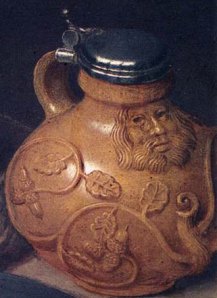
I had fun hunting down the origin of this lovely little piece, my guess -  an acorn cup from 16th century German Rhenish stoneware, fortunately for me captured in Flegel's still lives . 
Mudlarking Find: Acorn Cup 16th Century Cologne Stoneware

Detail from Still life below (hogsheadwine) 

George Flegel Still life with Stag beetle 1635
The potters from Cologne were keen on their relief acorns and oak leaves in the first half of the 16th century before they moved to Freshen, the Cologne bartmann jugs seem to be particularly refined. 

A yummy bit of hand painted delftware, a bit posher than the pieces I usually find and the first shard I've found with carefully drawn highlighting white lines in the centre of the leaves. Can't find a delft plate on the web which is similar to this. 
Mudlarking Find Delftware 1560-1750
Couldn't resist this tiny bird imprisoned in its shard 

Mudlarking find: Transferware bird 
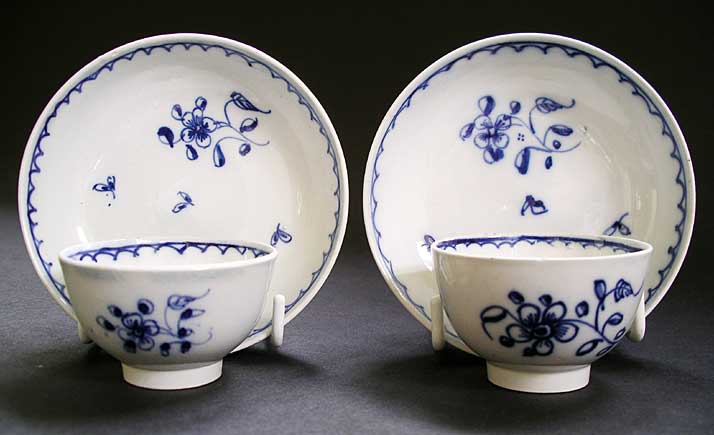
or the hand painted flowers in the base of this Georgian tea bowl


Mudlarking Find: Hand painted flowers in the base of a tea bowl. 
One antique site suggests this distinctive floral decoration with tadpole leaves and barb-hook ends derives from Liverpool tinglazed earthenware, but was then replicated in both Leeds and Staffordshire and similar to those depicted below 


Miniature Toy Tea cups and Saucers 1785 -1800 (antiqueszone) 
The moral of this next story is never let me look at your finds, I got home to find the glass seal  Brian thought he had lost had found its way into my bag! So before it's returned I thought it might as well feature here.  It would have sat proudly on the front of a 100 year+ wine bottle, is it a pig or an elephant on the front? 
Brian's glass seal 17th - 19th Century

Friday, 26 April 2013

Another Days Finds

Not the best day for finds, but here they are. Find of the day is a rather worse for wear clay pipe. It's taken me a long time to figure this one out as the details are so smudged out. Looked like it was a royal something with that preserved crown. I could make out three fleur de lys on the central shield, mottos circling and ribboned at the bottom and on the sides the buttocks and tails of a couple of animals presumably holding the whole thing up. 
Mudlarking Find Clay Pipe With Royal Coat of Arms
A couple of trips we just happened to plan for the next week helped out in my quest. As we entered the gates of Hampton Court with Janey and Megan I spotted the coat of arms on the gates of Hampton Court was a bit similar, and concluded the line and blobs on the bottom left of the pipe's shield were probably the woman's  curve on the Irish Harp and perhaps its top. 
Coat of Arms atop Hampton Court Gates
On our trip to the Victoria and Albert Museum with Gerry later that week, a great bunch of enthusiastic arty people were handing out drawing kits to kids so they could design their own coat of arms and on their stall was a book of heraldry. Interested in the mystery clay pipe from the Thames they worked out that it was probably the royal coat of arms, but which one? Having never been particularly interested in this previously, I didn't appreciate there was more than one. 

It's likely to be George III, the most recent monarch to include the French Fleur de lis, my history isn't good enough to throw light on why there is French  representation, it disappeared when George IV took the throne in 1820.  The red lion rearing in red border represents Scotland linked with England in the 1707 Act of union. My only reference point are the small paper flags  stuck into the sandcastles of our childhood. 
Royal Coat of Arms 1714- 1801 George II


The two beheaded rampant animals are probably the English Lion on the left and the Irish Unicorn on the right.  The writing is impossible to read, I assumed it would be Latin  but in fact its probably French. The words in the circle are likely to be 'Honi Soil Qui Mal Y Pense' 'Shamed be he who thinks evil of it' sometimes reinterpreted as 'Evil be to him who evil thinks'. 

George I  (middlesex-heraldry.org.uk) 
Decorated pipes became more common from the 1770s and the arms of George II were one of the common designs, so says one source anyway. 

Other finds are far more straight forward. A lovely pipe with minute perfectly rendered oak leaves running over the backbone of its bowl. 
Clay Pipe with Oak Leave 1830 -1900. 
Another Lion, this time it would have formed the centre of an armourial medallion on the side of german stoneware produced from between 1500- 1700. 
Mudlarking Find Lion from Freshen Stoneware 1485- 1700
Bartmann Jug with Lion and Crown Medallion Freshen 1551 - 1700 (Museum of London) 
My guess is the quickly hand painted top of a Chinese House which sat at the bottom of a bowl, is pearlware, but I could well be wrong. 


Mudlarking Find: Handpainted Chinese House decorating the bottom  of a  bowl
The next is definitely German Westerwald Stoneware, possibly from a small globular mug as shown below. The 400 year old rosettes in their sea of cobalt blue looking as though they were cast yesterday. 
Mudlarking Find:  Fragment of 17th C German Westerwald Stoneware 

17th Century Westerwald mug with moulded and applied rosettes (Crocker Farm) 
Finally my one of my favourites, naive hand painted delftware, the end of each leaf still marked by the brush that left it perhaps 400 years ago, maybe it wasn't such a bad day for finds after all.
Mudlarking Find: Delftware shard 1571-1800

Friday, 9 November 2012

Clay Pipes & 106 Old Street

Over the last few months I've begun to pick up clay pipes again, with some project in mind. Another one of the "It wasn't until I got home did I realise" stories, I noticed rather nice swirls on one of the pipe bowls and some faint writing. I worked out the second word was 'ROFFE'. Not enough for Google to throw me a lead. Oh for young eyes, it took a bright sunny morning for the first word 'WOOD' to reveal itself. Of course I could have asked my 13 year old - but I was filled with childlike determination to 'do it on my own'. 
Mudlarking Find: James Woodroffe Clay Pipe 1789-1799
Surprisingly there were only a couple of brief entries on the net "He was apprenticed to the pipe maker James Woodroffe on 10 January 1792, for the term of seven years" (Kieronheard.com). An article by David Wright, reveals his address in Islington "106 Old Street 1789-1799". An ancient route outside the City walls, Old Street was  recorded as Ealdestrate in 1200 and some believe was originally a Roman Road linking Silchester and Colchester. 

As the weeks went by I kept coming back to my delight in finding something I could trace to a familiar London Street. Eventually I decided to go and take a look. 

Ozge Bozyigit and her father Nihat Bozyigit welcomed me with Turkish tea and hospitality to 'The Legend' their barbers shop. Ozge had taken a break from her medical studies to meet me as she was particularly intrigued. 

The little object reunited with its birthplace after 200 years was passed around and considered, and considered again, as Nihat and his staff calmly attended to their customers. Turkish coffee and Turkish delight were delivered, encased in ornate silver metal work, to the men who'd chosen Saturday lunchtime to give themselves up to the full works. The large barbers chairs looked the perfect place to kick back, relax and enjoy the ritual finale, cosseted and cocooned under hot towels.  
Ozge Bozyigit and her brother iphoning Woodroffe's 200 year old pipe. 

Nihat Bozyigit making out the lettering on Woodroff'e's Pipe

One of Legend's customers getting into the history too. 
As I left, the yellow lit barbers looked as though it could almost fit into a 18th century scene. Alas 106 is no longer the pipe makers building - replaced by a Victorian high rise at some unknown date. I snapped a few adjacent buildings, several looked Georgian, so could have been the type of building which stood at 106 in 1789. 


What hasn't changed is James Woodroffe's view - a rather elegant  icing cake church, St Lukes, built across the road in 1733. 
St Lukes Old Street 1733

Update
Since Richard put me onto the definitive guide to clay pipes 'London Clay Tobacco Pipes by David Atkinson and Oswald' 1969, I was surprised to learn there were four Woodroffe's making clay pipes in London, James, John, Jane and Sarah. The design on my find above was in fact John Woodroffe 1799-1832, he's listed later in the appendices as working from 1832-37 in vinegar yard St Giles, a little enclave which has long gone. I wonder where he worked between 1799-1832?

Saturday, 31 March 2012

Clay Pipes

Segments of pipe stems are so easy to find mudlarking on the Thames. Bowls are less common but you are certain to find at least one on any foreshore walk. They range in date from 1580 – early 1900s. They can be dated by the size and shape of the bowl and size of the hole in the stem. The older ones have smaller bowls as tobacco was originally very expensive. The finds I've kept are below, dated using a identification chart to scale. They were the fags of their day, came packed with tobacco, were smoked only a few times and then thrown away. 


Top row  1610-1710,  middle  1700 - 1800, bottom 1820-40 found Mudlarking on the Thames
Clay Pipe Smoking 1600's
Some older pipes have very ornate decoration. I'm still searching for one of these. The most ornate to date is a simple diagonal leaf pattern on the seam. 


Clay Pipe from 1820-40  with diagonal leaf pattern along seam


A Reuters Article reveals ‘ A Museum of London study of skeletal remains excavated from a Victorian cemetery in Whitechapel, east London, found most people had "notches" in at least two, and often four, front teeth made through the habitual holding of pipe stems. Osteological analysis of 268 adults buried between 1843 and 1854 found that some disfigurement had occurred in 92 percent of adults exhumed, while wear associated with habitual use of pipes was evident in 23 percent. "In many cases, a clear circular "hole' was evident when the upper and lower jaws were closed," said Donald Walker, human osteologist at Museum of London Archaeology Service. Males were affected far more frequently than females. The study, published to coincide with national No Smoking Day in Britain, also found a number of young adult skeletons had tell-tale notches, suggesting pipe-smoking may have begun in childhood.’ It wasn’t until 1881 when James Bonsack invented a cigarette rolling machine that pipes began to replaced.