Showing posts with label Medieval. Show all posts

Sunday, 25 May 2014

Medieval Surrey Whitewares

I thought the mosaic might be a good way of ending this blog, but then I remembered my original intention -  to create something people could use to identify the pottery finds they found along the Thames foreshore, along with their back story. Essentially what I wanted but couldn't find when I started out.

The big gap in the blog is the old stuff. Unless you are an experienced archaeologist  I can't quite see how you can tell the difference between different types of old white or red earthenware pottery, so I've put off writing about it. A visit to the Museum of London's finds identification session organised by Thames discovery and the usual internet searching, have filled me with slightly more confidence, although I expect they'll be a few mis-identifications along the way - but here goes. 

The first clue is that most old stuff is characterised by green glaze. It was the first coloured glaze used in Britain, from the 11th century and achieved by adding copper to lead glaze. Not all green glazed ceramic is that old however, as it was in common use until at least 1700. 

The other clue is that certain 'forms' are associated with different periods, with jugs, cooking pots and storage vessels typical of medieval forms. Some venture the prevalence of jugs increased as wine became more available and popular.

If the pottery is white, it is likely to have been produced in Surrey, from 1240 in Kingston a Thames crossing point upstream, then from 1260 in multiple sites along the Surrey Hampshire border and from 1350 in Cheam. 


Pottery was produced in the Surrey Hampshire borders into the 17th Century. The medieval stuff is coarser with lots of 'bits' in the clay. Most of the pieces below have black flecks, which if you look closely are tiny pieces of quartz .  The finds below are are all from jug strap handles,  they were frequently adorned with stabbing or slashes which were practical as well as decorative, allowing steam to escape from the thicker sections of the jug thus preventing fracturing during firing. 

Mudlarking Finds:  Sections of Medieval Jug Handles 


Kingston Jug 1240-1360 (British Museum) 

Jug 14-15th C (Museum of London)


The green was used decoratively on jugs and the glaze was used inside pots to render them non porous.  
Mudlarking Finds

The last two finds are a decorative section with two different colours of clay, perhaps it formed part of a baluster jug similar to that below, a classic of the medieval period. The second is a frying pan or 'skillet' handle.  

Mudlarking Find 
Medieval Frying Pan Handle 

Medieval Baluster Jug mid-late 13th C (Museum of London) 
The white firing clay didn't occur locally and had to be transported by cart or by boat the 25 or so miles from the Reading Beds near Farnham. Most goods were wheel made although a few such as dripping trays were slab made.When finished they were most probably transported by boat along the Thames to London.  

These Surrey Whitewares were tremendously popular and gradually became the most common pottery in London between 1350-1450. This was a time of plague with the Black Death reducing London's population by half to 40-50,000. Subsequent plagues and famines suppressed population increase until the early 1500s. It was also the period of the Hundred Years war a dynastic conflict between English and French Kings beginning with England's Edward III. 
Edward III (Its about Time) 
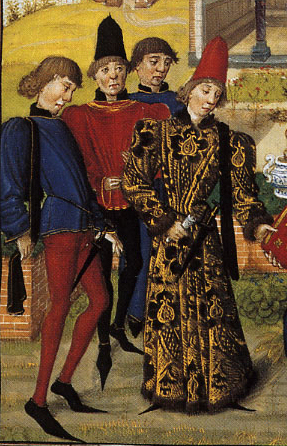
Money was required to fund the war stimulating trade in woolen cloth, an export trade centered on the capital, promoting further expansion in both the size and wealth of London. Even in these difficult times there seems to have been both the means and desire for people to indulge in a bit of consumerism, which included purchasing whitewares from Surrey, luxury imports from Europe and for the boys at least poulaine, those pointy shoes, the height of fashion in 1380 and than again a hundred years later. 
Poulaine France 1468
There are few pictures of London from this period, but here is one I tracked down from the 15th Century with the Tower of London in the foreground and London Bridge behind

London from 15th C manuscript (British Library) 
and a reconstructed map of medieval London with its Friaries, markets (including Leadenhall, Poultry, Guildhall and Cheapside), early hospitals and the population of the waterfront by foreign merchants from Cologne, France, Bruges and Antwerp. 

Medieval London (medart.pitt.edu) 

Wednesday, 14 May 2014

Medieval Anthropomorphic Jugs

Whilst some hanker after pilgrim badges or coins, the find I'd probably be most delighted by is from one of these 
Face Jug 1270-1310 (British Museum) 
a medieval jug with a face on it.  I rather like the 'proper' term for these too, a right mouthful, 'anthropomorphic' - which in this instance means pots with partial or complete depiction of human bodies. 
1301-1400 (Museum of London) 
Apparently these jugs were very popular in London, the ones above were made in one of the main towns supplying pottery to London in the 13th-15th centuries, Kingston. They tend to be quite small around 12cm.  Most jugs depict men with beards and they often seem to be tugging or stroking them. Their meaning has been lost over time, I like to think they embodied some irreverent joke. 
Kingston Anthropomorphic Jug 14th Century (Christies)  
As I packed away my finds and sifted through the old stuff, I pondered over one piece of decorated green glazed medieval pottery. I worked out the decoration  would have gone diagonally - I wonder, could it possibly be one of those arms?...
Mudlarking Find 
14th C (MetMuseum)


Sunday, 27 April 2014

Cistern Bung Holes

This post is for Facebook's London Mudlarker who has given up asking me to post on bung holes. Revealing our ultimate nerdiness. Not a great deal to say about these, part of the reason for the delay - but LM here you are.  

From time to time I've noticed largish earthenware shards with a hole surrounded by another piece of applied clay. Not all that appealing or interesting but certainly a 'type' so I decided to take one home with me, intending to work out what it was some time later. 

Medieval Bung Holes from Cisterns. Left Coarse Whiteware bundhole from 1340 to 1440 AD, 
They are bung holes from cisterns. Cistern comes from the middle English word cisterne which in turn is derived from the Latin cista for 'box' or the Greek kiste for 'basket'. They are waterproof vessels for holding liquids. 

Probably the most interesting thing about them is that they are very old and still hold the original potter's thumb indentations. Many will be medieval and others will be from the Tudor period. 


Coarse Borderware with Bung Hole 1340 - 1440 (British Museum) 
Some commentators speculate that their increase in the 15th century was due to an increase in home brewing and the popularity of beer. 

Medieval Cistern York (Doug Fitch Blog) 

London Redware Cistern 1480-1600 (Museum of London) 

Monday, 21 May 2012

Medieval Floor Tiles 13- 14th century

I’m reasonably certain about these finds, both found one day last week, jutting out among the stones and rocks of the Thames 'beach'. They are sections of thick medieval floor tiles -  amazingly  they could be 700 years old. 

Sections of Medieval Floor Tile Found Mudlarking on the Thames 

In the 13th century churches, monasteries, abbeys and later royal palaces and houses of the wealthy began to use large square, decorated tiles, to cover floors and walkways. ‘Westminster’ tiles were mass produced in London from the 1260s.  Penn tiles were also used, named after the Buckinghamshire village where they were made in large quantities.

The tiles are handmade using clay high in iron, hence the red colour. The clay was shaped in a wooden mould, one of over 160 designs was then stamped into the clay. The impressions were filled with fine white clay. They were left to dry. Most were glazed before they were fired.

Popular designs were geometric patterns, heraldry, animals, flowers, birds, monsters and stars. There were both individual tile designs and those which covered groups of four tiles.


Medieval Floor tile 13-14 Century from Museum of London 
At the beginning of the  14th century production in London had largely ceased as the initial demand for floor tiles  had been satisfied.

Many medieval tiles were taken up during 19th century restoration – perhaps some ending up in the Thames, or were they part of the 1666 fire of London debris dumped into the Thames?

Victorian tile manufacturers were drawn to medieval tile designs and replicated them. Our house is Victorian and has the original tiled hall way, pictured below, which we now know owes its origins to medieval artisans. 

Victorian tiles, based on medieval designs with evidence of teenagers descent en masse

Wednesday, 2 May 2012

Potters Leaving Their Mark: Stabbing

It took me ages to work out what these two mudlarking finds were. I just assumed they were the decorated side of a pot, but couldn't find anything like them on the net. It is some consolation that several  12 -16 year olds also failed to identify them. They are the top of jug handles, attached to the main body or at the least rim of a jug.

Section of Medieval Surrey Whiteware Jug Handle found Mudlarking on Thames Foreshore

The rim and top of Medieval Jug Handle 1240-1500
When I picked them up from the Thames foreshore, I just assumed that the ‘stabbing’ and slash marks were decoration. Their other function was to stop the thick sections from fracturing. Insertions allowed water to be expelled from the clay when it was fired,  preventing pressure building, thus averting cracks and splits.

These pieces could be Surrey whiteware, produced in Kingston up on Thames, Cheam or Farnborough, between 1240-1500, but perhaps they are too pale? Both have traces of green glaze. The intact jugs are likely to have looked like the one below. 

Surrey/Hampshire Border  Jug Mid 14th - 15th Century Museum of London 

Sunday, 29 April 2012

Potters Leaving their Mark: Thumb Marks

Recently, mudlarking on the Thames, I purposely sought out pottery where hands have left their mark. Poignant reminders of their makers. Impressions left by the maker’s thumbs, whether part of shaping the object, fixing a handle to the main body or in decoration have to be the most moving of all. 
Fragment of Medieval? Pot Found Mudlarking on Thames Foreshore
When following the potter’s decorative thumb mark on the piece above yesterday, I noticed clear finger prints captured in the clay, at the top of the indentations.

Close up of thumb marks on Medieval? Pot, showing finger prints. 
Perhaps a bit of a rushed job, the shapes are not quite as uniform as they are on the second  and third sherds below.  All I suspect  are  from the rims of storage jars, all have traces of glaze.   The curves on two are very shallow, they must have been enormous. My uneducated guess is the first is hand formed red ware made between 1250-1450. The second  and third are both wheel made, the second perhaps redware from 1600-1700,  quite possibly made in London as the redware industry was firmly established in London from end of 15th Century. The third could be Surrey whiteware made between 1240-1500.  

Sections of Pot Redware and White Ware Pot Rims found Mudlarking on the Thames 
Just now I noticed what could be 500+ year old finger prints on the reverse of the whiteware. The potter must have held the inside of the wet pot whilst they created the indentations on the outside, magic. Double click on the photo for a better view. 

Close up of border whiteware sherd, showing  potter's finger prints. 
The last example is a tree trunk of a handle base, decoratively attached to the body of a cooking pot with confident thumb presses.  Are the blackened areas the remains of the fires that cooked countless meals?

The base of a redware cooking pot handle found on the Thames Foreshore
I prefer not to dwell on the hours I’ve spent googling trying to identify these finds, with only partial success. Clearly something best  left to the experts and my up and coming visit to the Museum of London’s Finds Officer. Meanwhile,  I’ll  continue with this series of posts, it’ll be interesting to see if I get any of this right. 

Wednesday, 25 April 2012

Dog Paw Print on Medieval Clay Roof Tile Found Mudlarking on the Thames

I hadn't been mudlarking for well over a month, so was pleased to go down on Monday.  As I reached the stairs down to the foreshore, the familiar smell of old Thames mud drifted up to greet me, offering up its secrets for just a few hours.

My favourite find from that day is, what I presume to be, a medieval roof tile with small indentations. I was so taken with this find I popped it in my pocket as I went to work the following day. Throughout the day a few of my colleagues contemplated the find, with an intake of breath we considered whether the small imprints were from a  child’s fingers, each of us putting our fingers into the dips to see whether they were smaller than ours. It took healthily sceptical Wendy to work out, pretty quickly, that they were the marks of a dog’s footprint.  I subsequently noticed one claw mark on the edge diagonally above the far left pad imprint.

Medieval roof tile with dog paw print found Mudlarking on Thames foreshore  
Apparently it isn't uncommon to find dog or even rodent prints on roman and medieval tiles, a result of being left flat before they were fired.

Medieval roof tiles, made between 13-16th Centuries, are very common on the Thames foreshore. The ones I’ve noticed are aptly named ‘plain tiles’. They would be attached to the laths of the roof by a nail or peg inserted through a hole. The tiles usually only have one hole which is either diamond shaped, a square or circle.

Medieval roof tile found on Thames foreshore

Friday, 2 March 2012

Mudlarking on the Thames: How it all started

I spent my teenage years rather envious of those who had an absorbing passion, believing I just wasn't that type of person. To my surprise, scouring the Thames foreshore for fragments of long ago discarded objects, has me in its grip. 


Thames foreshore
A birthday treat Thames Explorer Trust guided walk started me off in September 2011. Returning home to party, I couldn't resist laying out my finds,  Roman pottery,  green glazed medieval chunks, earthenware Tudor pot handle, a section of a Tudor nit comb, pieces of tin glazed delft pottery from the 1600s, shards of blue and white Victorian pottery and the ubiquitous clay pipes.  I was hooked.


First finds Mudlarking on the Thames foreshore. L-R Roman, medieval, Tudor pot handle, Tudor nit comb, delft, Bellarmine both 1600s, combed slip ware, clay pipe, Victorian blue and white & glass bottle.