Showing posts with label Tudor 1485-1605. Show all posts

Tuesday, 3 June 2014

Surrey Hampshire Border Ware

Pottery continued to be made on the Surrey Hampshire Border, with Farnborough the main centre. Pottery produced in this area in the 16th -17th centuries seems to be referred to as Surrey Border Ware. 

The pottery is still buff coloured, but more refined.  Production techniques changed. The pottery was subject to two firings, the first to render the thinner vessels hard enough to decorate and a final firing after the application of glaze. 

In the mid 16th Century potters began to use a tougher type of clay. This together with improved firing techniques meant quartz in the form of sand didn't need to be added as a tempering agent to the clay mixture to add strength. Hence you can tell if you have the later shards by their smoothness and absence of 'black bits', as below

Mudlarking Finds: Possibly porringers and a Chafing Dish
Fine table ware began to replace the large utilitarian vessels of the medieval period, so another clue is form type. Potters extended their range to include these unfamiliar poetic names 'porringers',  'pipkins', 'chafing dishes' and  'fuming pots'. Porringers were used for foods which were eaten with a spoon and were often used to reheat food. 
Porringer 1550-1700 (Museum of London) 
Chafing dishes were portable heating devises. Hot coals were placed at the bottom and a dish balanced on the lugs to keep food hot. 
Chafing Dish 1550-1700 (Museum of London) 
Clear lead glaze began to be used which turned yellow when fired, in addition to the green glazes achieved by adding copper. The glaze on these 16th-17th century shards tends to cover the whole piece, usually the interior and is more uniform than the glaze found on medieval pottery. These examples include the edge of a large platter and a shard from a colander or strainer, another two new forms for the border potters. 


Border Ware Strainer 1601-33 (Museum of London) 
Other objects included money boxes,candle sticks, chamber pots and probably my favourite but not yet found, chicken feeding dishes. 
16th Century Border Ware Chicken Feeder (V&A) 

Germany was Europe's ceramic leader and at least one German potter settled in the Surrey Borders. This influence perhaps led Surrey borders to produce masses of tripod pipkins, a form popular in Germany. The characteristic small hollow handles are a reasonably common find along the Thames. A stick could be inserted into the handle to make it longer and of course less hot. Pipkins were placed on the coals at the edge of a fire and some recipes specified using an earthenware rather than a metal pipkin. 

Mudlarking Finds: Pipkin Handles 16th - 17th C

Tripod Pipkin 1636-1700 (Museum of London) 
Ellicksander Pottage.
Chop ellicksanders and oatmeal together,
being picked and washed, then set on
a pipkin with fair water, and when it
boils, put in your herbs, oatmeal, and
salt, boil it on a soft fire, and make it
not too thick, being almost boil’d put
in some butter.
 The Accomplisht Cook by Robert May 1678

When you scoop up one of these finds along the foreshore, it may well have come from a London which looked like this, 

Wyngaerde - Central London 1550 

This white pottery dominated London from 1500-1700 a period which saw London's population expand from  50,000- 600,000. It died out in the 18th century.  

Friday, 1 November 2013

Werra slipware, from Germany 1550-1650

I thought I’d identified most of the decorative pottery you can find along the Thames, so I was thrilled to find a new type. It was a treat to be back in detective mode, the UK finds database gave me the first lead  - ‘werra slipware’. It was this unusually large shard which prompted me to search 
Mudlarking Find: Werra Slipware 1550-1650
and interesting to find a dish which had a similar boarder design. 

Werra Slipware with Rabbit 1607 (Dr Fischer)
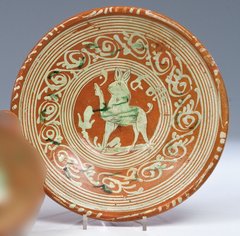
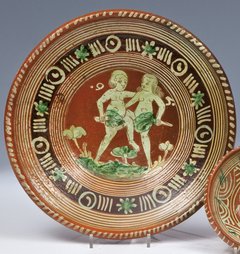
Werra Slipware was produced in Germany in potteries along the Werra River between 1550 – 1650. It was widely exported from the port of Breman and has been found in quantities in the low countries, North America and East and Southern England where finds are  concentrated in coastal and urban areas. 

Red bodied earthenware was decorated with a distinctive pale greenish yellowy slip - a thin clay mixture. The decoration tends to follow a standard format divided into zones. 

Dashes and lines were quickly struck around the rim of the plate. The potter then expertly looped thin bands of slip spiraling inwards. A wide band of swirls and squiggles forms a boarder followed by another set of bands which frame a central motif. Rather random  bright green splashes of copper oxide provide highlights in the centre and surrounding areas. 


Werra Slipware Plate with Pig/Boar 1615 (Museum Rotterdam) 
The central drawing is skillfully etched into the slip, a technique called sgraffito. Being a Werra potter was a tricky business, there was no room for error or second goes. Any mistake would be obvious. 

Animals or figures usually filled the centre. I love these confident, naive, bold, quirky pictures. I can't help think of our wonderful Grayson Perry (whose current Reith lectures on art are not be missed, link here.) when I look at these masterly drawings on pottery. 


Werra Angel 1613 (Museum Rotterdam)

Detail of Werra Slipware Horse (Museum Rotterdam) 

Werra Slipware Nobel Man on Horse back 1621 (Museum Rotterdam) 
Werra Ware with Dove 1585-1625 (Museum Rotterdam) 
I had picked up a few small pieces of these drawings over the last few months and noticed one or two appearing on other mudlarkers sites. I'd realised how different they were from anything else I'd found but thought they just came from one eccentric plate. My favourite is what I hope is a little bit of angel. 

Mudlarking Find: An angel? wing Werra Slipware 1550-1650. 
They were very keen on their angels

Werra Ware 1615
a couple of indecipherable shards I've found, but now I look at the second one, I wonder if the top right markings are 'I8' the second half of a date. Most plates seem to be dated and  it appears to be in the right place. 

Mudlarking finds: Werra Ware 1550-1650
Werra Slipware with Adam and Eve 1595 (Dr Fischer)

I was prompted to look through my box of slipware shards and pulled out a few more pieces of Werra Ware.
Mudlarking Finds: Werra Slipware 1550-1650

Mudlarking Find - Werra? slipware 
There is no doubt that Germany was the European ceramic market leader in the 16th and 17th centuries, it was where stoneware was perfected along with those deep cobalt blue and manganese purple glazes of Westerwald together with these ambitious slipware and sgraffito beauties.

 And finally a couple of Grayson Perry pots


. 

Friday, 22 March 2013

Chafing Dish

Once home, I knew I’d be determined to search until I found out what this piece of broken pottery was. I thought that strange little knob on the shard’s rim must give something away – and so it did.
Mudlarking Find: Rim Section of a Chafing Dish
The shard is quite big, its length 12cm. Yellow lead glaze covers the inside, a splash of green glaze under the handle where copper had been added looks almost accidentally placed.

Wheel made and well made with a deep robust rim and a stub protruding at right angles, all that remains of the handle. The knob rising from the rim above the handle has a small hole right through the middle, possibly where a stick had been placed before firing so this key part of the design kept its shape and place during firing.  I worked out fairly quickly  this shard came from a chafing dish, the only pottery boasting those rim knobs. Not sure where it was produced, it looks similar to the one below produced in Surrey/Hampshire borders or perhaps it was imported from France?
Chafing Dish 1550- 1700 Surrey Hampshire Ware (Museum of London) 
I immediately assumed it was a cooking vessel, similar to a pipkin or skillet.The description of the chafing dish in this picture throwing me somewhat ‘Diego Velazquez portraying an old woman poaching eggs in a glazed earthenware chafing dish over charcoal’ (Wiki) 
Diego Velazquez Woman Cooking Eggs 1618 (National Gallery of Scotland) 
I now reckon the earthenware pot, is just an earthenware pot and the chafing dish is beneath. So if I’m right – the chafing dish held the charcoal coals and not the food. Several chafing dishes I’ve tracked down seem to have holes or slits at the bottom, presumably to keep the coals bathed in oxygen and burning.
Chafing Dish Surrey Hampshire Boarders 1550- 1700 (Museum of London) 
Plates where placed on top, resting on the 4-8 knobs around the rim, to warm food or to cook food which required this type of gentle treatment. I’m assuming the gaps allowed hot air and fumes to escape, at the same time prevented the plates from overheating. They seem to be referred to as braziers in the States.

A recipe from the 1545 ‘New Booke of Cokerye’ mentions them
ake a dyche of rosewater and a dyshe full of suger, and set them upon a chafyngdysh, and let them boyle, then take the yolkes of vii or ix egges newe layde and putte them therto everyone, and so let them harden a lytle, and so after this maner serve them forthe and cast a little synamon and sugar upon them. (blogs.plimoth.org)

Like the skillet they seem to have been introduced from early Tudor times around 1480. A device that could be brought to the table to keep food warm, as described rather vividly in Wiki

‘ In 1520, Hernan Cortez reported to Charles V the manner in which Montezuma was served meals in  Tenochtitlan (now Mexico)
"He was served in the following manner: Every day as soon as it was light, six hundred nobles and men of rank were in attendance at the palace, who either sat, or walked about the halls and galleries, and passed their time in conversation, but without entering the apartment where his person was. The servants and attendants of these nobles remained in the court-yards, of which there were two or three of great extent, and in the adjoining street, which was also very spacious. They all remained in attendance from morning until night; and when his meals were served, the nobles were likewise served with equal profusion, and their servants and secretaries also had their allowance. Daily his larder and wine-cellar were open to all who wished to eat or drink. The meals were served by three or four hundred youths, who brought on an infinite variety of dishes; indeed, whenever he dined or supped, the table was loaded with every kind of flesh, fish, fruits, and vegetables that the country produced. As the climate is cold, they put a chafing-dish with live coals under every plate and dish, to keep them warm..." Gareth Dean, Medieval York 2008:140.

Friday, 1 March 2013

Skillet 1550- 1700

This was my favourite find from mudlarking trip a month or so ago. It was the completely pleasing tiny foot that did it. Roughly but somehow carefully and perfectly rendered. Soot still stains the flat base and licks the sides. The inside painted with shiny glaze, made green by the addition of copper.  The whole piece is only 4cm long, the complete vessel must have been strangely tiny. 
Mudlarking Find: Section of a  Tudor skillet. 
I'm guessing this comes from an earthenware skillet. Introduced in Tudor times and  placed on the charcoal burning stoves that begun to be used from the 16th century. Apparently it represents when cooking became more refined, necessitating smaller vessels.
Skillet 16th Century (Bridgeman Art Culture History)


Skillets are mentioned in this recipe from Hampton Court 1485- 1603

'Take a little faire warme water, as much sack, and take half flower half bread, mingle them altogether: then take five or six egges and break therein whites and all, a little nutmeg, pepper and salt and cut in appells very small then take a faire skillet with suet and let it boyle on the fire and so put the batter in it.'

Friday, 28 December 2012

Colander 1480- 1650

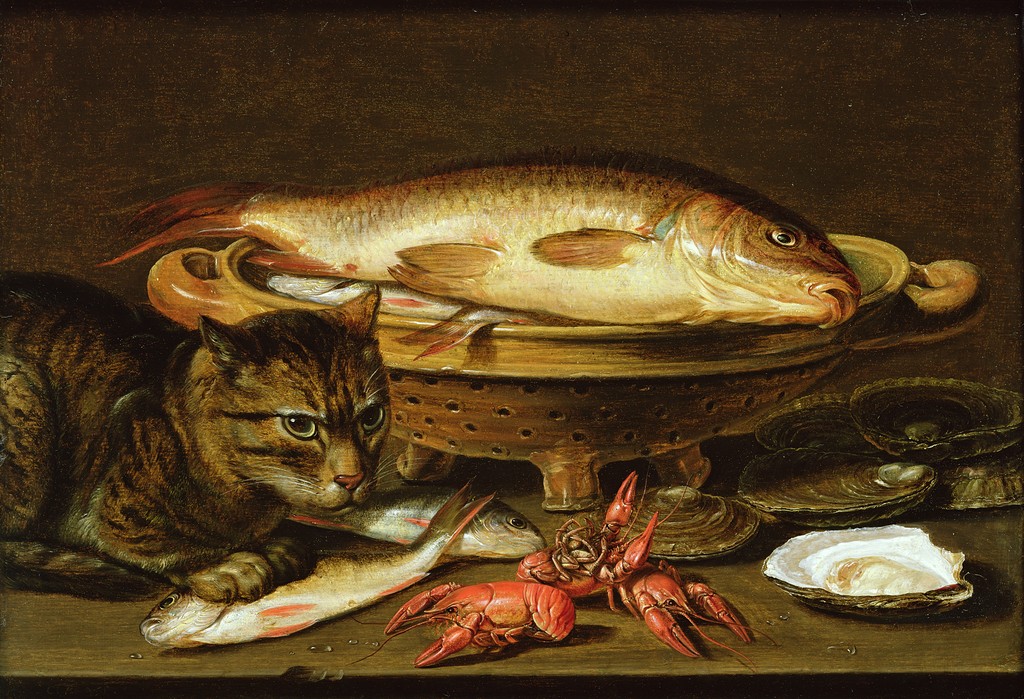
Hesitated before picking up the piece below with holes, now I'm really pleased that I bothered. Below I've carefully  propped it up with a very green English Tomato which was to hand ripening on our windowsill to better illustrate its origin. The shard is as big has my hand and has a shiny brown glaze on the inside and traces of a thin glaze on the outside. It took me a while to work out it was from a colander and that the little protrusion was in fact a foot - it was only when I came across the still life painting below that the penny dropped. 
Mudlarking Find: 16th Century Earthenware Colander
It is probably redware, the texture is quite rough and you can spot large inclusions in the clay. The holes are uneven. I've read that pottery in the 16th century was expensive and only owned by the well to do, the rest using vessels and cooking equipment made of leather, wood or pewter. I wonder how common colanders were? Were they must have kitchen equipment for those who could afford them? 

Still Life with Earthenware colander by Flemish Clara Peeters 1589- 1657
I can't end this post without reference to my surprise that this old still life was painted by a woman. Very little is known about her but she must have been pretty remarkable to have made it in 16th century. Apparently the painting is full of symbolism which is lost on our 21st century sensibilities, the fish represents Christ and are placed in the position of a cross, although I've read elsewhere is just represents abundance and has no moral or other subtext.  

Friday, 31 August 2012

Tygs and Blackware 1580-1700

It took me a while to notice and even longer to appreciate the bold, sometimes high shine black glazed fragments on the Thames Foreshore.  I suspect for a long time I didn’t pick any up – being much more attracted to the pretties or the evidently old.
Thames Mudlarking Finds: High Shine Blackwear. 
Mudlarking Find: Base & Side of Blackware bowl?


There isn’t much available on the net on this stuff so hard to craft a clear story. At the moment I have a number of rather general leads. Quite amusing that all blackware means is that the pottery is black – or perhaps it’s nice that the archaeologists can be quite straight forward and dispense affectation.

Cambridge University archaeologists describe blackware as ‘Made between 1580 and 1700AD. The clay is very similar to that of Colchester Ware and Glazed Red Earthenware, but the vessels have a black glaze, coloured by the addition of iron. Usually drinking vessels such as mugs, but also tall, narrow cups with up to eight handles, known as 'tygs'.

Black Glazed Earthenware Tyg 1590-1700 probably from  Harlow (St Alban's Museum) 
Some talk about black glazed pottery being made at Harlow in Essex around the time they made metropolitan slipware in 1630 – 1700, others suggest  that they were made in Wrotham in Kent from 1675-1700. 

One source claims that this glaze was more expensive to make because they needed more fuel than low fired earthenwares (I presume either higher temperatures or a longer firing in the kiln).

Kathryn Kane on her blog Regency Redingote has done a nice bit of research on tygs, 

'The oldest of all these drinking vessels is the tyg and it can trace its origins back to Elizabethan times. Its name is even older, tracing back to the Anglo-Saxon word tigel, which meant anything made of clay, particularly red clay. Over the centuries, the word tyg, or tig, came to mean a special kind of drinking cup. A tyg was similar to a loving cup, but it had many more handles, the number increasing with the size of the cup. Tygs have been found with as many as ten handles. A tyg was a social drinking vessel, for it was filled to the brim, then passed around a group of drinkers. Each member of the group would have his own handle and a section of the rim of the tyg to himself. Through the sixteenth and seventeenth centuries, tygs were primarily made of ceramic, but by the eighteenth century, they could also be made of pewter, and very occassionally, might be made of silver. Because they were meant for use by multiple drinkers, tygs were found almost exclusively in taverns and the tap rooms of inns and public houses. But there were some who favored convivial private drinking parties and they might have had a tyg or two in their homes. It was these privately owned tygs which were most likely to be made of silver. These silver tygs might be engraved, sometimes with the name of the owner, or more often with some amusing rhyme about the consumption of the alcoholic beverages which they contained.'
Slip-decorated earthenware, Wrotham, Kent, 1682  (Allen Gallery)


Three Handled Tyg 1621 (Steve on Steins)


Tyg from Bernard Rackham's Mediaeval Pots


Tygs being passed Brugal 1525-1569 (Steve on Steins) 

Monday, 14 May 2012

Pins found Mudlarking on the Thames.

Mudlarking, for me, has essentially been beach combing, wandering along the banks of the Thames, looking at the ground for things that catch my eye. I’ve wondered for while, what I’d find if I just sat down and looked closely at one patch. Last Friday I did just that, as I waited for my sister to join me.  I chose a slightly more muddy section, where erosion was uncovering pottery fragments from their centuries old resting place.  

I’ve been rather amused that my mudlarking to date has been quite’ gendered’, no digging or getting dirty for me. Only finding and probably looking for pottery, quintessential domestic remains. The boys on the foreshore invariably have their detectors, I assume metal their primary interest, coins, tokens, buttons, keys, buckles, musket balls, canon balls and badges.

Scanning my selected patch  I found my first metal find – pins – a wry smile about their domestic origins. I’d seen the guys on Mudmen uncovering pins on the foreshore, so I was half looking for these and there they were, not exactly in their hundreds but quite numerous.

17th ? Century Pins found Mudlarking on the Thames Foreshore
Amazingly old, web searches suggest pins found on the Thames foreshore are from the 14th – 17th centuries. Incredibly they were all handmade as pin machines weren’t in use until the early 19th century. The  main body, the ‘shank’, was usually  made of thin brass wire. The pins heads  made separately from a spiral of thinner brass gauge, affixed to the shank and then dipped into molten lead/tin  to solder. Longitudinal grooves in a pinner’s bone, held the shafts whilst they were being filed to a point.

16th Century Pinner's Bone  with grooves at top where pins were laid for sharpening, from Portable Antiquities Scheme
Pins were used to hold clothes in place and used extensively in ruffs, skirts, veils and partlets. They were  expensive. A 1563 warrant gives the prices ‘lviij m [58,000] small velvet and hed pynnes at xx d [20 pence] m [per 1,000]’.  The industry was deemed so important that in 1483 Parliament passed a law prohibiting imports. In the next century they were imported in large quantities from France until John Tilsby established his Gloucestershire business, employing over 1,500 people. London pin makers formed their own corporation in 1636.

Ordinary people would have a small number of pins, the wealthy thousands. Janet Arnold documents the pin purchases from Elizabetht I over 6 months
"Item to Roberts Careles our Pynner for xviij [18] thousand great verthingale Pynnes xx [20] thowsand great Velvet Pynnes and nyne thowsande smale hed Pynnes and xix [19] thowsand Small hed Pynnes all of our great warderobe"

Pins were carefully looked after and sharpened periodically. They were extracted after use so as not to tarnish the fabric and placed in a pincushion. The portrait of Countess of Southampton shows her pincushion on  the dressing table.


Countess of Southampton's Dressing Table with Pin Cushion 1590. From It's About Time

Saturday, 21 April 2012

Beautiful Delftware

Delftware is my favourite pottery find, perhaps because it is so old, 1560-1750 yet its hand painted designs are so vibrant, bold and modern, similar to the Spanish and Portuguese pottery seen on holiday. Several pieces I've found are also quite quirky. The unfamiliar, poetic names of the original objects enthrall, puzzle jugs, fuddling cups, bleeding bowls, porringers, flower bricks, posset-pots, blue chargers, drug jars.


A favourite find, delftware pottery approx 4cm with childlike design 


Tin glazed dish  1571-1800  Museum of London 
Delftware was first produced in London from 1571 by two Antwerp potters, Jacob Jansen and Japser Andries, who opened a pottery at Aldgate. During the 17th century several potteries were established close to the Thames in Southwark (in the wonderfully named Pickleherring Quay) , Lambeth, Vauxhall and  Rotherhithe and later at Putney and Wapping. The best delft descriptions I've found are from  Judith Miller, antiques expert, author and TV presenter, so many direct quotes from her,

‘Delftware is a type of earthenware characterised by its opaque white enamel glaze, made from a mixture of tin and lead ash, powdered glass and water.Before the development of this revolutionary enamel, British potters had been severely restricted in terms of decoration by the drab browns and greens of the clays they used. The clean white finish of Delftware allowed them to paint patterns, landscapes and portraits for the first time.They painted their naive designs in bright colours derived from various minerals - cobalt blue was the most widely employed, although copper green, manganese purple, iron red and antimony yellow were also used.’ 

Polychrome delftware shards found mudlarking on Thames foreshore 

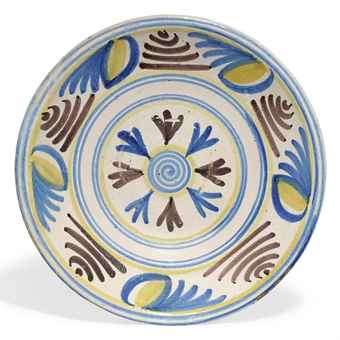
English Delft Polychrome Dish 1675-1700, Christies
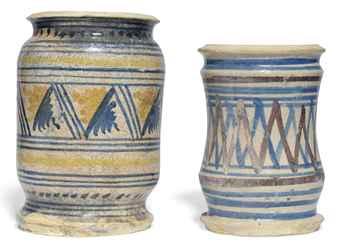
Drug jars, wine bottles, and ointment pots were typically produced in the 17th century 

Delft Drug Jars Early 17th Century, Christies


Delftware, some with manganese purple found mudlarking on Thames foreshore 
In the 18th century tea bowls, pots, cups and saucers were made. They were the possessions of the middle classes, status symbols, shown off in the best rooms rather than kept in the kitchen. 

In the latter part of the 18th century, Josiah Wedgwood promoted his more industrially produced tableware, which chipped less easily and was decorated in the new classical style, the public responded eagerly and delftware went out of production by the early 19th century.