It took me a while to notice and even longer to appreciate the bold, sometimes high shine black glazed fragments on the Thames Foreshore. I suspect for a long time I didn’t pick any up – being much more attracted to the pretties or the evidently old.
 |
| Thames Mudlarking Finds: High Shine Blackwear. |
 |
| Mudlarking Find: Base & Side of Blackware bowl? |
There isn’t much available on the net on this stuff so hard to craft a clear story. At the moment I have a number of rather general leads. Quite amusing that all blackware means is that the pottery is black – or perhaps it’s nice that the archaeologists can be quite straight forward and dispense affectation.
Cambridge University archaeologists describe blackware as ‘Made between 1580 and 1700AD. The clay is very similar to that of Colchester Ware and Glazed Red Earthenware, but the vessels have a black glaze, coloured by the addition of iron. Usually drinking vessels such as mugs, but also tall, narrow cups with up to eight handles, known as 'tygs'.
 |
| Black Glazed Earthenware Tyg 1590-1700 probably from Harlow (St Alban's Museum) |
Some talk about black glazed pottery being made at Harlow in Essex around the time they made metropolitan slipware in 1630 – 1700, others suggest that they were made in Wrotham in Kent from 1675-1700.
One source claims that this glaze was more expensive to make because they needed more fuel than low fired earthenwares (I presume either higher temperatures or a longer firing in the kiln).
'The oldest of all these drinking vessels is the tyg and it can trace its origins back to Elizabethan times. Its name is even older, tracing back to the Anglo-Saxon word tigel, which meant anything made of clay, particularly red clay. Over the centuries, the word tyg, or tig, came to mean a special kind of drinking cup. A tyg was similar to a loving cup, but it had many more handles, the number increasing with the size of the cup. Tygs have been found with as many as ten handles. A tyg was a social drinking vessel, for it was filled to the brim, then passed around a group of drinkers. Each member of the group would have his own handle and a section of the rim of the tyg to himself. Through the sixteenth and seventeenth centuries, tygs were primarily made of ceramic, but by the eighteenth century, they could also be made of pewter, and very occassionally, might be made of silver. Because they were meant for use by multiple drinkers, tygs were found almost exclusively in taverns and the tap rooms of inns and public houses. But there were some who favored convivial private drinking parties and they might have had a tyg or two in their homes. It was these privately owned tygs which were most likely to be made of silver. These silver tygs might be engraved, sometimes with the name of the owner, or more often with some amusing rhyme about the consumption of the alcoholic beverages which they contained.'
 |
| Slip-decorated earthenware, Wrotham, Kent, 1682 (Allen Gallery) |
 |
| Three Handled Tyg 1621 (Steve on Steins) |
 |
| Tyg from Bernard Rackham's Mediaeval Pots
|
 |
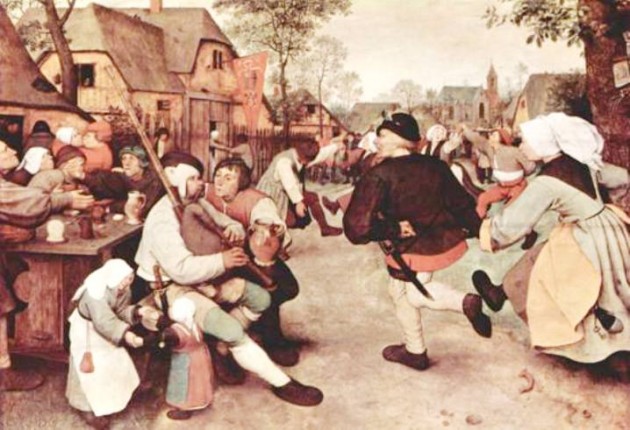
| Tygs being passed Brugal 1525-1569 (Steve on Steins) |