Showing posts with label Mudlarking all of it. Show all posts

Tuesday, 3 June 2014

Surrey Hampshire Border Ware

Pottery continued to be made on the Surrey Hampshire Border, with Farnborough the main centre. Pottery produced in this area in the 16th -17th centuries seems to be referred to as Surrey Border Ware. 

The pottery is still buff coloured, but more refined.  Production techniques changed. The pottery was subject to two firings, the first to render the thinner vessels hard enough to decorate and a final firing after the application of glaze. 

In the mid 16th Century potters began to use a tougher type of clay. This together with improved firing techniques meant quartz in the form of sand didn't need to be added as a tempering agent to the clay mixture to add strength. Hence you can tell if you have the later shards by their smoothness and absence of 'black bits', as below

Mudlarking Finds: Possibly porringers and a Chafing Dish
Fine table ware began to replace the large utilitarian vessels of the medieval period, so another clue is form type. Potters extended their range to include these unfamiliar poetic names 'porringers',  'pipkins', 'chafing dishes' and  'fuming pots'. Porringers were used for foods which were eaten with a spoon and were often used to reheat food. 
Porringer 1550-1700 (Museum of London) 
Chafing dishes were portable heating devises. Hot coals were placed at the bottom and a dish balanced on the lugs to keep food hot. 
Chafing Dish 1550-1700 (Museum of London) 
Clear lead glaze began to be used which turned yellow when fired, in addition to the green glazes achieved by adding copper. The glaze on these 16th-17th century shards tends to cover the whole piece, usually the interior and is more uniform than the glaze found on medieval pottery. These examples include the edge of a large platter and a shard from a colander or strainer, another two new forms for the border potters. 


Border Ware Strainer 1601-33 (Museum of London) 
Other objects included money boxes,candle sticks, chamber pots and probably my favourite but not yet found, chicken feeding dishes. 
16th Century Border Ware Chicken Feeder (V&A) 

Germany was Europe's ceramic leader and at least one German potter settled in the Surrey Borders. This influence perhaps led Surrey borders to produce masses of tripod pipkins, a form popular in Germany. The characteristic small hollow handles are a reasonably common find along the Thames. A stick could be inserted into the handle to make it longer and of course less hot. Pipkins were placed on the coals at the edge of a fire and some recipes specified using an earthenware rather than a metal pipkin. 

Mudlarking Finds: Pipkin Handles 16th - 17th C

Tripod Pipkin 1636-1700 (Museum of London) 
Ellicksander Pottage.
Chop ellicksanders and oatmeal together,
being picked and washed, then set on
a pipkin with fair water, and when it
boils, put in your herbs, oatmeal, and
salt, boil it on a soft fire, and make it
not too thick, being almost boil’d put
in some butter.
 The Accomplisht Cook by Robert May 1678

When you scoop up one of these finds along the foreshore, it may well have come from a London which looked like this, 

Wyngaerde - Central London 1550 

This white pottery dominated London from 1500-1700 a period which saw London's population expand from  50,000- 600,000. It died out in the 18th century.  

Sunday, 25 May 2014

Medieval Surrey Whitewares

I thought the mosaic might be a good way of ending this blog, but then I remembered my original intention -  to create something people could use to identify the pottery finds they found along the Thames foreshore, along with their back story. Essentially what I wanted but couldn't find when I started out.

The big gap in the blog is the old stuff. Unless you are an experienced archaeologist  I can't quite see how you can tell the difference between different types of old white or red earthenware pottery, so I've put off writing about it. A visit to the Museum of London's finds identification session organised by Thames discovery and the usual internet searching, have filled me with slightly more confidence, although I expect they'll be a few mis-identifications along the way - but here goes. 

The first clue is that most old stuff is characterised by green glaze. It was the first coloured glaze used in Britain, from the 11th century and achieved by adding copper to lead glaze. Not all green glazed ceramic is that old however, as it was in common use until at least 1700. 

The other clue is that certain 'forms' are associated with different periods, with jugs, cooking pots and storage vessels typical of medieval forms. Some venture the prevalence of jugs increased as wine became more available and popular.

If the pottery is white, it is likely to have been produced in Surrey, from 1240 in Kingston a Thames crossing point upstream, then from 1260 in multiple sites along the Surrey Hampshire border and from 1350 in Cheam. 


Pottery was produced in the Surrey Hampshire borders into the 17th Century. The medieval stuff is coarser with lots of 'bits' in the clay. Most of the pieces below have black flecks, which if you look closely are tiny pieces of quartz .  The finds below are are all from jug strap handles,  they were frequently adorned with stabbing or slashes which were practical as well as decorative, allowing steam to escape from the thicker sections of the jug thus preventing fracturing during firing. 

Mudlarking Finds:  Sections of Medieval Jug Handles 


Kingston Jug 1240-1360 (British Museum) 

Jug 14-15th C (Museum of London)


The green was used decoratively on jugs and the glaze was used inside pots to render them non porous.  
Mudlarking Finds

The last two finds are a decorative section with two different colours of clay, perhaps it formed part of a baluster jug similar to that below, a classic of the medieval period. The second is a frying pan or 'skillet' handle.  

Mudlarking Find 
Medieval Frying Pan Handle 

Medieval Baluster Jug mid-late 13th C (Museum of London) 
The white firing clay didn't occur locally and had to be transported by cart or by boat the 25 or so miles from the Reading Beds near Farnham. Most goods were wheel made although a few such as dripping trays were slab made.When finished they were most probably transported by boat along the Thames to London.  

These Surrey Whitewares were tremendously popular and gradually became the most common pottery in London between 1350-1450. This was a time of plague with the Black Death reducing London's population by half to 40-50,000. Subsequent plagues and famines suppressed population increase until the early 1500s. It was also the period of the Hundred Years war a dynastic conflict between English and French Kings beginning with England's Edward III. 
Edward III (Its about Time) 
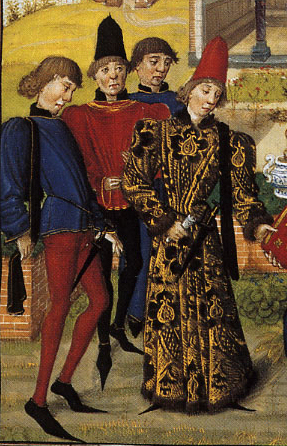
Money was required to fund the war stimulating trade in woolen cloth, an export trade centered on the capital, promoting further expansion in both the size and wealth of London. Even in these difficult times there seems to have been both the means and desire for people to indulge in a bit of consumerism, which included purchasing whitewares from Surrey, luxury imports from Europe and for the boys at least poulaine, those pointy shoes, the height of fashion in 1380 and than again a hundred years later. 
Poulaine France 1468
There are few pictures of London from this period, but here is one I tracked down from the 15th Century with the Tower of London in the foreground and London Bridge behind

London from 15th C manuscript (British Library) 
and a reconstructed map of medieval London with its Friaries, markets (including Leadenhall, Poultry, Guildhall and Cheapside), early hospitals and the population of the waterfront by foreign merchants from Cologne, France, Bruges and Antwerp. 

Medieval London (medart.pitt.edu) 

Wednesday, 14 May 2014

Medieval Anthropomorphic Jugs

Whilst some hanker after pilgrim badges or coins, the find I'd probably be most delighted by is from one of these 
Face Jug 1270-1310 (British Museum) 
a medieval jug with a face on it.  I rather like the 'proper' term for these too, a right mouthful, 'anthropomorphic' - which in this instance means pots with partial or complete depiction of human bodies. 
1301-1400 (Museum of London) 
Apparently these jugs were very popular in London, the ones above were made in one of the main towns supplying pottery to London in the 13th-15th centuries, Kingston. They tend to be quite small around 12cm.  Most jugs depict men with beards and they often seem to be tugging or stroking them. Their meaning has been lost over time, I like to think they embodied some irreverent joke. 
Kingston Anthropomorphic Jug 14th Century (Christies)  
As I packed away my finds and sifted through the old stuff, I pondered over one piece of decorated green glazed medieval pottery. I worked out the decoration  would have gone diagonally - I wonder, could it possibly be one of those arms?...
Mudlarking Find 
14th C (MetMuseum)


Saturday, 3 May 2014

Martincamp Ceramic Flasks

This broken bit of pottery has been on the blog before, but it wasn't until the finds id session organised by Thames Discovery earlier this year that I finally found out what it was. Nigel Jeffries from the Museum of London Archaeology immediately recognised it as the neck of a Martincamp flask, amusingly Nathalie Cohen from Thames Discovery captured the moment here., with Nigel animated in his enthusiasm and me all eyes and ears and geekily taking notes! 
Mudlarking Find: Stoneware Martincamp Flask
This stuff is named after the village of Martincamp in Normandy France, although it’s thought these vessels were produced across a larger area in northern France, allegedly just for export. Unsurprisingly it's a type of 'Normandy Stoneware'. 

The won’t stand up flask was made on a potter’s wheel. The neck was made separately and then attached over the crudely made hole in the flask as seen below, which I'd always been a bit perplexed by. 


The internal messiness is rather at odds with the rather polished outward appearance. 

Stoneware Martincamp Flask 1501-1600 (Museum of London) 
The flasks would have been covered in a wicker casing, similar to the bottle in Lubin Baugin's painting below ca. 1610–1663. Apparently they were used as water bottles by field workers and soldiers, slung over their backs using a strap attached to the wicker. It's surmised that a wicker base would have enabled the bottle to stand up. I wonder if the roundness of the bottle made it stronger, like an egg. At the very least a nifty design with no easily bashable edges and wicker padding to boot. They were also much cheaper than glass. 

Le Dessert de Gaufreetes, Lubin Baugin, ca. 1610–1663 (Louvre)

One of the 'signs' of a Martincamp canteen is the rings around the neck. Are these really caused by the imprint of the wicker or are they the potters throwing rings? As I finally cleared away my finds, which had crept onto every surface in the shed, I spotted what looked like another neck of a Martincamp flask, this time earthenware. Still, I suspect if not rare they are a fairly uncommon find along the Thames - but perhaps I'm wrong?

Mudlarking finds:  Martincamp Flask Necks 
There are apparently three diabetes type categories for these vessels (John Hurst 1986)

  • 1475-1500 off white fabric often with buff surfaces and a flattened profile (Type I) 
  • 1500- 1600 dark brown stoneware with a more globular form with one side slightly flattered and the other side breast shaped (Type II) 
  • 1600-1700 earthenware usually a low fired orange colour, but can be fired to near stoneware and appear reddish orange. (Type III)
1501-1600 (Museum of London) 

So my type II from the beginning of the post was knocking around when London looked like this, 
Anton van den Wyngaerde 1543

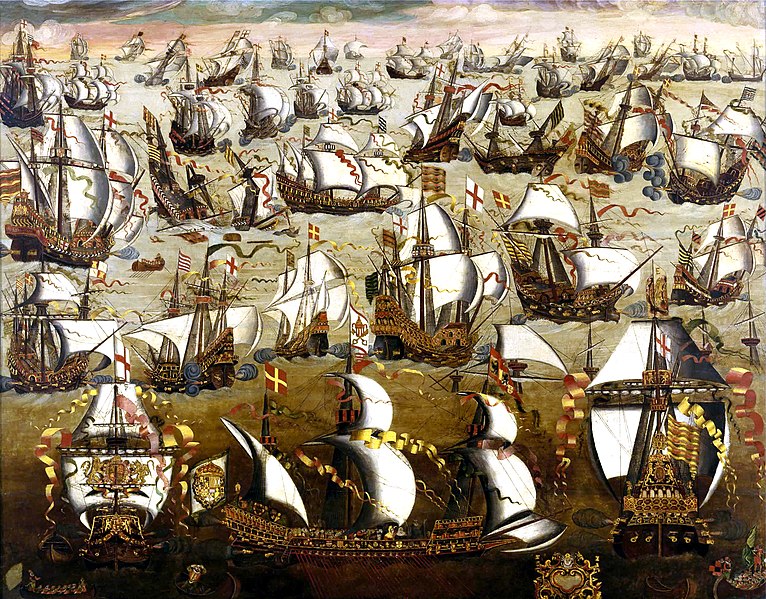
the century when England was ruled by our most famous Monarchs Henry VIII and Elizabeth I, the time of Shakespeare, the Spanish armada, and when potatoes came to Britain. It was the period when London became established as a great port which was accompanied by a trebling of the London population from 60,000 in 1500 to 190,000 in 1600, the average size of a London borough today. 


Spanish Armada and English ships in August 1588, by unknown painter (English School, 16th century) Wiki

Sunday, 27 April 2014

Cistern Bung Holes

This post is for Facebook's London Mudlarker who has given up asking me to post on bung holes. Revealing our ultimate nerdiness. Not a great deal to say about these, part of the reason for the delay - but LM here you are.  

From time to time I've noticed largish earthenware shards with a hole surrounded by another piece of applied clay. Not all that appealing or interesting but certainly a 'type' so I decided to take one home with me, intending to work out what it was some time later. 

Medieval Bung Holes from Cisterns. Left Coarse Whiteware bundhole from 1340 to 1440 AD, 
They are bung holes from cisterns. Cistern comes from the middle English word cisterne which in turn is derived from the Latin cista for 'box' or the Greek kiste for 'basket'. They are waterproof vessels for holding liquids. 

Probably the most interesting thing about them is that they are very old and still hold the original potter's thumb indentations. Many will be medieval and others will be from the Tudor period. 


Coarse Borderware with Bung Hole 1340 - 1440 (British Museum) 
Some commentators speculate that their increase in the 15th century was due to an increase in home brewing and the popularity of beer. 

Medieval Cistern York (Doug Fitch Blog) 

London Redware Cistern 1480-1600 (Museum of London) 

Friday, 24 January 2014

Stuck at home not mudlarking

Rain and being a responsible mother is keeping me away from the Thames for a good month. Growl. So as I'm not in the shed mosaicing tonight and a bunch of big teens have commandeered the TV room I'll spend a while finishing off this post with a few finds from my last mudlark. The first is part of a cartouche from a bellamine jug. Interestingly London Mudlark found one very similar shortly after I picked this up. Someone ventured it bore Amsterdam's coat of arms. 

Mudlarking find: salt glazed cartouche 1550-1700
A very worn decorated pipe, the same ghostly sleep walking figure appearing on both sides. There are surprising few pictures of decorated pipes on the web so have not a clue what this might  be, hoping Richard might be able to help out.  


Just love this large chunk of green glazed pottery. I'm always rather moved by seeing the decoration someone has pinched with their finger tips hundreds of year ago. It is unusually refined, does this mean it it was produced in France or is it the more recent (1550-1700) Surrey Hampshire Border Ware? I really am rubbish at identifying the different types of green glazed ceramic, so I'll be taking this down to the Thames Discovery identification session on 4 Feb for some expert advice from Jacqui Pearce the pottery czar from the Museum of London Archaeology.   


And finally the oldest pipe I have ever found 1580 - 1620, it's weeny and next to a whopper from the 1770s. 
Mudlarking finds: clay pipes L 1770s and R 1580

Saturday, 21 December 2013

Mid winter mudlarking

Almost our shortest day, the sun didn’t rise until after 8am. Son out the door delighted it’s the last day of term and off I waddle in wellie boots with mudlarking rucksack, to lower the tone of the train bearing city workers.

What a glorious day, the reflective light was almost blinding on the foreshore.  


Bumped into Jason and linked up with London Mudlarker. A lovely lead cloth seal, my find of the day,  softened the blow of losing my first ever jetton a few weeks ago. It had slipped through a hole in my bag. That will teach me. The small and metal require  a different storage strategy, the casual bung them in a plastic bag will no longer do.

Fortunately the jetton hadn’t washed away and was found a week later by one of the Thames Discovery crew. So you can fully commiserate with my loss, you can see it in all its glory via  this link.

So, the lead cloth seal. It’s big and complete with lots of clues. A crown on the front, with something else beneath perhaps a shield/coat of arms.  

Mudlarking Find: Cloth Seal possibly from late 15th Century
On the reverse is a small rose and what looks like lettering an ‘A’, ‘H’ – can’t tell. 


Then on the band is a little star or sun (top left hand side). 


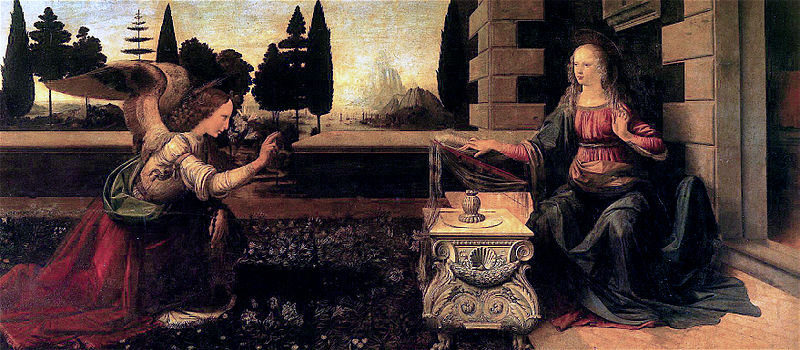
I've found a similar one on the portable antiquities scheme site here. It could date from as far back as 1474. The time of all that Renaissance art in Florence. 

Annunciation Leonardo da Vinci 1473-1475

In England the war of the roses was in full swing and and Edward IV was on the throne


Edward IV (Wiki) 
and was the decade when William Caxton established his printing press in London. There were 3 million people in England. 

Earlier I’d found one of those cute tiny money box tops dating from Shakespeare’s time. 

Mudlarking Find: Money box top from 1580 - 1620

They are associated with theatres, many were found when the Rose theatre was excavated in Southwark London.   Entrance fees would be collected in the box. The coins could only be extracted by breaking the pottery money box. It is thought these small globular vessels gave their name to the 'box office'. 
16th or 17th Century Surrey Border ware Money Box (Museum of London) 

It was the also a day of delft. An unusual piece with vivid polychrome on both sides, I suspect this might be Italian Fience (tin glaze) rather than English delft. 


Followed by a plate shard with  crude chequered pattern


And part of a delft picture tile.


And then I came across a little fella


Finally went off to collect more pipes, white china and shell edged pearlware for the mosaic. I hope to spend a few days over the holiday period ensconced in that shed, a hectic period of work having enforced a fortnight’s break.

Met up with Jason again, he had kindly pocketed this hand painted shard knowing I’m a sucker for those smashed bits of pottery.


I also snuffled up a few pieces of a mudlarker’s caste offs, the thin delicate handpainted neck of Chinese export porcelain my favourite.


Then off for a post mudlarking coffee and cake with London Mudlaker, passing the guy who has spent the last year decorating chewing gum with enamels all the way along the Millennium bridge.


As we gazed at St Pauls and watched a traditional  tug boat  pull it’s load of  yellow metal crates up the river, we eulogised about London. We’re both so pleased that this  mudlarking passion pulls us down to London’s  belly so regularly.

I decided to weave  through the back streets and alleys to Moorgate. Slanted winter light misted side streets . Every few minutes I came across another slender white church,  slices of old London preserved between rising walls of ultra modern office blocks. It was busy with city workers on their way to Christmas lunches.  Restaurants were full of large sedate groups, a few brave enough to wear their paper crowns in primary colours. Tables were laid with Christmas crackers and big wine glasses ready to welcome the next party. Enormous baubled Christmas trees stood behind the sheets of curved class which show off those minimalist cavernous company entrances. They almost softened them. Christmas really is the only festival London fully celebrates. Up to now I hadn’t felt the slightest bit Christmassy, but something stirred in me as I wandered through those narrow streets with all the Christmas glitter. Decided to come back one evening to really soak up the romance of  London at Christmas.