Showing posts with label Delftware. Show all posts

Friday, 7 June 2013

A Spring Mudlark and My First Coin

Back on part time wages and back on the bus. Low mists of cow parsley edge the parks. Above, horse chestnuts are dressed with white candles. Trees still hold the lime green haze of spring before they deepen into the green of summer. This time I noticed the Council block's lawns with their daises and buttercups squared off with black railings. We pass traffic lights and lamp posts covered in flowers wrapped in cellophane, tributes to someone killed in a traffic accident. Then the streets narrow, the height of buildings increase and you'd no longer know it was spring. Just tarmac, glass, metal and stone - albeit rather grand.

There were so many people down on the foreshore, the Thames Discovery crew measuring,  documenting and considering old archaeological features, a large group of kids, solitary souls, a gaggle of friends and kids with their families. I wasn't expecting to find much. I reckoned most stuff would have been scooped up after a series of low tides, a bank holiday weekend and half term. 

It was a pleasure to meet 11 year old Kane and his mum Sarah, all the way down from Merseyside for a mudlark. Whilst his friends immerse themselves in PS3s, minecraft and youtube Kane's out digging in bottle dumps. Kane kept me company for a while telling me what he'd found in the past and what he'd like to find. Keen to find some Tudor pins, it was nice to be able to show him where to look and how to find them. Turned round and there was Florida Tom, back in England for 6 weeks of mudlarking. Very good to meet up with him again. 

Fortunately Tom and Kane kept me mooching around one particular spot and just when I thought this was definitely my worst mudlark ever I found my first coin - well apart from a Russian Kopek and 2p - very excited. I didn't care that it was battered, thin and worn - it all added to its charm and it sparkled!


Mudlarking Find George II Copper Farthing


It's a George II copper farthing minted  between 1734-1754. I can't make out whether the date is the 30s or 50s. A crown of leaves (laureate) tops George's head and he wears Roman military dress in the classical style. On the reverse is Britannia, the Latin name for Roman Britain, who first appeared on British coins in  1672 and was only omitted from the 2008 redesign, much to the annoyance of the Daily Mail. 


Masses of fakes were also produced, the wording or 'legend' was often different so the counterfeiters could escape prosecution. Given I can't make out whether it reads  GEORGIUS.II.Rex and on the reverse BRITAN NIA no idea whether it's a genuine or not - quite like the idea it might be a fake. I wonder what it last bought? 


George II Farthing (AH Baldwin and Sons) 
On my way back I found a couple of nice delft shards,


Mudlarking Find: Delft Shard


Mudlarking Find Polychrome Delft Shard Early 1700s
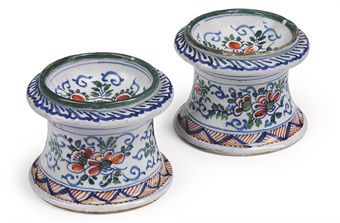
A couple of salts reckoned by Christies to be from 1720 and from Vauxhall, deploy similar colours and painting techniques to the one above. 
Delftware Salts possibly from Vauxhall 1720 (Christies) 

My other vaguely interesting find I'll keep for a separate post. As I left it started to rain. Ran for the bus and just managed to get home in time to help husband and youngest pack for our imminent holiday, which went some way to appeasing my rather irritated husband - who wasn't too happy that I'd absconded down to the Thames.

Sunday, 6 May 2012

Porringer or Bleeding Bowl Handle

To break up the rather dowdy browns and buff colours of the pots and storage jars, here’s a delftware handle of a porringer or possibly a blood bowl.  I had  to look up  ‘porringer’. It is, as it sounds, a bowl for porridge or other sloppy food you’d eat with a spoon. They had single handles and were often used for heating food. 
Delft Porringer or Bleeding Bowl Handle found Mudlarking on the Thames London 

Delft porringer or bleeding bowl,  1765 from Christie's

Saturday, 21 April 2012

Beautiful Delftware

Delftware is my favourite pottery find, perhaps because it is so old, 1560-1750 yet its hand painted designs are so vibrant, bold and modern, similar to the Spanish and Portuguese pottery seen on holiday. Several pieces I've found are also quite quirky. The unfamiliar, poetic names of the original objects enthrall, puzzle jugs, fuddling cups, bleeding bowls, porringers, flower bricks, posset-pots, blue chargers, drug jars.


A favourite find, delftware pottery approx 4cm with childlike design 


Tin glazed dish  1571-1800  Museum of London 
Delftware was first produced in London from 1571 by two Antwerp potters, Jacob Jansen and Japser Andries, who opened a pottery at Aldgate. During the 17th century several potteries were established close to the Thames in Southwark (in the wonderfully named Pickleherring Quay) , Lambeth, Vauxhall and  Rotherhithe and later at Putney and Wapping. The best delft descriptions I've found are from  Judith Miller, antiques expert, author and TV presenter, so many direct quotes from her,

‘Delftware is a type of earthenware characterised by its opaque white enamel glaze, made from a mixture of tin and lead ash, powdered glass and water.Before the development of this revolutionary enamel, British potters had been severely restricted in terms of decoration by the drab browns and greens of the clays they used. The clean white finish of Delftware allowed them to paint patterns, landscapes and portraits for the first time.They painted their naive designs in bright colours derived from various minerals - cobalt blue was the most widely employed, although copper green, manganese purple, iron red and antimony yellow were also used.’ 

Polychrome delftware shards found mudlarking on Thames foreshore 

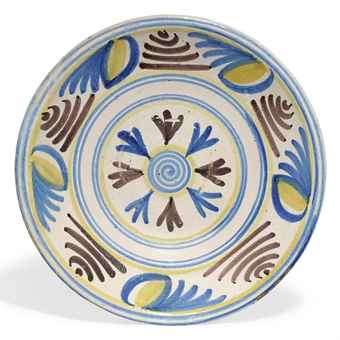
English Delft Polychrome Dish 1675-1700, Christies
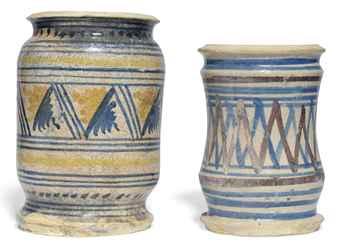
Drug jars, wine bottles, and ointment pots were typically produced in the 17th century 

Delft Drug Jars Early 17th Century, Christies


Delftware, some with manganese purple found mudlarking on Thames foreshore 
In the 18th century tea bowls, pots, cups and saucers were made. They were the possessions of the middle classes, status symbols, shown off in the best rooms rather than kept in the kitchen. 

In the latter part of the 18th century, Josiah Wedgwood promoted his more industrially produced tableware, which chipped less easily and was decorated in the new classical style, the public responded eagerly and delftware went out of production by the early 19th century.