Showing posts with label Victorian 1837-1901. Show all posts

Friday, 14 June 2013

Staffordshire Figurines 1775 onwards

I’d expected to come across a head of a china figure at some point but didn’t consider it could be a torso. I still do wonder why on earth I picked this broken old thing up. It’s a specimen of things I could never stand - china figurines, but things always seem rather more interesting when you ease them out of the mud and want to figure out what they are and the story they have to tell.  


Staffordshire figurines were produced from 1775 onwards in ‘the potteries’ a collection of six towns Burslem, Tunstall, Hanley, Fenton, Longton and Stoke, now all subsumed into Stoke on Trent.

Press moulds were used, the worker’s finger print can be seen clearly inside my find, left as they pressed the clay into the mould. Earlier figures were made with back and front moulds with features and colour all the way round. Enamel colours were painted onto the glazed figures by hand, fixed by another firing at lower temperatures, occasionally gilt was then added before a final firing.

After 1840 figures tended to be slip caste in one mould and flat backed so they could sit flush with the wall atop mantelpieces.

The emphasis was on cost. The figurines were churned out cheaply and quickly using child and women’s labour for 12 hours a day 6 days a week. There were dozens of potteries producing them. Virtually no one bothered to imprint maker’s marks.  Many potteries went out of business in this highly competitive market and sold on their moulds and stock. Therefore it’s rare you can trace particular figures to specific potteries.

What’s interesting about the figurines is the insight they provide into popular taste. They offered the middle classes an affordable alternative to the expensive porcelain figures produced by the Meissen pottery in Germany and Chelsea and Derby factories in England.

It seems the Victorians were particularly mad about these figurines. Perhaps more people had greater disposable income as the industrial revolution kicked in and production costs declined so they were within reach.

The early Georgian figurines tended to represent biblical or classical figures or romantic representations of rural life.

In Victorian times, the celebrities, venerated and events of their day were quickly caste. Likenesses were copied from prints. Purchase and display was a way of communicating your erudition, cultivation, humour and how with it you were, perhaps equivalent to the facebook likes, shares and retweets of today.

Actors and comedians seem to have been their celebrities, almost all of whom are forgotten now. Below is John Liston, apparently one of the greatest comedians of all time, he was the first comic actor to command a higher salary than a tragedian, earning the vast sum of  £60-£100 a week in 1820.  
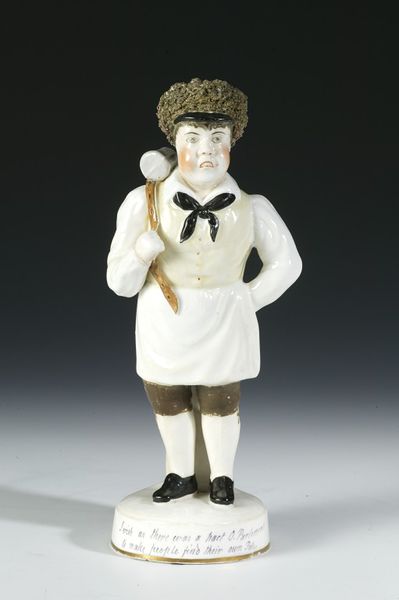
John Liston Playing Sam Swipes at the Haymarket 1820 (V&A) 
Busts of politicians, clergy and Shakespeare were produced.

Bust of John Wesley (Madelena.com) 
Scenes of intrigue were represented, such as Stanfield Hall, where local notable Isaac Jeremy met his end at the hands of an illegitimate gentleman farmer’s son James Rush, as were dramatic events, such as 17 year old Ellen Bright’s death by tiger in 1850.

Death of the Lion Queen 1850 (madelena.com) 
It’s not evident to me what period my find is from, she was found on the Georgian mudbank amid shards of white salt glazed plates and early Worcester Porcelain, so I suspect she’s one of the early Georgian types, a hunch backed up by her roundness and similarity to the figures below produced around 1790.
 
Ralph Wood Figurines C.1790 Staffordshire (antiquepottery.co.uk) 
(thank you to V&A and Madelena Antiques for all the information on their websites which helped me piece this together). 

Friday, 31 May 2013

Hairbrush

I found the remains of a hairbrush a few months ago, almost didn't pick it up. It took me back to another word - the London cottage industry of brush drawing - which sounds more romantic than it evidently was. 
Homeworking brush drawer East End London 19th C (Society of Brushmaker Decendents) . 

Holes were drilled into the brush back and wire or string was looped through the holes. Bunches of bristles were pushed through each loop by hand and were folded and pulled back into the hole as the twine was pulled from behind. Apparently it could take a whole day to draw a brush in this way. 


You can still see the twine sewn into the ridges at the back. On the reverse loops are just visible, nestling in each hole. The brush would have been finished with a back which was either stuck on with fish glue, the posher ones were screwed on. No screw holes in this one, so the commoner type I think. I can't work out if it's made of bone, horn or wood. Lovely comfy indentations for your thumb and forefinger, it would have been a rather cute hairbrush, I suspect from the 19th century.
Drilling holes in the brush backs (brushmakers.com)
As well as homeworkers the still in business GB Kent made their brushes in London from 1777, mainly employing women. An early visitor to their original factory observed 'bristles from Russia, Serbia, China and India; badger hair from Germany and the Balkans; whalebone from the Antarctic; fibres from Mexico, Brazil and Africa; beech, cherry, birch and sycamore from the English countryside and tropical timbers, ebony and satinwood from the forests of Ceylon, the West Indies, South America and Indonesia' (Executive Shaving Company) 

All of which I imagine would have arrived via the Thames.
The Rhinebeck Panorama of London c. 1807

Saturday, 25 May 2013

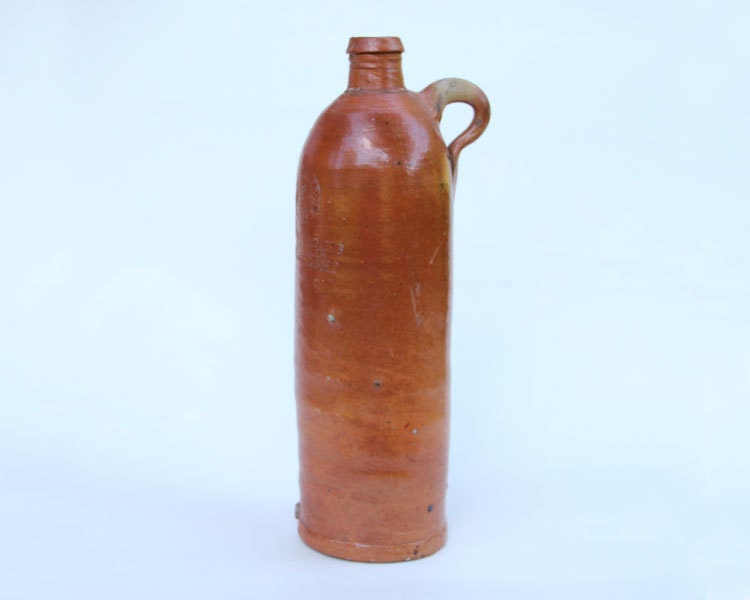
German Stoneware Mineral Bottle

I put down the first piece of stoneware I found, thinking the little bit of writing wasn't worth it. A few minutes later found a similar larger shard with a lot more, I went back ten feet to retrieve the discarded piece and as I suspected they slotted together. A fortnight later I found the missing middle fragment in the same place. 
Mudlarking Find  Georg Kreuzber Stoneware Bottle
Not an old find, Victorian and mildly interesting. It's German and probably held mineral water. Produced for Georg Kreuzber, a wine merchant from Ahrweiler who in 1850s began bottling mineral water from the Apollinaris spring .By 1860 40,000 bottles had been dispatched across the globe. The refinery shut in 1878. 

The rather crude and imperfect incised stamp has a circular inscription 'Apollinaris-Brunnen  M-W'. Inside appears a boaty logo and below 'Georg Kreuzberg, Ahrweiler, Rheinpreussen'. 

A clearer picture of the logo on another bottle 
Georg Kreuzberg Mineral Bottle (Etsy) 
There seem to be quite a few German mineral water bottles scattered along the Thames and a number of different companies. Others have suggested these bottles contained gin and this type continued to be produced until the 1890s. I tracked down a picture of one with the label intact. Exported to the States seemingly from London with their offices at 19 Regent Street, this rather salty mineral water must have been a hit. 

Georg Kreuzberg looks like a man about town. He developed the springs in the area, building the first bath house with hotel attached at Bad Neuenahr hot spring. He had a penchant for sequoia and started a bit of civic planting, some of the redwoods still stand today. 

old postcard with Georg Kreuzberg and dedication of Neuenahrer Hot Spring in 1858

Friday, 3 May 2013

R. White London Stoneware Bottles

A month ago, I found a large piece of stoneware pottery. As I bent down and flipped it over I was pleased to see writing and a picture underneath. 'R.Whites' sits above a stamped plaque of St George and the dragon, their 19th Century logo. 


Mudlarking Find R White trademark logo on Stoneware bottle  Circa 1894
As we stopped to show each other our finds another mudlarker said he'd spotted another Whites bottle and suggested I picked it up on my way back, so I did


Mudlarking Find: R Whites London Stoneware bottle 
In the 1840s Robert and Mary White started selling their home made ginger beer from a barrel in Camberwell in South London , made with 'the finest Jamaica Ginger and Refined Sugar only.. and cannot be surpassed for its warming and invigorating properties'. Their business grew rapidly. Their produce range expanded to include lemonade and mineral water and by 1869 R Whites had 5 factories and 16 depots in the Midlands and London. 

At some point they could afford to promote their brand via stoneware bottles. The lettering reminds me of J Bourne, covered in this earlier post and I think I read somewhere the bottles were produced in Bourne potteries. The bottles would have been recycled and reused, the ritual captured in an old London school kids rhyme

'R. White's ginger beer goes off pop; a penny on the bottle when you take it to the shop!'. 


R Whites Price List 1888 (British Library) 

Testaments from a court case at the old Bailey in 1894 give a glimpse into the stoneware bottles journey, or perhaps it refers to the glass bottles which came later. 


ALEXANDER SMITH , unlawfully selling two bottles of gingerbeer to which a trade mark was falsely applied. 

MR. HORACE AVORY. Prosecuted.
GEORGE SURTELL . I am an inspector of the Mineral Water Bottle Exchange Company, which was formed for the purpose of restoring bottles to mineral water manufacturers—if bottles get into wrong hands they are sent to the Exchange, sorted out and sent back to the original owners—on 29th July I found the prisoner standing with a barrow, on which was gingerbeer, in Acorn Street, Bishopsgate—I bought from him these two bottles of gingerbeer, each bearing the trade mark of R. White—I called the prisoner's attention to the trade mark—he said, "I make my own gingerbeer. I have brought bottles to the Exchange. I am also a dealer"—I examined the rest of the stuff on his barrow and found about seven dozen of gingerbeer, four dozen bearing the trade mark of R. White, and the remainder bearing the names of other well-known makers—two days afterwards I went to 58, Wentworth Street, a private house where the prisoner lives in one room—I saw a tub in the back yard and about ten dozen empty bottles, all bearing the names of different makers—I heard the prisoner before the Magistrate claim to be tried by a jury.
Cross-examined by the prisoner. I told the man with me to give you the money, and he gave you 2d.
HENRY CLEMENTS . I am a foreman to R. White and Sons, Limited, of Camberwell, one of the principal mineral water manufacturers in London—I produce the certificate of registration of their trade mark, "R. White," which appears on these bottles—I was with Surtell on 29th July when these two bottles were bought—they are White and Sons property; they are never sold—I have not examined the gingerbeer in the bottles, but by the way the bottles are corked I can tell they were not filled by White and Sons—these two bottles came from the prisoner's barrow—another man was standing there with a barrow at the same time; I purchased six bottles of him, and proceedings were also taken against him.
The prisoners statement before the Magistrate: "I wish Mr. White would protect his bottles a little better; I clean them for him and use them, and save them from being destroyed."
The prisoner in his defence stated that Messrs. White would not receive back their bottles if they were greasy; that he bought old stuff, and when he had enough of these bottles he sent them back.
HENRY CLEMENTS . Re-examined). We do not buy these bottles back; they are not allowed to be bought or sold.
GEORGE SURTELL . Re-examined). We allow twopence per dozen for bottles brought to the Exchange.
GUILTY .— Discharged on recognisances.

(Old Bailey On Line)

Over the years the company was merged, taken over and in the 1960s absorbed into Britvic, but R Whites lemonade lives on

Friday, 1 February 2013

Chelsea Sprig Pattern 1860- 1900s.

With many mudlarking months under my belt, I now realise that the Thames chooses to give up shards from the same object over time, sometimes several months apart. 

When I  fancy unearthing the story behind a fragment I rifle through my trove, pulling out all examples of type. Often it’s only then I realise two shards slot together or are so close in design or form I conclude they must originate from the same thing. 

These first two were found six weeks apart. Whilst worn differently, I suspect they’re from the same cup.
Mudlarking Finds: Chelsea Sprig Pattern
They aren’t the most refined pieces but are full of aspiration with their relief blue posey sprigs, echoing Wedgewoods Jasperware.

Two of the next lot I suspect are from the same shiny plate. This time the sprigs, still with the flowery theme, bleeding slightly under the glaze. The companion piece feathery and herbaceous.
Mudlarking Finds: Chelsea Sprig plate shards
Several different names are attached to this genre, ‘Chelsea Sprig’, ‘Granmother’s ware’, Chelsea pattern’, ‘Aynsley’. The sprigs tend to be flowers, thistles or vines and grapes. 
Mudlarking Find: Chelsea thistle sprig. 
This stuff was churned out by many different potteries in the Victorian era between 1860- 1900s, perhaps even later. Almost exclusively sold by ebay and seemingly shunned by the antiques sites suggesting they were cheap and mass produced wares for the middle and working classes, unsought after and not collected – still it must have been quite tricky getting those clay relief bits to stick. 
Chelsea Grape Sprig 1900 (Postrex) 
Chelsea Pattern (Betty Ann Antiques).

Friday, 18 January 2013

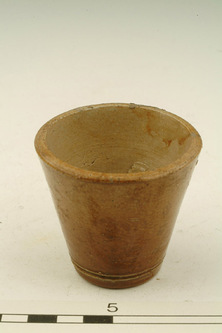
Blacking Pots 19th Century

Took me a little while to find out what this small salt glazed stoneware vessel was.Tapping stoneware drinking or  goblet into google failed to  flash up a twin. It was 'ink' that did it. The excellent Museum of London seems the only site to give this little object its voice and they have done it so brilliantly I can't do better than quote their account 


Mudlarking Find: Blacking Pot

Blacking Pot 1835-1895 (Museum of London) 

' Such pots traditionally contained blacking paste. Blacking ink was widely used in the 19th century for the cleaning and polishing of boots and shoes, floors and doorsteps. The most famous and successful blacking factory in London was Robert Warren's located at 30, the Strand. In the 1830s Warrens' was selling blacking liquid in bottles and blacking paste in pots of three different sizes, priced 6d, 12d and 18d each 'in every town in the Klngdon'. Many firms were set up as rivals to Warren's, attempting to cash in on the success and emulate the 'secret' recipe of the firm. One of these was run by James Lambert at Hungerford Stair who employed the 12 year old Charles Dickens to work in the factory. Dickens never recovered from the humiliation of having been sent to work in the factory due to his father's financial problems. He described his work as 'to cover the pots of paste-blacking;first with a piece of oil paper, and then with a piece of blue paper;to tie them round with a string' and then to clip the paper close and neat, all round, until it looked as smart as a pot of ointment from an apothecary's shop. When a certain number of grosses of pots had attained this pitch of perfection, I was to past on each a printed label; and then go on again with more pots'. (Museum of London)
A Midshipman Blackening his boots 1825 (National Maritime Museum, Greenwich, London)

Friday, 30 November 2012

Flow Blue 1820s onwards

Type flow blue into a search engine and page upon page of material springs up, so much more than other types of pottery I’ve researched. The reason – the States. In the 19th century onwards the US couldn’t get enough of this stuff,  so the pre conditions for a collectors market were fulfilled, large quantities of old things in different forms which in turn has created demand for information on the internet.
Mudlarking Finds: Flow Blue Pottery Shards
Flow blue is not uncommon the Thames foreshore. I do rather like the effect, rather more romantic than the bog standard transfer ware or perhaps its relative scarcity attracts.
Mudlarking Finds: More Flow Blue
Flow Blue is a type of transfer ware. As the name suggests it’s where the blue of a transfer print bleeds or ‘flows’ onto the white body of the object, caused by adding lime, chloride or ammonia to the kiln whilst firing. The origins are not clear. Some claim discovery was accidental others an intentional development by Staffordshire potters, with Josiah Wedgewood credited with its invention.
Wedgwood Flow Blue 'Chapoo' Platter (live auctioneers)
It’s usually applied to earthenware although sometimes to Porcelain. The blues varied with the most popular being cobalt blue, mulberry was also used. Flow blue was applied to the full range of objects from full dinner service to tea ware to bedroom wash sets.
Flow Blue Tea Pot, Shapoo Pattern by Thomas Hughes 1860-1870
The degree of bleeding varied widely. When first introduced the flow was limited, later some flowed so much the original design was completely obscured. It had the advantage of hiding defects in the application of transfer or faults in moulding or glazing.
When introduced flow blue was a popular product in Britain but demand apparently quickly diminished perhaps due to the sniffy attitude of some contemporary pottery commentators with this later illustration
N. Hudson Moore, wrote in his 1903 edition of The Old China Book, "There is a certain style of design known as 'flow blue,' which has nondescript patterns, flowers, geometric designs, and which has nothing whatever of beauty or interest to recommend it..."
After WWI the States began their own industry..... The English production of flow blue hugely reduced once the export market to the US dried up after WWI, a result of the States producing their own versions.

Friday, 16 November 2012

Transferware


The Thames foreshore is littered with transferware. I just assumed they were all Victorian but of course many are much older, dating to Georgian times. A stepped change in the development of ceramics, it was a new industrialised process. Eventually transferware was far cheaper to produce than hand painted goods, allowing the middle classes to purchase matching full dinner services to grace their dining tables and wash sets for their bedrooms, with matching basin and ewer, a cup for brushing teeth, soap dish, sponge dish, and a chamber pot.

Some claim John Sadler and Guy Green in Liverpool invented transferware, others Ravenet and Hancock at the York House Battersea factory in 1756. Patterns or pictures were etched onto copper plates, these were inked up and the image was transferred to a special tissue. The tissue was placed on a bisque fired ceramic object  thus transferring the print. It  was removed before more glaze was applied, the object was then fired again. 

There are two types of transferware pattern, the most common are those with a border design and a separate picture in the middle of the plate. The amount of white space between them varied with fashion over the decades. The second type used sheet patterns which covered the whole object. Marble patterns were popular in the 1800s and between 1860 – 1900 floral patterns.
Mudlarking Find: Transferware border design & middle picture
Mudlarking Find: Sheet Transferware - marbled pattern?
The early transfers were fixed on top of the glaze (overglazed) as the earthenware bodies available could not withstand the high kiln temperatures required. 

In the 1760s the Caughley factory in Shropshire produced underglaze printing. Joseph Spode and Wedgwood further developed this technique at their potteries in Staffordshire. This area became associated with this new product and indeed became known as 'the potteries' . Its production heralded the start of the industrial revolution. Churned out in such vast quantities it was one reason why woollen cloth was knocked off the top of England’s export list. America was its primary overseas destination contributing to mainland Europe no longer being the main recipient of England’s goods.

Patterns were initially printed in just one colour. Tricky to find out exactly when different colours were introduced as information out there is contradictory. The most common on the foreshore is unsurprisingly blue which some claim was the only  colour until 1809 and then continued to dominate with dark navy blue being introduced in 1818, developed by Enoch Wood. I have to confess to accumulating a rather large mound of this stuff, not all of it displayed below. 


Green apparently was  used from 1828 and green is certainly the second most common find.

Mudlarking Finds: Green Transferware from 1829
Wedgwood began using brown printing on a cream background in 1835, although I've read brown was first used in 1809. The two brown rim pieces which I realised slotted together were found 5 months apart – I like that. Brown seems to be the third most common find.
Mudlarking Find: Brown Transferware from 1809
Other colours appeared after 1830, English pink, purple, mulberry, yellow and sepia. All of which are less common on the foreshore. Can’t work out when they starting producing transferwares in black, but they too are far and few between. 
There seem to be two ways of identifying whether a piece of pottery is transferware rather than handpainted. Sometimes if you look closely you can seen the small dots that make up the pattern. Secondly the designs tend to be far more intricate and detailed. However, I still have a few pieces where I'm flummoxed.

Saturday, 25 August 2012

Torpedo Bottles

When I was a child, teenager and young adult I would look aghast, with disbelief and contempt at the middle aged plus as they tried to work the unfamiliar.  Disappearing brain cells and diminished synaptic connectivity mean I am now that person. I therefore edge slowly into the technology of social networking.  For those of you who receive email updates (and I have no idea how many of you do this or who you all are ) or look at the blog regularly, I  proudly point out that you can now search by category on the right. My inability to fix different historical periods in my head  has been a long time frustration,  so I’m hoping now I’ve got the Georgians  and Co. with their dates  this mudlarking spin off  might just do the trick. Thank you to those who have left such lovely and encouraging comments,  I’m not quite sure about blog etiquette so haven’t responded to them all.  Now on to torpedo bottles. 

On my first ever mudlarking trip I picked up an unusual thick glass pointed bottle end. It belongs to a torpedo bottle, also referred to as ‘Hamiltons’, the original producers called them ‘egg’ bottles.  A simple but clever invention. The rounded end forced the bottles to lie on their side keeping the cork wet, stopping it from shrinking and thus preventing the fizz escaping from carbonated drinks.


Mudlarking Finds: The end of Torpedo Bottles
I was surprised to learn that artificially created carbonated drinks were first produced in 1790s. Somehow I  thought it all started with coke in the 1940s or with the perrier water my teenage sophisticated best friend used to buy in 1980.

The line running down each side of the bottle fragments and meeting at the top reveals they were made in a mould and were therefore produced after 1831.

Several hours detective work on the web which I know makes me sound rather sad,  but I just couldn’t let it go – and I'd  found the company the bottles were made for. John Webb, the soda water company was only a mile or so from us in Islington. Founded in 1818 and granted a royal warrant in 1830 the first embossed lettering was ‘J. Webb, manufacturer/double soda water/to his majesty/Islington/Near London’, very close to the endings on the bottle fragment ‘...ers of /...ter/...sty/...on/....n, looks like the first bottle  -  ‘...rs/...y’ could be from the same company, later labelling was ‘Webb’s double soda & other waters/to her majesty/Islington/London’  this one from around 1840. In a matter of ten years Islington, an out of London town had been absorbed into the metropolis, funny given we now think of Islington as very inner city. 

 Webb's Double Soda Torpedo Bottle with blob top c1840 with 'WEBB'S DOUBLE SODA & OTHER WATERS-TO HER MAJESTY- ISLINGTON- LONDON' embossed.  (ebay)
Victorian households purchased special stands for the torpedos, so the bottles could stand on the dining table. All looks rather elegant - I wonder if there'd be a market for them today?  

Torpedo Stands (backpackagingdesign)

Sunday, 29 July 2012

Spongeware or Spatterware 1840- 1920

One website clearly states Scotland was the origin, another  Staffordshire. Some say 1775 others 1840. Whatever its roots, it’s claimed it was made in great quantities, several people imply most spongeware was exported either to the states or Canada. As the name suggests decoration was applied to whiteware with a sponge.  It tends to be referred to as Spatterware in the States. I seem to have found only the very basic type of spongeware,  the cheapest available in the form of teaware or bowls, most popular from 1840 – 1875.
Spongeware Pottery Shards found Mudlarking on the Thames. 
The main colours were blue, red, green, purple and yellow. I’ve only found blue and interestingly black, to which I’ve found no reference. It’s been quite a task tracking down pictures of the original objects, they clearly weren’t treated as precious family heirlooms. Now I compare the fragments I've found with the originals below I'm questioning whether they are in fact spongeware, but if not what could they be? There is one shard in the picture above which I later realised was an imposter. 

Spongeware Tea Cup 1830 - 1850  

Spongeware Sugar Bowl (ebay)

Friday, 22 June 2012

Derbyshire Stoneware Ink Bottle

I don't often find glass or pottery with writing on. Over the last few months mudlarking these are probably the best examples. Nice to find sufficient writing to help trace precise origins. ‘VITREOUS STONE BOTTLES WARRANTED NOT TO ABSORB J.BOURNE PATENTEE DENBY & CODNOR PARK POTTERIES NEAR DERBY’ was stamped onto these 150 ink bottles, produced by a Derbyshire pottery between 1833 – 1850


Large fragments of Derbyshire Stoneware Ink Bottle 1833-1850

The Bourne company was set up in 1806 by William Bourne, a local entrepreneur,  who heard about the exceptional clay found  during construction of a Derbyshire  road. He purchased some of the land and started production in 1809. He appointed his son Joseph to run the pottery. The "J. Bourne & Son" mark was not used until about 1850.

The clay used in making the stoneware bottles was a coarse, sandy and heat-resistant quality. When fired at a high temperature it became very hard, dense and non-absorbent. These bottles are referred to as salt-glazed pottery; salt glazing was a popular method of decorating stoneware in the mid 1800's. Common salt was thrown onto the kiln fires when the embers were at their hottest. The salt vapor combined with the surface of the pot to produce a shiny brown surface coating. The process for producing these salt-glazed wares was patented as noted by the stamp at the base of the bottle below the J. Bourne & Son company name.


The complete Ink Bottle from Museum of London 

Saturday, 31 March 2012

Clay Pipes

Segments of pipe stems are so easy to find mudlarking on the Thames. Bowls are less common but you are certain to find at least one on any foreshore walk. They range in date from 1580 – early 1900s. They can be dated by the size and shape of the bowl and size of the hole in the stem. The older ones have smaller bowls as tobacco was originally very expensive. The finds I've kept are below, dated using a identification chart to scale. They were the fags of their day, came packed with tobacco, were smoked only a few times and then thrown away. 


Top row  1610-1710,  middle  1700 - 1800, bottom 1820-40 found Mudlarking on the Thames
Clay Pipe Smoking 1600's
Some older pipes have very ornate decoration. I'm still searching for one of these. The most ornate to date is a simple diagonal leaf pattern on the seam. 


Clay Pipe from 1820-40  with diagonal leaf pattern along seam


A Reuters Article reveals ‘ A Museum of London study of skeletal remains excavated from a Victorian cemetery in Whitechapel, east London, found most people had "notches" in at least two, and often four, front teeth made through the habitual holding of pipe stems. Osteological analysis of 268 adults buried between 1843 and 1854 found that some disfigurement had occurred in 92 percent of adults exhumed, while wear associated with habitual use of pipes was evident in 23 percent. "In many cases, a clear circular "hole' was evident when the upper and lower jaws were closed," said Donald Walker, human osteologist at Museum of London Archaeology Service. Males were affected far more frequently than females. The study, published to coincide with national No Smoking Day in Britain, also found a number of young adult skeletons had tell-tale notches, suggesting pipe-smoking may have begun in childhood.’ It wasn’t until 1881 when James Bonsack invented a cigarette rolling machine that pipes began to replaced.