Showing posts with label Teaware. Show all posts

Friday, 21 December 2012

Worcester Porcelain – Dr Wall Period 1751-1783

I had a few moments before I had to leave. The lapping low tide was intermittently granting access to a mud plateau littered with white ceramic shards. Most were undecorated creamware but  a few patterned pieces caught my eye, which I quickly scooped up. Later I noticed two displayed hatched crescent marks– a lead just too tempting to resist, so onto google images. It took no time to work out they originated from the first period of Worcester Porcelain Factory, referred to as ‘Dr Wall’. One very similar to the bottom of the coffee mug (rosecroft antiques) pictured below, but now they are adjacent, I suspect mine is from a tea bowl or cup. 
Mudlarking Finds: Worcester Hatched Crescent
Worcester coffee Mug & Saucer 1780


Worcester Hatched Crescent
Whilst I'd heard of Worcester, no idea where is was - England’s West Midlands and in the 1750s home to the impressive Dr Wall. A doctor, founder of Worcester Royal Infirmary, champion of Malvern water and such a talented artist David Garrick jumped on chairs at Wall’s home to get a closer look at his paintings. In 1751 Dr Wall persuaded a group of 13 business men to pump prime the Worcester Porcelain Factory, a precursor of Royal Worcester and key player in the history of ceramics.

Dr Wall artist unknown (BBC) 
Porcelain had been produced in China since 200 and imported to Britain in large quantities from 16th century. It took until 1710 for Europeans to master the art of production in Meissan Germany. The race was on to develop  British porcelain. It’s said that Dr Wall and apothecary William Davis experimented at Davis shop and discovered a way to make soft paste porcelain, later bringing additional technical expertise by  purchased their rival Benjamin Lund’s Bristol porcelain business in 1752. Securing a supply of soapstone from Cornwall clinched their success. When added to the mix soapstone rendered the finished product heat resistant -  other porcelain cracked on contact with hot water. Business canny and continuing to aim for best in class in 1756 they secured the services of Robert Hancock arguably the most talented copper plate engraver of his time.
Their target was the middle market. Products were tea and table wares. In 1754 they accessed the London market via a warehouse in Aldergate Street and large quantities of Worcester products were decorated in London by James Giles. Initially designs were hand painted. It is claimed Worcester were the first to introduce transfer printing to porcelain and from the 1770s most of their designs were transfer printed. Decorated in blue and white with Chinese and Japanese themes and from the mid 1750s with flowers in the flowing German style popular at this time.  They also produced more expensive coloured enamelled sets. They became the largest producer of blue and white Porcelain, so many of the porcelain shards found on the foreshore must originate from this company. 
I wonder if the other porcelain shards I found nearby are Worcester? German flowing flower style?
Mudlarking Finds: Porcelain Shards - Worcester?


Pattern on reverse of one shard


For some time I've wanted to match designs on my mudlarking fragments to their original patterns and even better linking these to developments in design over the centuries. Apart from the willow pattern up until now I’ve had no success. This time to my delight I thought I’d found the remains of the parrot pecking fruit design, associated with the aforementioned Robert Hancock, this shard has the hatched crescent on its reverse. Sadly on a closer look it's not an exact match, which wiped the very pleased with myself expression off my face. 
Mudlarking Find: Worcester Porcelain not the Parrot Eating Fruit Pattern

Parrot Pecking Fruit Pattern Worcester Mug 1775 (Steppes Hill Farm) 

Update
Ha, found it, the shard above (albeit upside down)  is from the 'fruit sprig' pattern, pic below - smug again. 

Worcester mug  with the “ Fruit Sprigs” pattern Circa 1770 (cathcartsantiques.com)

Saturday, 20 October 2012

Pratt Ware 1780s – 1840s.

How great to have a type of pottery called Pratt Ware. The few examples I’ve found probably aren’t strictly from Pratt Ware whose defining feature is relief moulding,  the forms were usually figures or jugs. Instead I’ve found tiny, tiny thin pottery shards hand painted in pratt colours, magnified in the photo below. They seem to come from both creamware and the blue tinged pearlware, both are present in shards below. I suspect they may all be from tea bowls or saucers. 
Mudlarking Finds: Creamware and Pearlware hand painted in pratt colours
There is something I just love about these pieces, the combination of the muddy greens,   browney oranges with flashes of cobalt blue and the snapshot of such detailed miniature hand painted designs crammed onto each of these small fragments.


In this period artists were constrained in the colours they could use. Only colours that could withstand the high kiln temperatures required to fire lead glaze were available to them, namely cobalt for blue, copper and lead for greens, manganese oxide and iron were mixed to produce brown, orange was produced by adding iron oxide to yellow oxide. But there is something even more specific about the tone of Pratt colours.

Their name derives from the pottery they became associated with, the Pratt pottery in Fenton Staffordshire, although this type of pottery was also churned out by many others in Staffordshire and in other areas of England and Scotland. I've found it almost impossible to track down images of table and teaware in pratt colours, although I've had more luck in finding the more 'official' pratt ware. 

Prattware jug, circa 1820 (Martyn Edgell)


The hand painted ware was phased out around 1840 as the cheaper and more popular transfer wares began to predominate
Prattware jug with the Kings initials GR, circa 1810 (Martyn Edgell)

Saturday, 13 October 2012

Tea Ware

Dedicated to Norma, queen of teakies.

Tea first introduced to London in the mid 17th century created demand for affordable, refined heat resistant cups and other equipment worthy of this expensive brew. Initially small handless Chinese porcelain tea bowls were imported.
In 1700 large saucers appeared. Some poured their drink into the saucers allowing the tea to cool and drank directly from these.  

Pieter Gerritsz Van Roestraeten. Chinese Tea Bowls, 17th century (on familiar things)

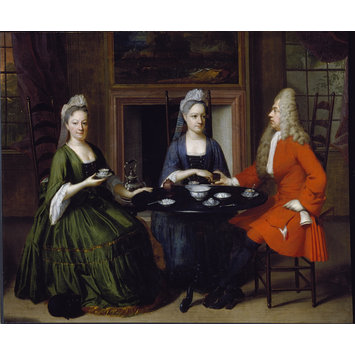
Fashionable family sitting around a tea table 1727 Richard Collins (V&A) 

The tea bowls I came across at my recent trip to the V&A were so much smaller than I’d imagined, due to the exorbitant cost of tea I suspect.
17th Century Chinese Export Porcelain Tea Bowl. 
In 1750 Robert Adams inspired porcelain tea sets in which tea cups had handles. Adams tea cups were taller than their base and came with a saucer – there began the English tea service set – with matching tea pot, sugar bowl, milk jug and even tea spoons. The English welcomed the handle having found the tea bowls rather messy and liable to burn their hands.

Throughout the 18th and 19th centuries demand for new and cheaper teaware grew apace, driven by the growing fashion of tea drinking. We see the rise and fall of several types of ceramic. Europeans began to produce their own version of porcelain. The first success in England was at the Chelsea Porcelain Manufactory in 1743- 5. In the 1750s Wedgwood perfected the production of fine stoneware ‘black basalt ware’, popular for around 50 years.  Stoneware is water proof, so no glaze was required.  The 1770s brought Wedgwoods’s refined red stoneware Rosso antico,  affordable cream ware, shortly followed by pearlware.
Bone china was developed in England in the 1800s, by Joseph Spode, another name which keeps popping up. It was lighter and cheaper than porcelain and apparently better at carrying bright colours. It became and remains the posh tea cup of choice. 


1820 Spode London shape ( from spode history blog)


I’ve found a number of shards with small circular ‘stands’ , sometimes with a tiny design in the base. I suspect these are the bases of tea bowls, two I think are pearlware because of their bluish tint, the other porcelain.


Mudlarking Finds: Pearlware and Porcelain Tea Bowl Bases

Mudlarking Finds:Tea Bowl Bases
Occasionally I find the shallow curve of what I assume are saucers. The two with transfer ware I suspect are creamware the older middle hand painted example pearlware.


Mudlarking Finds: Saucer Fragments
This last group of fragments I’m guessing are also from saucers. In each case the middle of the base. This time their design is not so ‘tiny in the middle’. Each has a stand beneath, the curve of which is shallower than the tea bowls. A mixture of pearlware and porcelain.


Mudlarking finds: Pearlware and Porcelain Saucer Fragments

Friday, 28 September 2012

The History of Tea

So many Thames mudlarking finds are from tea ware.

As I was trying to trace its development, it occurred to me to make sense of it all; the place to start was the history of tea. Tea was first brought to England in the 17th century and first consumed in coffee houses. ‘China tea’ and hot chocolate were introduced to the beverage menu from the late 1650s. Thomas Garroways promoting tea in his coffee house advert placed in Mercurius Politicus in 1658 ‘That Excellent, and by all Physicians approved, China drink, called by the Chinese, Tcha, by other nations Tay alias Tee, ...sold at the Sultaness-head, ye Cophee-house in Sweetings-Rents, by the Royal Exchange London".   
Coffee House 17th Century from British Museum. 
Samuel Pepys noted in 1660 "I did send for a cup of tee, (a China drink) of which I had never had drunk before". At one level the coffee houses appear to be equitable establishments with the aristocracy and wealthy business men rubbing shoulders with the less well to do. These establishments buzzed with discussion of current affairs and functioned as business networking hubs.

Different coffee houses attracted different clientele. Garraway’s was the haunt of scientists and natural philosophers. St James’ was favoured by traders and mariners. Will’s was for poets and White’s for actors and musicians. The mark of a true Renaissance Man in those days was to regularly patronise as many different houses as possible. 

Coffee houses play an important part in London history

‘Lloyd's of London had its origins in a coffeehouse run by Edward Lloyd,  where underwriters of ship insurance met to do business. By 1739, there were 551 coffeehouses in London; each attracted a particular clientele divided by occupation or attitude, such as Tories and Whigs, wits and stockjobbers, merchants and lawyers, booksellers and authors, men of fashion or the "cits" of the old city center. According to one French visitor, Antoine François Pervost, coffeehouses, "where you have the right to read all the papers for and against the government," were the "seats of English liberty." In London, coffeehouses preceded the club of the mid-18th century, which skimmed away some of the more aristocratic clientele. Jonathan's Coffee-House in 1698 saw the listing of stock and commodity prices that evolved into the London Stock Exchange. Lloyd's Coffee House provided the venue for merchants and shippers to discuss insurance deals, leading to the establishment of Lloyd's of London insurance market, the Lloyd's Register classification society, and other related businesses. Auctions in salesrooms attached to coffeehouses provided the start for the great auction houses of Sotherby's and Christie's. In Victorian England, the temperance movement set up coffeehouses for the working classes, as a place of relaxation free of alcohol, an alternative to the public house,’ (Wiki)
Edward Lloyd's Coffee House 1798
 ‘Coffeehouses were such important institutions to London society that one did not inquire where a fellow lived but rather what coffeehouse he frequented’.  (research.history.org)

The tea they consumed would be considered undrinkable today. Until 1689 tea was taxed in liquid form. The day’s tea would be brewed in the morning enabling the excise officer to tax, it was then kept in barrels and reheated when needed throughout the day. After 1689 tea was taxed by weight and fresh brews ensued.

Outrageously women were banned from coffee houses. You could however buy loose tea from coffee houses, this enabled women to enjoy tea at home. Kicking off the tradition of afternoon tea, women from wealthier households would gather for tea parties, a very genteel social occasion. The tea equipment would be set up by servants and the lady of the house would unlock the tea caddy and spoon the precious tea into the tea pot. Tea was unbelievably expensive, up to £10 a pound more than a labourer earned in a year. Sugar was added, another very expensive import. In this period milk was not used.
Tea drinking at home ca 1715 (Victoria and Albert Museum) 
Tea stimulated various claims and warnings, Pepys writing again in 1667 ‘Home, and there find my wife making of tea a drink which Mr. Pelling the Pottecary tells her is good for her colds and defluxions."

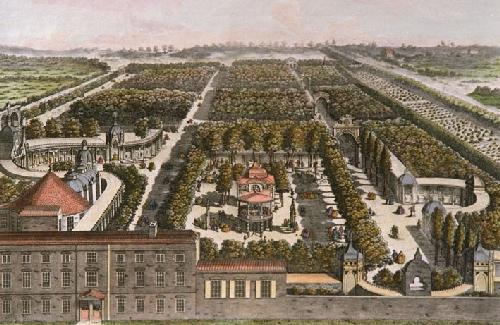
'After experiencing the Dutch "tavern garden teas", the English developed the idea of the Tea Garden. Here ladies and gentlemen took their tea out of doors surrounded by entertainment such as orchestras, hidden arbors, flowered walks, bowling greens, concerts, gambling, or fireworks at night. The tea garden began in the reign of King Charles II. Diarists John Evelyn and Samuel Pepys recorded visits to the New Spring Garden (also called Vauxhall or Foxhall) in the early 1660s. The tea garden reached the height of its popularity in the mid 18th Century the most famous were Vauxhall and Ranelagh. The gardens were both places to stroll and to be seen.

Tipping as a response to proper service began in the Tea Gardens of England. Small, locked wooden boxes were placed on the tables throughout the Garden. Inscribed on each were the letters "T.I.P.S.". If a guest wished the waiter to hurry (and so insure the tea arrived hot from the often distant kitchen), he dropped a coin into the box on being seated "to insure prompt service", hence TIPS. '(teacakesandteddybears.com)

Vauxhall Pleasure Gardens Samuel Wale 1751


Between 1720-1750 imports of tea through British East Indian Company quadrupled. One commentator Fernand Braudel asked "is it true to say the new drink replaced gin in England". By 1766 exports from Canton stood at 6 million.

In 1785 the government significantly reduced the tax on tea in an attempt to undermine the flourishing black market, which was diminishing the profits of legal tea merchants. Whilst tea remained expensive it was now acceptable to a much broader spectrum of society, seeds of our national tea drinking habit were set. 

The impact on pottery  covered in the next post. 

Sunday, 9 September 2012

Solid Agateware 1730 - 1760

This post is for Gerry,  the only person I don't feel guilty about continually bombarding with handfuls of my latest finds and old treasures - as she takes as much or even more delight in them than I do.

I love these pieces and have found only two in what is now almost  a year of mudlarking. When I picked up the first large shard, I presumed it was from the 1950s. Searched long and hard to identify their clan, finally getting there in the last few weeks. Less surprised that these finds are really old, in this case 250+ years, than I used to be.

Thames Mudlarking Find: Solid Agateware shard. 
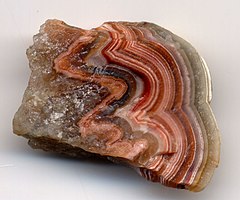
As the post heading reveals they are are solid agateware named after the polished technicolour stone 


Banded Agate (Wiki) 
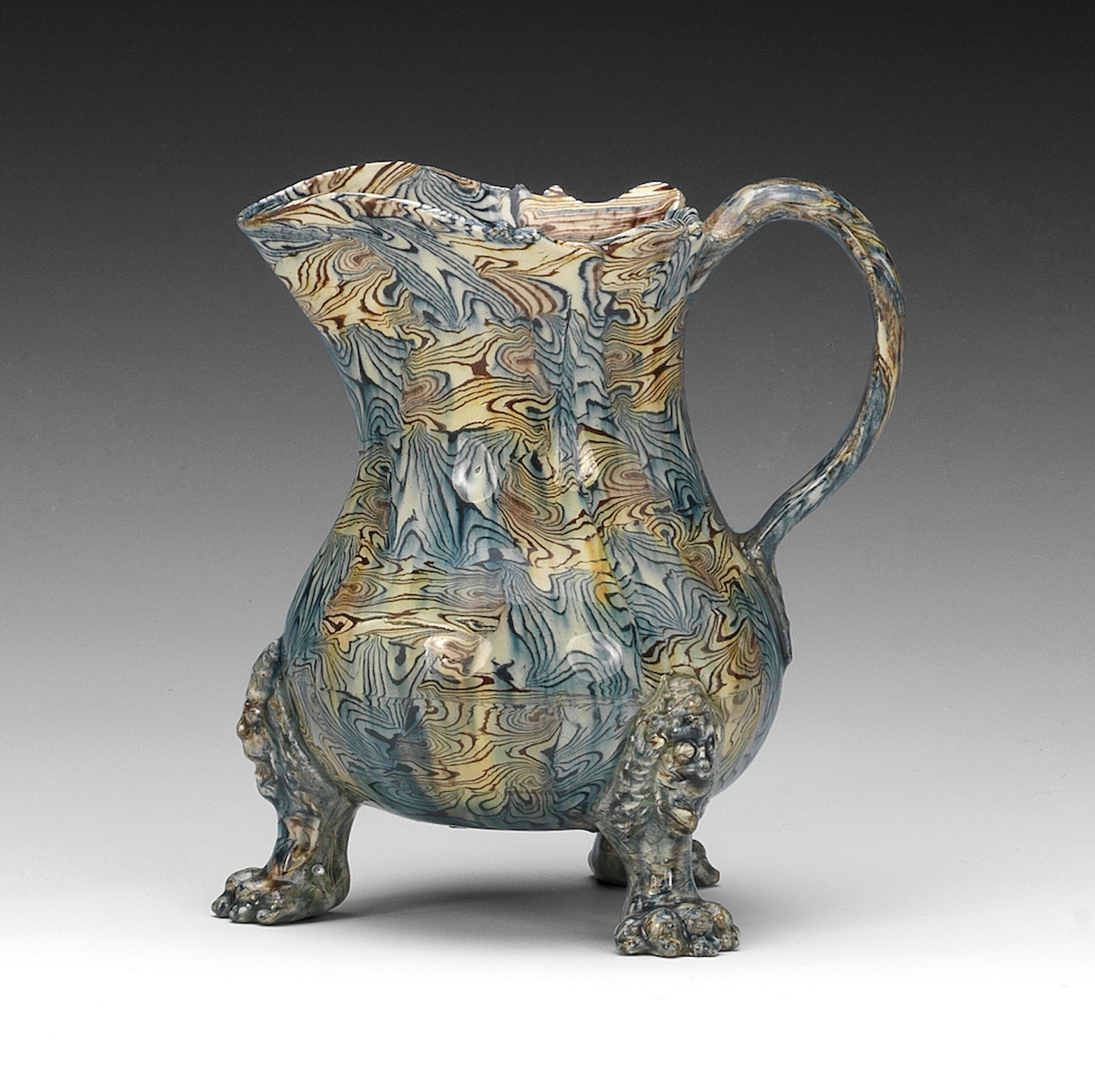
The stunning decoration characteristic of solid agate is achieved by rolling together sheets of different coloured clay. It looks as though the layers sometimes varied in thickness. On compression some would squash through the original neat lines. The large blocks of clay were then sliced to expose the layering and moulded into forms. Additional techniques must have been used to create the arcs of lines seen on many of the mugs and teapots. The way to distinguish solid agate fragments from agate ware which only uses surface marbling is to check whether the lines of colour can be seen throughout the cross section, as below - took me a while to spot that. 
Cross Section of Agateware showing the lines of colour throughout
To preserve the effect objects had to be made in moulds rather than on the wheel. They hadn't perfected the means of hiding the seams of a join, hoping the kalidascope of colour would mask it. The seam can be seen quite clearly down the middle of the fragment below and on the teapot below that. Initially I thought this piece was from the handle of a teapot or jug, it would have been a very straight one. 
Mudlarking Find: Solid Agateware
These two small mudlarking finds tell yet another interesting story about the development of ceramics. Staffordshire was the pottery silicon valley of early 18th century. As tea became cheaper its popularity increased, fuelling the demand for new and innovative teaware.  Dr T Wedgewood of Rowley Pottery Burslem, Staffordshire is credited with introducing solid agate in 1730. He used red and buff clays to give broad veined effects. Thomas Whieldon (1719-95) pottery genius, improved the technique considerably in the 1740s  by adding metallic oxides to white clay to achieve the effect. It was very expensive to make therefore production declined considerably after 1760, so only around for quite a short period of time. Today a small coffee cup will sell for £1,000. 
Thomas Whieldon 1719-95 (Whieldon Genealogy) 
Agate ware coffee mug 1750 (Martyn Edgell antiques) 

Solid Agateware Teapot 1740 - 50 (Victoria and Albert Museum) 

Agateware jug 1755- 60 (V&A) 

Sunday, 29 July 2012

Spongeware or Spatterware 1840- 1920

One website clearly states Scotland was the origin, another  Staffordshire. Some say 1775 others 1840. Whatever its roots, it’s claimed it was made in great quantities, several people imply most spongeware was exported either to the states or Canada. As the name suggests decoration was applied to whiteware with a sponge.  It tends to be referred to as Spatterware in the States. I seem to have found only the very basic type of spongeware,  the cheapest available in the form of teaware or bowls, most popular from 1840 – 1875.
Spongeware Pottery Shards found Mudlarking on the Thames. 
The main colours were blue, red, green, purple and yellow. I’ve only found blue and interestingly black, to which I’ve found no reference. It’s been quite a task tracking down pictures of the original objects, they clearly weren’t treated as precious family heirlooms. Now I compare the fragments I've found with the originals below I'm questioning whether they are in fact spongeware, but if not what could they be? There is one shard in the picture above which I later realised was an imposter. 

Spongeware Tea Cup 1830 - 1850  

Spongeware Sugar Bowl (ebay)

Friday, 6 July 2012

Black Basalt Stoneware 1760s – 1800

These shards are clearly so much more refined and sophisticated than the often found coarse pottery fragments on the Thames foreshore.


Black Basalt Pottery Shards Found Mudlarking on the Thames
I found a piece of black basalt on my second ever mudlarking trip. When I asked our Thames Discovery guide what it was he simply responded ‘Wedgewood’ and indeed it probably is.

Some writers use black basalt interchangeably with Egyptian black, others draw clear distinctions.

‘ Josiah Wedgewood pioneered the development of black basalt ware in the late 1760s, creating an exceedingly hard form of vitreous stoneware that required no external glaze. This new material improved upon an earlier form of Staffordshire earthenware known as Egyptian Black, which had been stained with iron oxide to create a black finish. Not only did Wedgewood’s new material offer greater durability and sheen than its predecessor, it proved far more suitable for creating finely detailed ornamentation. Black basalt ware consisted of Staffordshire clay, ground glass slag, manganese oxide and calcined ochre that had been mixed together and fired at a temperature slightly lower than that of hard paste porcelain. Wedgewood accentuated the shiny appearance of this material by applying a varnish, re-firing it and then polishing it with a cloth dipped in milk.’ Stephan Osdene at materialculture

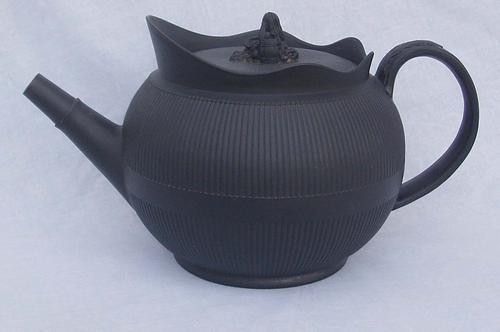
Wedgewood Style Black Basalt Teapot 1800 (bid or buy) 
Black Basalt is named after the volcanic rock, basalt, which was widely used at the time in the manufacture of vases, candlesticks and busts of historical figures. Wedgewood’s quest was partly inspired by the desire to emulate the Etruscan black pottery pieces called ‘buchero onto’ that were being excavated at Pompeii at the time and hence neo classically inspired. The range of goods was impressive, vases, lamps, ink stands, candlesticks, ewers (a vase shaped jug which is often decorated),  plaques and tableware. The  tea and coffee ware with its cups, milk jugs, tea pots and sugar bowls was the most popular.   Their capacity to withstand boiling water being poured directly  into them without cracking made them popular on two fronts function and design.

Black Basalt was a huge hit in its day, Wedgewood’s first major commercial success. In the height of its popularity in 1790-1800, selling out more quickly than it could be produced. After Wedgewood, many factories began to produce black basalt ware, notably Spode and Neale, some even copied his designs.