Showing posts with label 18th Century. Show all posts

Friday, 3 August 2012

Hunting Jugs and other English Stoneware

From 1750s English potters began making salt glazed brown stoneware vessels,  mainly mugs and bottles with 'sprigs',  pictures rising from the clay. Originating from potteries on the south bank of the Thames,  from Mortlake in the west to Vauxhall in the East. Some types are referred to as Fulham type stoneware others Lambeth type.

Among the most  popular vessels were the hunting jugs, or toby jugs, used for serving or storing ale and produced from the 18th to early 20th century. I do remember these jugs from my childhood, perhaps from a display cabinet or perched on a high shelf in one of my grandparent’s houses. I can still feel the glimmer of distain for what I thought were rather tastless, gaudy, rather scary monsters – how things change. Perhaps I'm confusing the ones below with the toby jugs made in the shape of a face. 

As the name suggests, a lively hunting scene runs around the bottom section of the jug, with either a hare, deer or fox chased by hounds and huntsmen on horseback. The same series of pastoral scenes, a tree, a windmill, a farmyard, and later ‘Toby’ Fillpott are emblazoned on the upper section. Philip Mernick's website reveals whilst the same scenes were depicted, different potteries used their own designs and therefore specific ‘sprigs’ can be traced to individual potteries, either Kishere or Sanders in Mortlake, the Vauxhall pottery, Doulton and Watts, Stiff and Sons or Stephen Green in Lambeth.
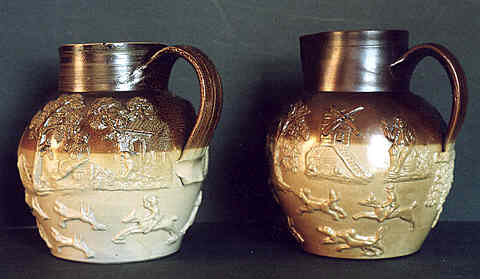
Hunting Jugs (mernick.org.uk)
Several months ago I found a fragment from a hunting jug, the nearest similar sprig I can find is attributed to the Kishere pottery, but as you can see not an exact match.
Thames Mudlarking Find:  Hunting Jug Fragment 
Kishere Pottery Hunting Jug  1797-1843
(Museum of London ) 
I’ve also found a couple of sprigs in plaques, which I’m guessing are from other forms of stoneware, After spending  far too long trying to find something similar on the web, to no avail,  I’ve given up and so posting now to stop me wasting any more time surfing. 

Thames Mudlarking Find Stoneware Plaque
Thames Mudlarking Find Saltglaze Windmill Scene

Sunday, 15 July 2012

'Dot' Slip Ware 1670-1795

The official cute nick name of this pottery secures these rare mudlarking finds a separate post. The dots apparently were often applied to rims and necks and could be light or dark. 


Thames Mudlarking 'Dot' Slipware Pottery Shards
In the first half of the 17th century it was produced in Wrotham in Kent and in London and then Staffordshire until end of the 18th century. 


Staffordshire Slipware Posset Cup 1670-1795 (Museum of London) 

Staffordshire Type Red Slipware Posset Pot 1781-1800 (Museum of London ) 

Friday, 6 July 2012

Black Basalt Stoneware 1760s – 1800

These shards are clearly so much more refined and sophisticated than the often found coarse pottery fragments on the Thames foreshore.


Black Basalt Pottery Shards Found Mudlarking on the Thames
I found a piece of black basalt on my second ever mudlarking trip. When I asked our Thames Discovery guide what it was he simply responded ‘Wedgewood’ and indeed it probably is.

Some writers use black basalt interchangeably with Egyptian black, others draw clear distinctions.

‘ Josiah Wedgewood pioneered the development of black basalt ware in the late 1760s, creating an exceedingly hard form of vitreous stoneware that required no external glaze. This new material improved upon an earlier form of Staffordshire earthenware known as Egyptian Black, which had been stained with iron oxide to create a black finish. Not only did Wedgewood’s new material offer greater durability and sheen than its predecessor, it proved far more suitable for creating finely detailed ornamentation. Black basalt ware consisted of Staffordshire clay, ground glass slag, manganese oxide and calcined ochre that had been mixed together and fired at a temperature slightly lower than that of hard paste porcelain. Wedgewood accentuated the shiny appearance of this material by applying a varnish, re-firing it and then polishing it with a cloth dipped in milk.’ Stephan Osdene at materialculture

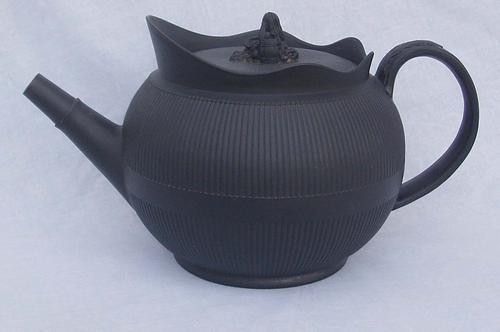
Wedgewood Style Black Basalt Teapot 1800 (bid or buy) 
Black Basalt is named after the volcanic rock, basalt, which was widely used at the time in the manufacture of vases, candlesticks and busts of historical figures. Wedgewood’s quest was partly inspired by the desire to emulate the Etruscan black pottery pieces called ‘buchero onto’ that were being excavated at Pompeii at the time and hence neo classically inspired. The range of goods was impressive, vases, lamps, ink stands, candlesticks, ewers (a vase shaped jug which is often decorated),  plaques and tableware. The  tea and coffee ware with its cups, milk jugs, tea pots and sugar bowls was the most popular.   Their capacity to withstand boiling water being poured directly  into them without cracking made them popular on two fronts function and design.

Black Basalt was a huge hit in its day, Wedgewood’s first major commercial success. In the height of its popularity in 1790-1800, selling out more quickly than it could be produced. After Wedgewood, many factories began to produce black basalt ware, notably Spode and Neale, some even copied his designs.

Monday, 2 July 2012

Mocha Ware 1792- 1850


Another type of pottery looking far more modern than the period it was made. Pretty common on the Thames foreshore, at least one piece being found on most mudlarking trips.
Mocha wear pottery shards found Mudlarking on the Thames 
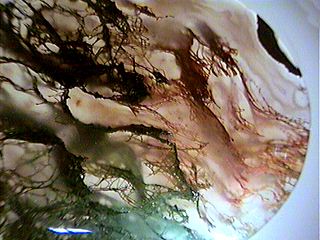
It took me a while to find this pottery on the internet and a while longer its name. It seems to be called ‘Mochaware’, a type of dipped ware decorated with slip. The feature which sets it apart  is clearly the fuzzy, blotting paper, sea weed like decorations. The technical name is ‘dentric’ (tree like or branching). They were thought to resemble the natural geological markings on moss agate known as ‘Mocha Stone’ (pictured below), imported from Arabia through the port of Mocha (al Mukha in Yemen) – hence the name. Apparently geological patterns were rather popular in this period.

Moss Agate (from theimage.com)
Mochaware was produced in potteries throughout Britain. It was the cheapest decorated ware available. I’ve read that most British production was exported, but clearly it was still a popular item in domestic market, in London at least. Usually used for kitchen ware, but also evidently chamber pots, one of only two images I can find of this type of mocha wear. 

Mocha wear chamber pot (from artistheanswer) 
Clearly a new technique, it was achieved by dripping a coloured acidic solution into wet alkaline slip. The colour would instantly disperse into the random dentric markings. The bodies were creamware or pearlwear, later heavier and thicker whiteware bodies were used.

The main type of mochaware I’ve found has been the yellow bodies with blue dentric markings. I’ve read this is also called ‘yellow wear’. I’ve found a few other bits of mocha which I’ll cover in a future post, hoping to pick up a few more examples on my mudlarking wanderings. 

Sunday, 17 June 2012

Debased Scratched Blue & White Stoneware 1765- 1795

I keep thinking I'm going to run out of things to blog about, but every week there seems to be another type of pottery or object to investigate. 

Over the last 8 months I’ve collected a handful of this stuff, gradually clocking it was different from the other blue and white china I’d been picking up. I kept it in my Westerwald pottery box,  realising it was similar but not quite the same. Took me a while to track down what it is, as there aren’t many pictures on the web, but persistence paid off.
 Debased Scratched Blue White Stoneware Pottery Shards Found Thames Mudlarking 
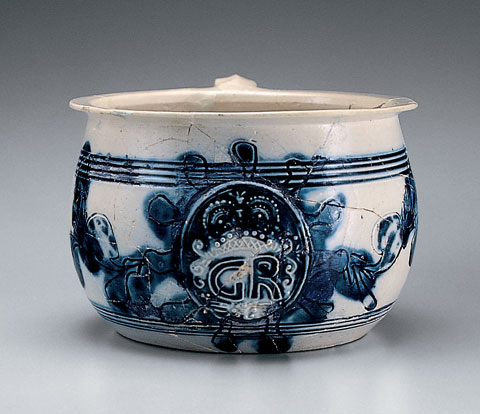
In the 18th century the not so well off found porcelain too expensive, delft ware too fragile. There was a market for cheaper alternatives; German Westerwald decorated grey stoneware filled part of this gap. Some say English potters sought to compete with these products by creating a similar looking but this time white stoneware, rather unfortunately retrospectively named ‘debased' scratched blue stoneware.  I’m yet again struck by the modern looking design of old pottery, in this case  free flowing, incised decoration with quite messy splashes of cobalt blue which bleed over the incised lines,  thus emulating Westerwald to some degree. The products seem to be quite limited, mugs, jugs and chamber pots.  Decorated with sprays of leaves (technical name apparently is foliate) amusingly the chamber pots frequently boasted  spig-moulded raised medallions with the cipher of George III and sometimes a picture of his  profile. Apparently this blue stoneware was only fashionable for  one decade from 1765, with chamber pots remaining popular for a longer period – I wonder why. This flash in the pan appearance doesn’t quite square with how frequently I find this stuff  which seems about as often as I find Westerwald– strange, maybe it was more of a must have or cheaper product hence its prevalence.
Chamber Pot Debased Scratch Blue White Stoneware (Colonial Williamsburg Foundation)


Georgian Debased Scratched Blue Mug (Denhams) 
Debased Scratched Blue Jug (ebay)

Sunday, 10 June 2012

Blue and Green 'Shell Edged' Pearlware 1780- 1840


Over the months I've noticed quite a few pieces of pottery with mainly blue but sometimes green crinkly edges. Eventually tracked down the name, once I have this the story is quite easy to piece together. I can’t better others descriptions of this pottery.

'Shell-edged decoration first appeared on creamwares. Later, shell-edge became the most common type of decoration found on pearlware. Colours applied to the rims were usually blue or green with red being less common. The earlier examples of the shell-edged decoration are generally well painted, with the brush strokes being drawn in from the edge, which creates a feathery appearance. In later examples (usually after 1800 or 1805), it was common to sweep the brush along the edge laterally, producing a stripe’ St Mary's University

Different brush strokes nicely illustrated in the photographs of my Thames mudlarking finds below, with the green piece showing the lazier more efficient edging ‘line’ and the blues showing the careful brushing downwards. You can see the bluish tinge in the ‘white’ attributable to the cobalt blue added to the glaze, so characteristic of Pearlware. 


Thames Mudlarking finds 'Shell Edged' Pearlware 1780- 1840
'The 18th century saw the development of a style of tableware, which combined handsome colour and smooth texture of plain Creamware with a moulded and often tinted edging, intended to draw the eye to the food being served. The most popular edging pattern proved to be one, which imitated the random yet rhythmic structure of a scallop shell and Shell Edge Ware produced in vast quantities by potteries throughout England. Inspired by original designs in Leeds Pottery’s 18th century pattern books this new range of Shell Edge dinnerware rekindles the spirit of the Age of Elegance'.world wide shopping


'Such wares were always termed simply 'edged' in potters' invoices and price lists. Next to plain undecorated creamware they were the cheapest items offered for sale and thus although very serviceable, tended to be purchased by consumers at the lower end of the income scale. They were cheap to make and cheap to buy. As time passed many variants of 'shell edge' developed, some with quite elaborately moulded borders'.The potteries

British shell-edged earthenware was produced and exported in such large volumes between 1780 and 1860 that it appears to have been used in almost every American household. In terms of quantity, being the least expensive English earthenware available with color decoration, shell-edged ware was in fact one of the most successful developments in ceramic production during the 18th and 19th centuries.

Enoch Wood’s Burslem pottery works shipped 262,000 pieces in a single consignment. The surviving invoices of American merchants are especially telling: shell-edged products accounted for 40-70% of dinnerware sold in America between 1800 and the eve of the Civil War in 1861, despite the introduction of a number of more fashionable styles during this period.Odyseey marine exploration 2011

Monday, 4 June 2012

Early English Plates: White Salt Glaze Stoneware, Creamware and Pearlware 1720- 1780

The history of English tableware is scattered across the Thames foreshore, something I’ve never been particularly interested in until I started wondering about the origins of the pottery I’d found.

As ever those modern looking ‘finds’ turn out to be quite old, so for anyone else interested in identifying pottery from the Thames and finding out about its history here goes..

In 1720 potters succeeded in producing the white pottery with a glossy sheen people had been hankering after. High stoneware kiln temperatures gave the kaolin clay durability. The first sets of matching tableware were produced and were far cheaper than porcelain alternatives. Less expensive plain white plates, sometimes with relief patterns were the most popular. They were considered very fashionable in their day.

Large amounts of the stuff was exported to the US and Europe, Staffordshire potters had begun an international industry. Whilst there was clear demand, the cost of producing stoneware prevented it from becoming widespread. Consequently potters sought to develop cheaper refined earthen wares.  Creamware was the first mass produced tableware from 1750. Iron oxide in the glaze gave it a yellow cream colour. Very functional, it was the first widely available ceramic that enabled you to cut food without chipping the glaze.  Again the centre of production was in Staffordshire (plus Yorkshire). Wedgewood came onto the scene in 1759 and although not the ‘inventor’, was at the forefront of developing both Creamware and Pearlware. Not satisfied with Creamware, Wedgewood’s letters reveal the search for ‘a white Earthenware body, and a colourless or white opaque glaze, very proper for Tea & other wares’, From 1775 Pearlware moved the industry one step closer. China clay was added to the creamware body and cobalt blue to the glaze, giving it a blue tint  and a whiter appearance– a blueing technique of course still used in our washing powders and clothes manufacture.


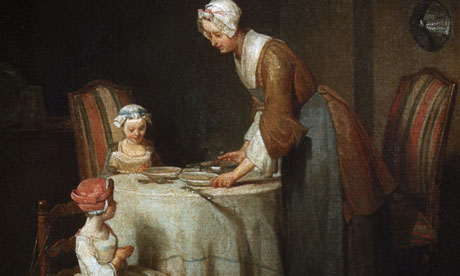
A detail from Grace at Table by Jean-Baptiste-Simeon Chardin (1740) Photograph: © Francis G. Mayer/CORBIS 

The introduction of the ceramic plates coincided with a change in table manners, I wonder if they were related?.  'The children learning their table etiquette in Chardin's 1740 painting are in the avant-garde of a cultural revolution. Cutlery, as opposed to eating with your fingers; sitting up straight in a high-backed chair; these were innovations in the way people defined themselves at table in 18th-century Europe'. (Jonathan Jones Guardian)
By 1750 white salt-glazed stoneware had caused the demise of the delftware industry and by 1760 the refined earthenwares, Creamware and Pearlware, were superceding white stoneware.

My initial impetus for returning to the Thames was to collect pottery for mosaic making, not something I’d ever done before I might add. Playing around with blue and white pottery, I soon realised that I’d need large amounts of white crockery to surround the interesting bits. A month ago I therefore collected a bag of white pottery, extremely abundant as I assume no one else bothers to pick this up. Now that I’ve found out a bit about the different types of ‘white’ pottery, I can see that virtually all the fragments I’d picked up were Creamware- which fits with its ubiquitousness. 

From the 1740s  block moulds were used, each imprinting one of several  standard patterns around the plate rim. I’ve found  a handful of these over the past 8 months. By far the most popular was the ‘barley’ or ‘basket’ design. My favourite is the feather pattern,  I haven’t yet spotted any of the  nicely named ‘dot, diaper and basket’.

Clockwise from top R, feather edge white stoneware salt-glaze, creamware, barley pearlware, barley white salt- glaze
When you see the different types of pottery side by side it’s easy to distinguish the creamware from the slightly grey stoneware. The two feather edged pieces illustrating this nicely above. I’ve found it quite hard to distinguish the White salt glaze stoneware from  Pearlware, eventually concluding the easiest way is to catch the salt glaze pitted ‘orange peel effect’ in the light. Although when together as the two barley pieces above show, you can see the pearlware does appear whiter than the stoneware. Apart from the blue and green ‘shell edged’ pottery, to be covered in the next post, I believe I’ve only found two  fragments of Pearlware, one shown below with rather crude enamel overglaze, the bluey tinge created by cobalt blue is really clear.

Thames Mudlarking: Close up of Pearlware Pottery Fragment with enamel overglaze  
Meanwhile my internet ordered box of mosaic materials sits in a corner whilst I'm preoccupied with classifying, sorting, researching, documenting and pondering my finds. Not to mention the still frequent trips to that intriguing river with all its secrets.  It’s going to take a while to get this mudlarking thing out of my system. 

Friday, 1 June 2012

Nails Found Mudlarking on the Thames

When I got home I laid out the bunch of nails,  I had this time bothered to pick up from the Thames foreshore, I was touched by their quirkiness and imperfect beauty.

Nails found Mudlarking on the Thames 
The pointy ones will have been made between 1700-1800. Each one will have been handmade by nailers or blacksmiths. Heating an iron rod, they would achieve the point by hammering each  side. The nail was then  inserted into an anvil or nail header and the top hammered into a head. ‘Roseheads’ a shallow tent like head with 4 panels were the most common, others were adorned with broad butterfly heads or  L heads.

Handmade Nail with Rosehead found Mudlarking on the Thames 
Nail making machines were  invented in the US at the end of the 18th century. Nails with no point, but a tapered sawn off end are not handmade, instead made in one of these machines.

By the first part of the 20th century most nails were made from steel and the process was fully mechanised. A more detailed description can be found at history of nails

As my good friend Maddy says, we tend to  take everything for granted, never considering how they are made, so removed from their manufacture. Gazing at these small objects, for a moment, offsets this 21st century mentality.

Saturday, 31 March 2012

Clay Pipes

Segments of pipe stems are so easy to find mudlarking on the Thames. Bowls are less common but you are certain to find at least one on any foreshore walk. They range in date from 1580 – early 1900s. They can be dated by the size and shape of the bowl and size of the hole in the stem. The older ones have smaller bowls as tobacco was originally very expensive. The finds I've kept are below, dated using a identification chart to scale. They were the fags of their day, came packed with tobacco, were smoked only a few times and then thrown away. 


Top row  1610-1710,  middle  1700 - 1800, bottom 1820-40 found Mudlarking on the Thames
Clay Pipe Smoking 1600's
Some older pipes have very ornate decoration. I'm still searching for one of these. The most ornate to date is a simple diagonal leaf pattern on the seam. 


Clay Pipe from 1820-40  with diagonal leaf pattern along seam


A Reuters Article reveals ‘ A Museum of London study of skeletal remains excavated from a Victorian cemetery in Whitechapel, east London, found most people had "notches" in at least two, and often four, front teeth made through the habitual holding of pipe stems. Osteological analysis of 268 adults buried between 1843 and 1854 found that some disfigurement had occurred in 92 percent of adults exhumed, while wear associated with habitual use of pipes was evident in 23 percent. "In many cases, a clear circular "hole' was evident when the upper and lower jaws were closed," said Donald Walker, human osteologist at Museum of London Archaeology Service. Males were affected far more frequently than females. The study, published to coincide with national No Smoking Day in Britain, also found a number of young adult skeletons had tell-tale notches, suggesting pipe-smoking may have begun in childhood.’ It wasn’t until 1881 when James Bonsack invented a cigarette rolling machine that pipes began to replaced.

Sunday, 25 March 2012

“Staffordshire” Combed Slipware. 1690- 1830


This was the first type of pottery I found on the Thames foreshore in 2010, I didn’t bother to pick it up, assuming it was Victorian or even more modern. A volunteer at a Thames Festival stall with ‘things found on the Thames’ to my astonishment notionally told me it was 300 years old. Since then other foreshore explorers have suggested they weren’t that old. I was delighted when I tracked down the pictures below, which confirmed the original lady was right, very satisfying to find the name of this pottery. This pottery is very common on the foreshore. I still find its bold, simple, rather modern bakewell tart design delightful. 


Fragments of Staffordshire Combed Slipware found on Thames Foreshore


The pieces are usually pretty chunky and apparently are earthenware with a clear lead glaze, with iron inclusions, which gives the white slip its yellowish colour. Most pieces are glazed on one side only. Whilst originating in Staffordshire, the pottery was produced in potteries across the Midlands, in Yorkshire and Bristol. 


Selection of combed effects 
 Several have been ‘coggled’ or ‘crimped’ to achieve a very uniform pie crust edge, 


Pie crust edge of combed slipware
The late 17th century saw the production of combware dishes and plates intended for poor to middle class kitchens and dining tables, as well as for use in taverns. The images I’ve tracked down to date show baking dishes. 
Baking dish
Baking dish from Victoria and Albert Museum ca. 1770-1830
 

Baking Dish from Christies late 18th century


I’ve also found a few marbled pieces, which are glazed on both sides, most likely from cups and bowls. I’ve read that combed and marbled designs tend to be more elaborate and fine-grained on early pieces than on later 18th century vessels.


Marbled slipware found on Thames Foreshore 


Cup from Victoria and Albert Museum ca. 1690