Showing posts with label Porcelain. Show all posts

Saturday, 16 February 2013

Chinese Export Porcelain 1556 - today

I think I can now deduce what shards are Chinese or Japanese porcelain. Their cross sections are dense like stoneware and very white. They don’t tend to stain, so despite being hundreds of years old look new. The blue and white decoration is slightly blurred, subdued and a lighter blue than transferware- a bit dreamy.
Mudlarking Finds: Chinese Export Porcelain with hand drawn flowers
Pretty common on the foreshore I can never pass them by and pick up 2-3 pieces on each visit.
These shards were usually hand painted with deceptively modern patterns. 
Mudlarking Finds: Dreamy porcelain
China was the first nation to discover the art of making porcelain possibly as early as 1300.
In the 16th Century Portugal began trading with China, importing Ming Dynasty blue and white porcelain, heralding the 300 year European love affair with porcelain. The Chinese began making porcelain specifically for the European market hence the term Chinese Export Porcelain and the first European port opened in Canton in 1556. Porcelain was a handy bit of cargo,  placed in the ships hulls it provided ballast and  was unaffected by water, allowing the more vulnerable silks, teas and furniture to be stored higher up.

In the early 1600s the Dutch captured two Portuguese ships laden with porcelain and other goods. The cargo was auctioned off, the buyers of this ‘white gold’ the European elite including the Kings of France and England. The Porcelain craze had begun – among those who could afford it. It is hard to imagine how wondrous it must have been. Nothing like it had been seen  before. The only pottery had been course earthenware. Chunky German stoneware was the  most refined. Westerwald wasn’t on the scene until the late 17th century and I believe delftware of this time was rather crude. These gleaming, smooth, white painted beauties began to replace the aristocracy's silver tableware.

Homage is paid in the 17th century Dutch still life paintings with Chinese export porcelain sometimes placed centre stage. 
Pieter Gerritsz van Roestraten  1627-1698 (It's About Time) 
England and Holland began trading with China themselves, with each country's East Indian Company playing pivotal roles. In the middle of the 17th Century, civil war in China caused trade to shift to Japan. Porcelain trade was re-established with China again in the late 17th Century.

There are a bewildering array of types, Kraak, Famile Vert, blanc de chine, famille rose and patterns canton, mandarin, rose medallion, encre de chine, Fizhugh and bird and butterfly, all associated with particular periods.
Kraak Porcelain Bowl  1573-1620 (Pater Gratia Oriental Art) 
Kraak Porcelain Saucer 1575 - 1615 (Pater Gratia Oriental Art)
Over time Chinese potters produced European forms and designs ewers, mugs, candlesticks, sugar bowls and milk jugs. Wooden models were sent so they could learn how to produce these unfamiliar objects. European motifs Christian imagery, heraldry, classic mythology were used.
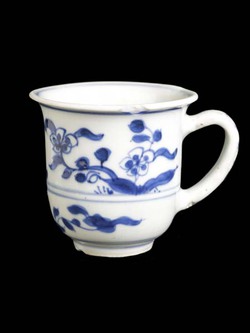
Chinese Export Porcelain Coffee Mug 1750 (Museum of London) 
1690 Porcelain Mug made for the English Market (Michael Pashby Antiques) 
By the late 18th century imports from china were declining as English ceramic innovation and mass production took over.  

Friday, 11 January 2013

Imari Porcelain

Over the last year I’ve collected six pieces of porcelain with lines etched in red. Looking closely you spot trails of paintbrushed gold. You can just see the gold line gliding through the middle of the branch below on the left shard.  The red and gold are over glazed and contrast strikingly with the chunkier splashes of under glazed cobalt blue.
Mudlarking Find: Imari Porcelain

Mudlarking Finds: Imari Porcelain shards


Surprisingly they could be 350 years old. Initially made in Arita, Japan  and exported from the port of Imari, between 1650 – 1750. There are many subcategories, the shards pictured above I suspect are Kinrande Imari.

Imari porcelain was exported by the Dutch East India Company and became popular when Chinese Porcelain was difficult to source due to the chaos at the end of the Ming Dynasty in 1644 and subsequently by the decision of the Qing Dynasty to cease trading between 1656-1684. Quite something to think these small fragments may have been carried by these enormous old, old ships below 
Dutch Ships 1685 by Isaac Sailmaker (National Maritime Museum)
Export from Japan ceased when China opened for business again, as Japan couldn’t compete with China’s low labour costs. China cashed in on the popularity of Imari in Europe and replicated the designs. This pattern is most common in export porcelain in the early Qing dynasty period from 1662-1722.  I've also read there was a surge in Imari imports into England in late 19th century when all things Japanese were in fashion. 
Chinese Imari Tea Caddy (Antiques now) 

Chinese Imari Style (Aspire Auctions)

Friday, 21 December 2012

Worcester Porcelain – Dr Wall Period 1751-1783

I had a few moments before I had to leave. The lapping low tide was intermittently granting access to a mud plateau littered with white ceramic shards. Most were undecorated creamware but  a few patterned pieces caught my eye, which I quickly scooped up. Later I noticed two displayed hatched crescent marks– a lead just too tempting to resist, so onto google images. It took no time to work out they originated from the first period of Worcester Porcelain Factory, referred to as ‘Dr Wall’. One very similar to the bottom of the coffee mug (rosecroft antiques) pictured below, but now they are adjacent, I suspect mine is from a tea bowl or cup. 
Mudlarking Finds: Worcester Hatched Crescent
Worcester coffee Mug & Saucer 1780


Worcester Hatched Crescent
Whilst I'd heard of Worcester, no idea where is was - England’s West Midlands and in the 1750s home to the impressive Dr Wall. A doctor, founder of Worcester Royal Infirmary, champion of Malvern water and such a talented artist David Garrick jumped on chairs at Wall’s home to get a closer look at his paintings. In 1751 Dr Wall persuaded a group of 13 business men to pump prime the Worcester Porcelain Factory, a precursor of Royal Worcester and key player in the history of ceramics.

Dr Wall artist unknown (BBC) 
Porcelain had been produced in China since 200 and imported to Britain in large quantities from 16th century. It took until 1710 for Europeans to master the art of production in Meissan Germany. The race was on to develop  British porcelain. It’s said that Dr Wall and apothecary William Davis experimented at Davis shop and discovered a way to make soft paste porcelain, later bringing additional technical expertise by  purchased their rival Benjamin Lund’s Bristol porcelain business in 1752. Securing a supply of soapstone from Cornwall clinched their success. When added to the mix soapstone rendered the finished product heat resistant -  other porcelain cracked on contact with hot water. Business canny and continuing to aim for best in class in 1756 they secured the services of Robert Hancock arguably the most talented copper plate engraver of his time.
Their target was the middle market. Products were tea and table wares. In 1754 they accessed the London market via a warehouse in Aldergate Street and large quantities of Worcester products were decorated in London by James Giles. Initially designs were hand painted. It is claimed Worcester were the first to introduce transfer printing to porcelain and from the 1770s most of their designs were transfer printed. Decorated in blue and white with Chinese and Japanese themes and from the mid 1750s with flowers in the flowing German style popular at this time.  They also produced more expensive coloured enamelled sets. They became the largest producer of blue and white Porcelain, so many of the porcelain shards found on the foreshore must originate from this company. 
I wonder if the other porcelain shards I found nearby are Worcester? German flowing flower style?
Mudlarking Finds: Porcelain Shards - Worcester?


Pattern on reverse of one shard


For some time I've wanted to match designs on my mudlarking fragments to their original patterns and even better linking these to developments in design over the centuries. Apart from the willow pattern up until now I’ve had no success. This time to my delight I thought I’d found the remains of the parrot pecking fruit design, associated with the aforementioned Robert Hancock, this shard has the hatched crescent on its reverse. Sadly on a closer look it's not an exact match, which wiped the very pleased with myself expression off my face. 
Mudlarking Find: Worcester Porcelain not the Parrot Eating Fruit Pattern

Parrot Pecking Fruit Pattern Worcester Mug 1775 (Steppes Hill Farm) 

Update
Ha, found it, the shard above (albeit upside down)  is from the 'fruit sprig' pattern, pic below - smug again. 

Worcester mug  with the “ Fruit Sprigs” pattern Circa 1770 (cathcartsantiques.com)

Saturday, 13 October 2012

Tea Ware

Dedicated to Norma, queen of teakies.

Tea first introduced to London in the mid 17th century created demand for affordable, refined heat resistant cups and other equipment worthy of this expensive brew. Initially small handless Chinese porcelain tea bowls were imported.
In 1700 large saucers appeared. Some poured their drink into the saucers allowing the tea to cool and drank directly from these.  

Pieter Gerritsz Van Roestraeten. Chinese Tea Bowls, 17th century (on familiar things)

Fashionable family sitting around a tea table 1727 Richard Collins (V&A) 

The tea bowls I came across at my recent trip to the V&A were so much smaller than I’d imagined, due to the exorbitant cost of tea I suspect.
17th Century Chinese Export Porcelain Tea Bowl. 
In 1750 Robert Adams inspired porcelain tea sets in which tea cups had handles. Adams tea cups were taller than their base and came with a saucer – there began the English tea service set – with matching tea pot, sugar bowl, milk jug and even tea spoons. The English welcomed the handle having found the tea bowls rather messy and liable to burn their hands.

Throughout the 18th and 19th centuries demand for new and cheaper teaware grew apace, driven by the growing fashion of tea drinking. We see the rise and fall of several types of ceramic. Europeans began to produce their own version of porcelain. The first success in England was at the Chelsea Porcelain Manufactory in 1743- 5. In the 1750s Wedgwood perfected the production of fine stoneware ‘black basalt ware’, popular for around 50 years.  Stoneware is water proof, so no glaze was required.  The 1770s brought Wedgwoods’s refined red stoneware Rosso antico,  affordable cream ware, shortly followed by pearlware.
Bone china was developed in England in the 1800s, by Joseph Spode, another name which keeps popping up. It was lighter and cheaper than porcelain and apparently better at carrying bright colours. It became and remains the posh tea cup of choice. 


1820 Spode London shape ( from spode history blog)


I’ve found a number of shards with small circular ‘stands’ , sometimes with a tiny design in the base. I suspect these are the bases of tea bowls, two I think are pearlware because of their bluish tint, the other porcelain.


Mudlarking Finds: Pearlware and Porcelain Tea Bowl Bases

Mudlarking Finds:Tea Bowl Bases
Occasionally I find the shallow curve of what I assume are saucers. The two with transfer ware I suspect are creamware the older middle hand painted example pearlware.


Mudlarking Finds: Saucer Fragments
This last group of fragments I’m guessing are also from saucers. In each case the middle of the base. This time their design is not so ‘tiny in the middle’. Each has a stand beneath, the curve of which is shallower than the tea bowls. A mixture of pearlware and porcelain.


Mudlarking finds: Pearlware and Porcelain Saucer Fragments