Showing posts with label Tableware. Show all posts

Friday, 16 November 2012

Transferware


The Thames foreshore is littered with transferware. I just assumed they were all Victorian but of course many are much older, dating to Georgian times. A stepped change in the development of ceramics, it was a new industrialised process. Eventually transferware was far cheaper to produce than hand painted goods, allowing the middle classes to purchase matching full dinner services to grace their dining tables and wash sets for their bedrooms, with matching basin and ewer, a cup for brushing teeth, soap dish, sponge dish, and a chamber pot.

Some claim John Sadler and Guy Green in Liverpool invented transferware, others Ravenet and Hancock at the York House Battersea factory in 1756. Patterns or pictures were etched onto copper plates, these were inked up and the image was transferred to a special tissue. The tissue was placed on a bisque fired ceramic object  thus transferring the print. It  was removed before more glaze was applied, the object was then fired again. 

There are two types of transferware pattern, the most common are those with a border design and a separate picture in the middle of the plate. The amount of white space between them varied with fashion over the decades. The second type used sheet patterns which covered the whole object. Marble patterns were popular in the 1800s and between 1860 – 1900 floral patterns.
Mudlarking Find: Transferware border design & middle picture
Mudlarking Find: Sheet Transferware - marbled pattern?
The early transfers were fixed on top of the glaze (overglazed) as the earthenware bodies available could not withstand the high kiln temperatures required. 

In the 1760s the Caughley factory in Shropshire produced underglaze printing. Joseph Spode and Wedgwood further developed this technique at their potteries in Staffordshire. This area became associated with this new product and indeed became known as 'the potteries' . Its production heralded the start of the industrial revolution. Churned out in such vast quantities it was one reason why woollen cloth was knocked off the top of England’s export list. America was its primary overseas destination contributing to mainland Europe no longer being the main recipient of England’s goods.

Patterns were initially printed in just one colour. Tricky to find out exactly when different colours were introduced as information out there is contradictory. The most common on the foreshore is unsurprisingly blue which some claim was the only  colour until 1809 and then continued to dominate with dark navy blue being introduced in 1818, developed by Enoch Wood. I have to confess to accumulating a rather large mound of this stuff, not all of it displayed below. 


Green apparently was  used from 1828 and green is certainly the second most common find.

Mudlarking Finds: Green Transferware from 1829
Wedgwood began using brown printing on a cream background in 1835, although I've read brown was first used in 1809. The two brown rim pieces which I realised slotted together were found 5 months apart – I like that. Brown seems to be the third most common find.
Mudlarking Find: Brown Transferware from 1809
Other colours appeared after 1830, English pink, purple, mulberry, yellow and sepia. All of which are less common on the foreshore. Can’t work out when they starting producing transferwares in black, but they too are far and few between. 
There seem to be two ways of identifying whether a piece of pottery is transferware rather than handpainted. Sometimes if you look closely you can seen the small dots that make up the pattern. Secondly the designs tend to be far more intricate and detailed. However, I still have a few pieces where I'm flummoxed.

Sunday, 10 June 2012

Blue and Green 'Shell Edged' Pearlware 1780- 1840


Over the months I've noticed quite a few pieces of pottery with mainly blue but sometimes green crinkly edges. Eventually tracked down the name, once I have this the story is quite easy to piece together. I can’t better others descriptions of this pottery.

'Shell-edged decoration first appeared on creamwares. Later, shell-edge became the most common type of decoration found on pearlware. Colours applied to the rims were usually blue or green with red being less common. The earlier examples of the shell-edged decoration are generally well painted, with the brush strokes being drawn in from the edge, which creates a feathery appearance. In later examples (usually after 1800 or 1805), it was common to sweep the brush along the edge laterally, producing a stripe’ St Mary's University

Different brush strokes nicely illustrated in the photographs of my Thames mudlarking finds below, with the green piece showing the lazier more efficient edging ‘line’ and the blues showing the careful brushing downwards. You can see the bluish tinge in the ‘white’ attributable to the cobalt blue added to the glaze, so characteristic of Pearlware. 


Thames Mudlarking finds 'Shell Edged' Pearlware 1780- 1840
'The 18th century saw the development of a style of tableware, which combined handsome colour and smooth texture of plain Creamware with a moulded and often tinted edging, intended to draw the eye to the food being served. The most popular edging pattern proved to be one, which imitated the random yet rhythmic structure of a scallop shell and Shell Edge Ware produced in vast quantities by potteries throughout England. Inspired by original designs in Leeds Pottery’s 18th century pattern books this new range of Shell Edge dinnerware rekindles the spirit of the Age of Elegance'.world wide shopping


'Such wares were always termed simply 'edged' in potters' invoices and price lists. Next to plain undecorated creamware they were the cheapest items offered for sale and thus although very serviceable, tended to be purchased by consumers at the lower end of the income scale. They were cheap to make and cheap to buy. As time passed many variants of 'shell edge' developed, some with quite elaborately moulded borders'.The potteries

British shell-edged earthenware was produced and exported in such large volumes between 1780 and 1860 that it appears to have been used in almost every American household. In terms of quantity, being the least expensive English earthenware available with color decoration, shell-edged ware was in fact one of the most successful developments in ceramic production during the 18th and 19th centuries.

Enoch Wood’s Burslem pottery works shipped 262,000 pieces in a single consignment. The surviving invoices of American merchants are especially telling: shell-edged products accounted for 40-70% of dinnerware sold in America between 1800 and the eve of the Civil War in 1861, despite the introduction of a number of more fashionable styles during this period.Odyseey marine exploration 2011

Sunday, 6 May 2012

Porringer or Bleeding Bowl Handle

To break up the rather dowdy browns and buff colours of the pots and storage jars, here’s a delftware handle of a porringer or possibly a blood bowl.  I had  to look up  ‘porringer’. It is, as it sounds, a bowl for porridge or other sloppy food you’d eat with a spoon. They had single handles and were often used for heating food. 
Delft Porringer or Bleeding Bowl Handle found Mudlarking on the Thames London 

Delft porringer or bleeding bowl,  1765 from Christie's

Saturday, 21 April 2012

Beautiful Delftware

Delftware is my favourite pottery find, perhaps because it is so old, 1560-1750 yet its hand painted designs are so vibrant, bold and modern, similar to the Spanish and Portuguese pottery seen on holiday. Several pieces I've found are also quite quirky. The unfamiliar, poetic names of the original objects enthrall, puzzle jugs, fuddling cups, bleeding bowls, porringers, flower bricks, posset-pots, blue chargers, drug jars.


A favourite find, delftware pottery approx 4cm with childlike design 


Tin glazed dish  1571-1800  Museum of London 
Delftware was first produced in London from 1571 by two Antwerp potters, Jacob Jansen and Japser Andries, who opened a pottery at Aldgate. During the 17th century several potteries were established close to the Thames in Southwark (in the wonderfully named Pickleherring Quay) , Lambeth, Vauxhall and  Rotherhithe and later at Putney and Wapping. The best delft descriptions I've found are from  Judith Miller, antiques expert, author and TV presenter, so many direct quotes from her,

‘Delftware is a type of earthenware characterised by its opaque white enamel glaze, made from a mixture of tin and lead ash, powdered glass and water.Before the development of this revolutionary enamel, British potters had been severely restricted in terms of decoration by the drab browns and greens of the clays they used. The clean white finish of Delftware allowed them to paint patterns, landscapes and portraits for the first time.They painted their naive designs in bright colours derived from various minerals - cobalt blue was the most widely employed, although copper green, manganese purple, iron red and antimony yellow were also used.’ 

Polychrome delftware shards found mudlarking on Thames foreshore 

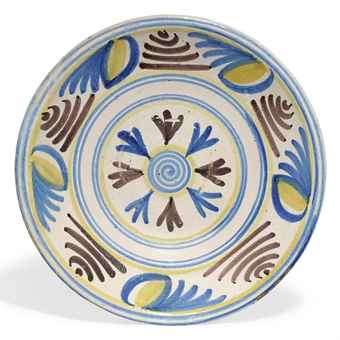
English Delft Polychrome Dish 1675-1700, Christies
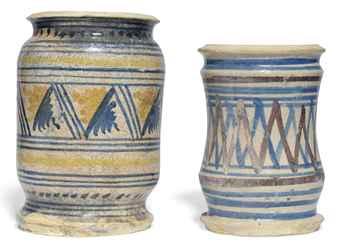
Drug jars, wine bottles, and ointment pots were typically produced in the 17th century 

Delft Drug Jars Early 17th Century, Christies


Delftware, some with manganese purple found mudlarking on Thames foreshore 
In the 18th century tea bowls, pots, cups and saucers were made. They were the possessions of the middle classes, status symbols, shown off in the best rooms rather than kept in the kitchen. 

In the latter part of the 18th century, Josiah Wedgwood promoted his more industrially produced tableware, which chipped less easily and was decorated in the new classical style, the public responded eagerly and delftware went out of production by the early 19th century.

Sunday, 25 March 2012

“Staffordshire” Combed Slipware. 1690- 1830


This was the first type of pottery I found on the Thames foreshore in 2010, I didn’t bother to pick it up, assuming it was Victorian or even more modern. A volunteer at a Thames Festival stall with ‘things found on the Thames’ to my astonishment notionally told me it was 300 years old. Since then other foreshore explorers have suggested they weren’t that old. I was delighted when I tracked down the pictures below, which confirmed the original lady was right, very satisfying to find the name of this pottery. This pottery is very common on the foreshore. I still find its bold, simple, rather modern bakewell tart design delightful. 


Fragments of Staffordshire Combed Slipware found on Thames Foreshore


The pieces are usually pretty chunky and apparently are earthenware with a clear lead glaze, with iron inclusions, which gives the white slip its yellowish colour. Most pieces are glazed on one side only. Whilst originating in Staffordshire, the pottery was produced in potteries across the Midlands, in Yorkshire and Bristol. 


Selection of combed effects 
 Several have been ‘coggled’ or ‘crimped’ to achieve a very uniform pie crust edge, 


Pie crust edge of combed slipware
The late 17th century saw the production of combware dishes and plates intended for poor to middle class kitchens and dining tables, as well as for use in taverns. The images I’ve tracked down to date show baking dishes. 
Baking dish
Baking dish from Victoria and Albert Museum ca. 1770-1830
 

Baking Dish from Christies late 18th century


I’ve also found a few marbled pieces, which are glazed on both sides, most likely from cups and bowls. I’ve read that combed and marbled designs tend to be more elaborate and fine-grained on early pieces than on later 18th century vessels.


Marbled slipware found on Thames Foreshore 


Cup from Victoria and Albert Museum ca. 1690


Saturday, 24 March 2012

Willow Pattern Fragments

Willow Pattern 1780- present. 
The Willow Pattern was first produced in 1780-90, from Thomas Turners Factory in Shropshire from an engraving by Thomas Minton or from Josiah Spode’s factory in Staffordshire.

It combined elements from standard Chinese designs, willow tree hanging over three figures on a bridge, fence, bridge , boat, the pagoda teahouse with orange tree, island and two birds. The design was popular and copied by other factories.

In 1849, the willow pattern became associated with the tale first published in ‘The Family Friend’. English in origin it had no links to China, but captured the public imagination for the next hundred years.

I’m not adept enough to identify which shards are from willow patterns, but have clustered found elements from Thames foreshore over the last 5 months, which look as though they originate from this design. 
A Mandarin, grown fat and rich from bribes in his duties as a customs officer for the Emperor, planned an alliance between his beautiful young daughter and an old but wealthy aristocrat. On discovering his daughter was in love with his secretary, Chang, the son of a poor fisherman, the Mandarin flew into a rage and locked Koong-se inside a small house,


 surrounded by a fence to prevent the lovers from continuing their association.

As is the way with all romances, at least in fiction, love finds a way and the lovers met in secret to make their plans – on the day appointed, they began their escape, sheltering in a gardener's cottage temporarily until their absence was discovered. Recovering his wits, Chang leads Koong-seout through a back door and they cautiously make their way across the bridge,


but are spotted by the Mandarin who gives chase. Reaching the other side, the lovers make use of a small rowing boat to attempt to cross the waters and reach refuge on a small island. But the Mandarin and his household are gaining on them, in faster boats propelled by stronger oarsmen. Seeing their desperate plight, the gods take pity on the young people and turn them into birds who soar away to freedom(from http://ruby-lane.hubpages.com/hub/Willow-Pattern-Pottery-These-Lovers-Flew-Away)

Segments of orange trees

 and willow trees & the only bit of boat I’ve found.


Full willow pattern (Photo from http://www.teapartydiva.com/willow-pattern-china-history/)