Showing posts with label 17th Century. Show all posts

Saturday, 3 May 2014

Martincamp Ceramic Flasks

This broken bit of pottery has been on the blog before, but it wasn't until the finds id session organised by Thames Discovery earlier this year that I finally found out what it was. Nigel Jeffries from the Museum of London Archaeology immediately recognised it as the neck of a Martincamp flask, amusingly Nathalie Cohen from Thames Discovery captured the moment here., with Nigel animated in his enthusiasm and me all eyes and ears and geekily taking notes! 
Mudlarking Find: Stoneware Martincamp Flask
This stuff is named after the village of Martincamp in Normandy France, although it’s thought these vessels were produced across a larger area in northern France, allegedly just for export. Unsurprisingly it's a type of 'Normandy Stoneware'. 

The won’t stand up flask was made on a potter’s wheel. The neck was made separately and then attached over the crudely made hole in the flask as seen below, which I'd always been a bit perplexed by. 


The internal messiness is rather at odds with the rather polished outward appearance. 

Stoneware Martincamp Flask 1501-1600 (Museum of London) 
The flasks would have been covered in a wicker casing, similar to the bottle in Lubin Baugin's painting below ca. 1610–1663. Apparently they were used as water bottles by field workers and soldiers, slung over their backs using a strap attached to the wicker. It's surmised that a wicker base would have enabled the bottle to stand up. I wonder if the roundness of the bottle made it stronger, like an egg. At the very least a nifty design with no easily bashable edges and wicker padding to boot. They were also much cheaper than glass. 

Le Dessert de Gaufreetes, Lubin Baugin, ca. 1610–1663 (Louvre)

One of the 'signs' of a Martincamp canteen is the rings around the neck. Are these really caused by the imprint of the wicker or are they the potters throwing rings? As I finally cleared away my finds, which had crept onto every surface in the shed, I spotted what looked like another neck of a Martincamp flask, this time earthenware. Still, I suspect if not rare they are a fairly uncommon find along the Thames - but perhaps I'm wrong?

Mudlarking finds:  Martincamp Flask Necks 
There are apparently three diabetes type categories for these vessels (John Hurst 1986)

  • 1475-1500 off white fabric often with buff surfaces and a flattened profile (Type I) 
  • 1500- 1600 dark brown stoneware with a more globular form with one side slightly flattered and the other side breast shaped (Type II) 
  • 1600-1700 earthenware usually a low fired orange colour, but can be fired to near stoneware and appear reddish orange. (Type III)
1501-1600 (Museum of London) 

So my type II from the beginning of the post was knocking around when London looked like this, 
Anton van den Wyngaerde 1543

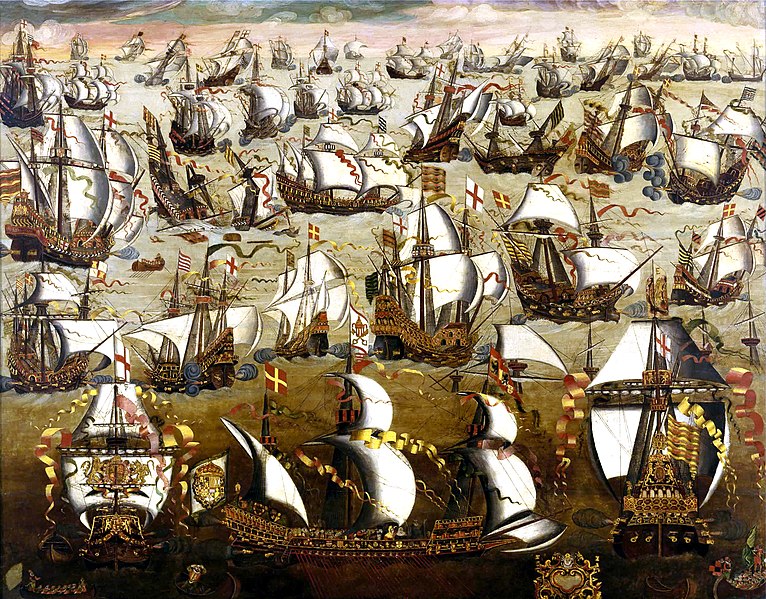
the century when England was ruled by our most famous Monarchs Henry VIII and Elizabeth I, the time of Shakespeare, the Spanish armada, and when potatoes came to Britain. It was the period when London became established as a great port which was accompanied by a trebling of the London population from 60,000 in 1500 to 190,000 in 1600, the average size of a London borough today. 


Spanish Armada and English ships in August 1588, by unknown painter (English School, 16th century) Wiki

Friday, 20 July 2012

Sgraffito Slipware

The fabulous name of this slipware warrants a posting all of its own. For the uninitiated like me, sgraffito involves scratching through a layer of coloured slip to reveal the different colour of the  pottery underneath. Very rare on the Thames foreshore, to date I’ve only found one example – nice though as the lines are so obviously etched by a human hand. Tom, mudlarker from Florida recently showed me a lovely example he’d found on his most recent trip to the UK.
Thames Mudlarking: Sgraffito Medieval shard
In the late 17th century, this type of slipware was produced in North Devon. another attempt to produce more decorative items a long with Westerwald stoneware and metropolitan slipware setting them apart from the crude eathernwares in most ordinary households. 

Update: I've recently found out that this is probably Cambridgeshire Sgraffito ware, made between 1400-1500, the body was covered with white clay. After scratching the whole object was covered in a pale yellow glaze,  when fired the body turned red -  fits the bill think. Amazingly 500-600 years old. 

Sunday, 15 July 2012

'Dot' Slip Ware 1670-1795

The official cute nick name of this pottery secures these rare mudlarking finds a separate post. The dots apparently were often applied to rims and necks and could be light or dark. 


Thames Mudlarking 'Dot' Slipware Pottery Shards
In the first half of the 17th century it was produced in Wrotham in Kent and in London and then Staffordshire until end of the 18th century. 


Staffordshire Slipware Posset Cup 1670-1795 (Museum of London) 

Staffordshire Type Red Slipware Posset Pot 1781-1800 (Museum of London ) 

Friday, 13 July 2012

Metropolitan slipware 1630 -1700

Slipware is essentially a type of decoration, a runny fine clay mixture is applied to clay either by painting, splashing or dripping, once it is leather hard. Sometimes the rather fabulously termed engobe (a white or coloured slip) is applied. The most common slip technique was slip-trailing, in which patterns were drawn by dripping slip through a cow’s horn or similar device. 

‘In the London area, slip-decorated pottery was used from the 16th century onwards, inheriting a tradition for using decoratively slips of different colours that has its origins in the 12th century. The products of local potteries and imported wares from as far away as Devon, Somerset, the Midlands, the Netherlands, Germany and Italy all found a place in the London market, where they provided some of the most attractive and affordable, decorated household ceramics available between the 16th and 18th centuries.’ (Museum of London)

I spot a piece of slipware on every trip to the Thames foreshore. As I laid out the slipware I’d collected, the one type I thought I had suddenly transmuted into a confusing multitude. I’d previously identified the bakewell tart lookalike Staffordshire combed slipware 1680- 1770  and marbled ware, these are quite straight forward , kept in a separate box and covered in a previous post.

Both groups looks very old. One set is dark brown almost black from afar with rather attractive raised trails of cream slip, often partially worn, I presume by the Thames. The clay bodies are brick red. The two lower dark brown pieces differ in three respects, the white slip, colour of the clay in one case white the other pinkie and the glaze only covers the top.
Mudlarking on the Thames: Slipware pottery finds
The next lot have an orangey red clay body. The background is  lighter brown,  the trailed slip appears more yellowy and the slip is different in style.

The brown I’ve discovered is a brown ‘ground’ formed by applying a slip over the clay. I’m assuming a number of these pieces are 300-400 years old Metropolitan slipware, the most common slipware in London it was produced  17 miles away in Harlow Essex. London was the obvious market, hence the name, mainly trailed white slip under a thick glossy clear glaze, which renders the white yellow. Clay with a high iron content varied in colour from light brown to bright red orange to darker red brown, with some thicker forms having a grey core. Some say only clear glaze was used, others suggest it could also be a ginger brown. Apparently it rarely extended over rim edge. The original objects were mugs, cups, candlesticks, chamber pots, salts and chaffing dishes. Vessels were wheel thrown, with heavy knife-trimming often apparent on open forms such as dishes.
Metropolitan Slipware Mug (Museum of London)
Metropolitan Slipware Dish 1630- 1700 (Museum of London) 


Alternatively one or both collections may in fact be London redware with major industries around Woolwhich and Deptford from late 17th – 18th  centuries. I’ve also read slipware was produced in Wrotham Kent.

Monday, 28 May 2012

Westerwald Stoneware Pottery


Whilst I love the really old finds, I’m getting a bit fed up again of all the browns on the blog, so time for some pretties.

Over the last 8 months I’ve amassed a small collection of Westerwald pottery shards. Whilst they are less prevalent than Tudor green glaze,  blue and white china, slipware or even delft, I usually spot a piece of Westerwald on each visit to the Thames.

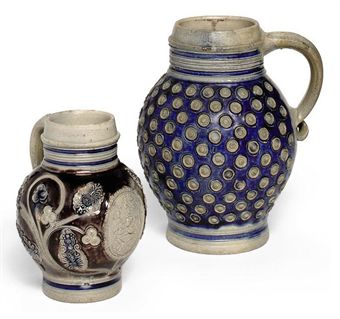
The most pleasing finds have relief or incised decoration, impressed circular flower heads, medallions, coats of arms, hand drawn zig zags and outlines highlighting  what appear to be petals or leaves. The modern appearing shiny cobalt blue glaze, often against a grey background, belies their age. One find has manganese purple alongside the blue, a rare find. Apparently this colour was only used between 1650 – 1680 and again briefly in the final quarter of the 19th century. Cobalt blue and manganese were the only two colours which could withstand the extreme temperatures required in stoneware kilns.  

Westerwald Stoneware Pottery Fragments Found Mudlarking on the Thames 

Westerwald Stoneware Jugs 1700 Christies 

More common are larger shards from the rims of tankards, with their distinctive lines of cobalt blue amid a series of circular raised tracks.

Westerwald Pottery Shards from tankards found Mudlarking on the Thames

18th Century Westerwald Stoneware Winebottle and salt glazed mugs from Reeham and Dansie auctioneers

Westwerwald is a region of Germany east of the Rhine, where the stoneware pottery industry was well established at end of the 16th century. Its golden age was in the 17th century and remained buoyant in the 18th and 19th centuries.

Jugs, tankards, mugs and chamber pots were the primary products, particularly popular between 1675-1775 and imported to London in great quantities until the end of the 19th century.  So best guess is that these shards are from between 1675- 1900 – a  rather irritatingly wide range.
Westerwald pottery shard from Thames Foreshore

Monday, 14 May 2012

Pins found Mudlarking on the Thames.

Mudlarking, for me, has essentially been beach combing, wandering along the banks of the Thames, looking at the ground for things that catch my eye. I’ve wondered for while, what I’d find if I just sat down and looked closely at one patch. Last Friday I did just that, as I waited for my sister to join me.  I chose a slightly more muddy section, where erosion was uncovering pottery fragments from their centuries old resting place.  

I’ve been rather amused that my mudlarking to date has been quite’ gendered’, no digging or getting dirty for me. Only finding and probably looking for pottery, quintessential domestic remains. The boys on the foreshore invariably have their detectors, I assume metal their primary interest, coins, tokens, buttons, keys, buckles, musket balls, canon balls and badges.

Scanning my selected patch  I found my first metal find – pins – a wry smile about their domestic origins. I’d seen the guys on Mudmen uncovering pins on the foreshore, so I was half looking for these and there they were, not exactly in their hundreds but quite numerous.

17th ? Century Pins found Mudlarking on the Thames Foreshore
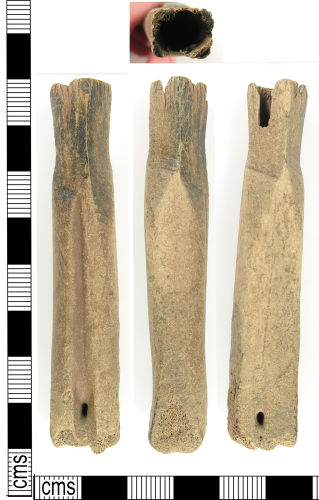
Amazingly old, web searches suggest pins found on the Thames foreshore are from the 14th – 17th centuries. Incredibly they were all handmade as pin machines weren’t in use until the early 19th century. The  main body, the ‘shank’, was usually  made of thin brass wire. The pins heads  made separately from a spiral of thinner brass gauge, affixed to the shank and then dipped into molten lead/tin  to solder. Longitudinal grooves in a pinner’s bone, held the shafts whilst they were being filed to a point.

16th Century Pinner's Bone  with grooves at top where pins were laid for sharpening, from Portable Antiquities Scheme
Pins were used to hold clothes in place and used extensively in ruffs, skirts, veils and partlets. They were  expensive. A 1563 warrant gives the prices ‘lviij m [58,000] small velvet and hed pynnes at xx d [20 pence] m [per 1,000]’.  The industry was deemed so important that in 1483 Parliament passed a law prohibiting imports. In the next century they were imported in large quantities from France until John Tilsby established his Gloucestershire business, employing over 1,500 people. London pin makers formed their own corporation in 1636.

Ordinary people would have a small number of pins, the wealthy thousands. Janet Arnold documents the pin purchases from Elizabetht I over 6 months
"Item to Roberts Careles our Pynner for xviij [18] thousand great verthingale Pynnes xx [20] thowsand great Velvet Pynnes and nyne thowsande smale hed Pynnes and xix [19] thowsand Small hed Pynnes all of our great warderobe"

Pins were carefully looked after and sharpened periodically. They were extracted after use so as not to tarnish the fabric and placed in a pincushion. The portrait of Countess of Southampton shows her pincushion on  the dressing table.


Countess of Southampton's Dressing Table with Pin Cushion 1590. From It's About Time

Saturday, 12 May 2012

Potters Leaving their Mark: Stamped patterns.

These  fragments somehow look less old, neater, more sophisticated. I suspect they are from the 17th or 18th centuries.  I haven’t been able to locate many similar objects on the web. All redware, they may have been made at the potteries near the Woolwich Ferry or Deptford in South London, which operated from the late 16th century to the 18th century.

The first is a whopper of a thing, 31 cm long. A rather lovely, presumably stamped, line of repeated leaves and either acorn or flower bud runs under the pot rim. As my colleague Pat observed, this pot or storage container must have been huge as the curve is fairly shallow. A rather handsome, thick, mottled brown glaze covers the reverse.


Large section of Pot Rim found Mudlarking on Thames Foreshore London 
A similar glaze is found on the second wheel made find. I’ve located a similar fragment, South Somerset ware 1700-1800, on the net. 

18th ? Century Pot Rim found Mudlarking on Thames Foreshore
The last find is again wheel made, not stamped but rather finely made with a pie crust edge, carefully glazed on the inside rim with a rather professional looking wavy pattern on the exterior. Now what is that 'bit of thing' just to right of curvy pattern? Same 'thing' is captured in clay on rim far left above. 
Redware Pot Rim found Mudlarking on Thames London

Sunday, 29 April 2012

Potters Leaving their Mark: Thumb Marks

Recently, mudlarking on the Thames, I purposely sought out pottery where hands have left their mark. Poignant reminders of their makers. Impressions left by the maker’s thumbs, whether part of shaping the object, fixing a handle to the main body or in decoration have to be the most moving of all. 
Fragment of Medieval? Pot Found Mudlarking on Thames Foreshore
When following the potter’s decorative thumb mark on the piece above yesterday, I noticed clear finger prints captured in the clay, at the top of the indentations.

Close up of thumb marks on Medieval? Pot, showing finger prints. 
Perhaps a bit of a rushed job, the shapes are not quite as uniform as they are on the second  and third sherds below.  All I suspect  are  from the rims of storage jars, all have traces of glaze.   The curves on two are very shallow, they must have been enormous. My uneducated guess is the first is hand formed red ware made between 1250-1450. The second  and third are both wheel made, the second perhaps redware from 1600-1700,  quite possibly made in London as the redware industry was firmly established in London from end of 15th Century. The third could be Surrey whiteware made between 1240-1500.  

Sections of Pot Redware and White Ware Pot Rims found Mudlarking on the Thames 
Just now I noticed what could be 500+ year old finger prints on the reverse of the whiteware. The potter must have held the inside of the wet pot whilst they created the indentations on the outside, magic. Double click on the photo for a better view. 

Close up of border whiteware sherd, showing  potter's finger prints. 
The last example is a tree trunk of a handle base, decoratively attached to the body of a cooking pot with confident thumb presses.  Are the blackened areas the remains of the fires that cooked countless meals?

The base of a redware cooking pot handle found on the Thames Foreshore
I prefer not to dwell on the hours I’ve spent googling trying to identify these finds, with only partial success. Clearly something best  left to the experts and my up and coming visit to the Museum of London’s Finds Officer. Meanwhile,  I’ll  continue with this series of posts, it’ll be interesting to see if I get any of this right. 

Sunday, 8 April 2012

Pipkin

Sounds like it should be a character from a children’s book and on googling found out it’s the name of  a kids TV programme.  I had never heard of a pipkin until I was browsing through the Museum of London’s online catalogue and matched a find. A pipkin is an earthen ware cooking pot with three legs and at least one handle. Glaze is usually only found in the interior and can be clear (showing yellow) or less commonly green. Late 1500s and 1600s. Likley to have been  produced from potteries in Surrey/Hampshire, hence this type of pottery is called border ware. These manufacturers supplied most houses in London with pottery goods for 150 years.

Mudlarking on the Thames foreshore, I’ve found what I assume to be a couple of pipkin handles. I can’t avoid the inevitable comparison, which the kids and  teens immediately supplied when I asked them what they looked like, ‘small penis’, or the more colloquial equivalent.

Pipkin handles found Mudlarking on Thames foreshore
Ceramics and glass project digital image
Pipkin 1636- 1700, Height 14cm from Museum of London 
Each is hollow, so a stick could be inserted to lift the pot. The handles are short, one is 5 the other 6cm long. One has green glaze on the base, from the inside of the pipkin,  the other tiny remains on the outside. Movingly, you can still see the marks of the potter’s thumbs as they smoothed the handle onto the main body. 

Hollow pipkin handles 
Pipkin base showing green glaze

Wednesday, 4 April 2012

Is this from a 400 year old money box?

To my surprise my web trawling suggests the small green glazed knob I found on the Thames foreshore topped a ceramic money box. The 'inside' shot shows  the potter's rather pleasing twist, used to create the lid.  


Money box lid found Mudlarking on the Thames, London 

Probably made from Surrey/Hampshire border ware. They were made between 1550- 1650, covering the life time of Shakespeare. Apparently, often found at theatres where they are thought to have functioned as box offices - could it have come from the original Globe Theatre, across the river from where I found this? 

Ceramics and glass project digital image
Money Box from Museum of London 
A couple of weeks after posting this, I've just seen one of these money boxes in the Globe Theatre's exhibition,  it is so much smaller than I thought from this photograph, even though the Museum of London's photo above has the dimension. You could easily fit it into your hand. 

Saturday, 31 March 2012

Clay Pipes

Segments of pipe stems are so easy to find mudlarking on the Thames. Bowls are less common but you are certain to find at least one on any foreshore walk. They range in date from 1580 – early 1900s. They can be dated by the size and shape of the bowl and size of the hole in the stem. The older ones have smaller bowls as tobacco was originally very expensive. The finds I've kept are below, dated using a identification chart to scale. They were the fags of their day, came packed with tobacco, were smoked only a few times and then thrown away. 


Top row  1610-1710,  middle  1700 - 1800, bottom 1820-40 found Mudlarking on the Thames
Clay Pipe Smoking 1600's
Some older pipes have very ornate decoration. I'm still searching for one of these. The most ornate to date is a simple diagonal leaf pattern on the seam. 


Clay Pipe from 1820-40  with diagonal leaf pattern along seam


A Reuters Article reveals ‘ A Museum of London study of skeletal remains excavated from a Victorian cemetery in Whitechapel, east London, found most people had "notches" in at least two, and often four, front teeth made through the habitual holding of pipe stems. Osteological analysis of 268 adults buried between 1843 and 1854 found that some disfigurement had occurred in 92 percent of adults exhumed, while wear associated with habitual use of pipes was evident in 23 percent. "In many cases, a clear circular "hole' was evident when the upper and lower jaws were closed," said Donald Walker, human osteologist at Museum of London Archaeology Service. Males were affected far more frequently than females. The study, published to coincide with national No Smoking Day in Britain, also found a number of young adult skeletons had tell-tale notches, suggesting pipe-smoking may have begun in childhood.’ It wasn’t until 1881 when James Bonsack invented a cigarette rolling machine that pipes began to replaced.

Sunday, 25 March 2012

“Staffordshire” Combed Slipware. 1690- 1830


This was the first type of pottery I found on the Thames foreshore in 2010, I didn’t bother to pick it up, assuming it was Victorian or even more modern. A volunteer at a Thames Festival stall with ‘things found on the Thames’ to my astonishment notionally told me it was 300 years old. Since then other foreshore explorers have suggested they weren’t that old. I was delighted when I tracked down the pictures below, which confirmed the original lady was right, very satisfying to find the name of this pottery. This pottery is very common on the foreshore. I still find its bold, simple, rather modern bakewell tart design delightful. 


Fragments of Staffordshire Combed Slipware found on Thames Foreshore


The pieces are usually pretty chunky and apparently are earthenware with a clear lead glaze, with iron inclusions, which gives the white slip its yellowish colour. Most pieces are glazed on one side only. Whilst originating in Staffordshire, the pottery was produced in potteries across the Midlands, in Yorkshire and Bristol. 


Selection of combed effects 
 Several have been ‘coggled’ or ‘crimped’ to achieve a very uniform pie crust edge, 


Pie crust edge of combed slipware
The late 17th century saw the production of combware dishes and plates intended for poor to middle class kitchens and dining tables, as well as for use in taverns. The images I’ve tracked down to date show baking dishes. 
Baking dish
Baking dish from Victoria and Albert Museum ca. 1770-1830
 

Baking Dish from Christies late 18th century


I’ve also found a few marbled pieces, which are glazed on both sides, most likely from cups and bowls. I’ve read that combed and marbled designs tend to be more elaborate and fine-grained on early pieces than on later 18th century vessels.


Marbled slipware found on Thames Foreshore 


Cup from Victoria and Albert Museum ca. 1690