Friday, 22 February 2013

Mudlarking in the snow

It was rather bizarre, mudlarking as snowflakes glided down. As I scoured the upper bank suddenly a tall guy whooshed down the stairs towards me, turning sharply to clamber up to search the section of wall he was looking for, ‘found it’, a geocacher delighted with another kind of find.

Deborah joined me half an hour in, for her first mudlark. Find of the day was so good, it’ll have a post all of its own, when I’ve had a chance to get back to its roots.

An early find was this rather fine medieval shard, picked up because of its incisions. Looking at it side on, I worked out it is probably the bottom of a strap handle attached to a jug. There are three small indentations on the glazeless reverse, which fit the tips of my fingers perfectly, where the likely female potter had strengthened the body of the jug as she smoothed and merged the handle 500+ years ago.
Mudlarking Find: Section of strap handle

Side view of handle showing diagonal join


Reverse showing three finger indentations 
Previous white clay handles I’ve found before have been
stabbed’, as described in this previous post. I suspect the incisions mark where the handle began to break away from the base and as with stabbing had two functions, decorative and prevented the clay from fracturing by enabling water to be released from the thicker sections of the jug as it was fired. It could well be Surrey whiteware produced 1240 – 1500, but I’ve failed to find a jug from these medieval pottery producing areas which has similar slashes – so perhaps it is from somewhere else? I wonder if it came from a one of these lovely baluster jugs.
Kingston ware Baluster Jug 1240 - 1360 (British Museum) 
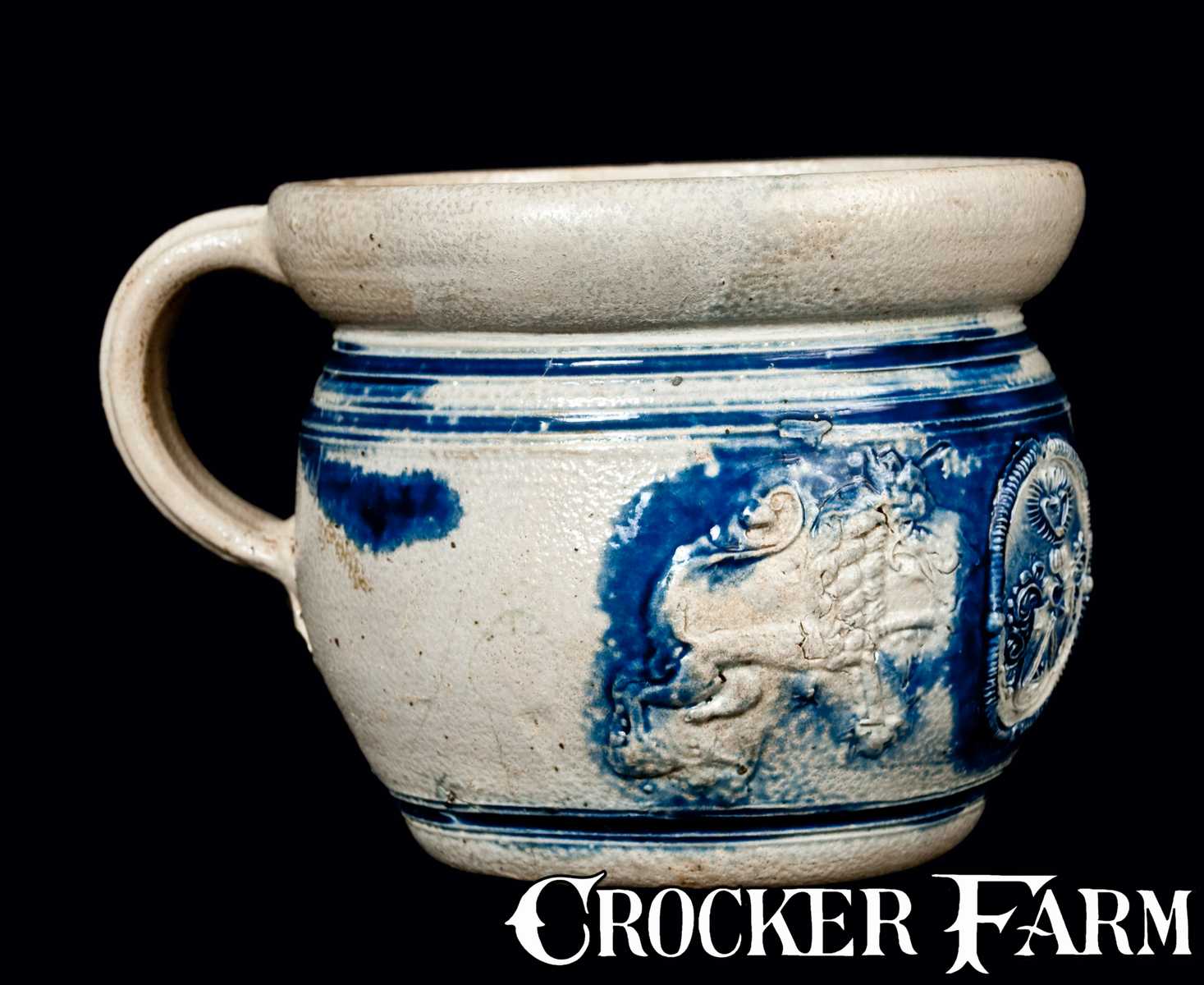
This next piece is only 300+ years old. When I picked it up, I could see the bubbly relief bits and suspected they belonged to a Westerwald animal. It took me ages to work it out when I got home. As I look at it now it all seems rather obvious. A lion, its bush ended thin tail on the top left swishing into the cobalt blue. Beneath its body. The blobs are its mane, his face badly rendered but you can make out the crescent of its mouth swallowing the blue, with a single sharp tooth top and bottom.
Mudlarking Find: Westerwald Rampant Lion 
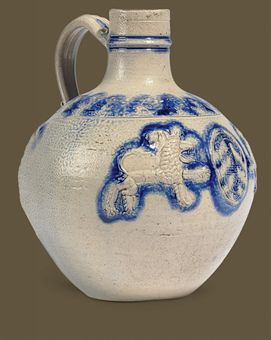
It’s likely he is one of two lions who supported a large medallion on the front of an imported German Westerwald chamber pot, popular for over 100 years, between 1630s – 1750s. Alternatively he could have been doing the same thing on a jug. Amusingly these animals seem to be referred to as 'rampant' in the antiques trade. 
17th C Westerwald Camber Pot  (Croker Farm) 

Westerwald Salt glazed Jug 1656 (Christies) 
Another pressed copper alloy button, this time with the inscription  O H ? Attneave Farringdon St EC. My google searching got me only so far, an existing street near Farringdon Street was renamed Attneave Street in 1895 probably after Alfred Attneave a Clerkenwell vestryman according to one source. Alternatively it could refer to a company name, in the census of 1881 there were 5 people with the surname Attneave in Clerkenwell.
Mudlarking Find: Copper Alloy Button 
The Georgian mudbank is giving up quite a bit of red stoneware at the moment. This time a rather fine teacup handle. It wasn’t until 1750 that teacups were produced with handles and red stoneware reached its popularity between 1750-1760, so reasonable to assume it’s from around this time. Quite possibly from Staffordshire whose potters were producing copies of the popular Chinese Yixing red stoneware teapots which were first imported to Britain in 1669. Covered in an earlier post on Rosso Antico
Mudlarking Find: Red  Stoneware  teacup handle
I haven’t bothered to pick up the bakewell tart like Staffordshire Combed Slipware for ages, but this large, big as your hand piece was just too yummy.
Mudlarking Find: Staffordshire Combed Slipware 1690-1830
A large piece of what I assume is English porcelain was also swishing about in the low tide, perhaps Worcester or Caughley but I can’t find a pattern match.
Mudlarking Find: English Porcelain 
Other finds are chucked together below, the usual mixture of slipware, hand painted pearl ware, Chinese export porcelain, delft, transferware, banded ware, white salt glaze,  and yet more sections of clay pipes with makers initials either side of their feet, this time P/S  and W/W. 

Mudlarking Finds: The rest. 
Our morning was finished off with a cup of tea and cake in the Tate restaurant where we shared our finds. Our view couldn't have been more spectacular looking across to St Pauls  through the falling snow. The cold hadn't put Deborah off and she's keen to come down again, although I should remember Deborah can deal with anything, even her broken rib on this trip. Off with the boots and on with the shoes with just enough time to walk along the Southbank, over Westminster Bridge for a meeting in Whitehall I had to attend on my day off. As we were ushered in to a room to wait to be summonsed, had just enough time to pull out a few of my treasures to show my colleague, amused by the juxtaposition. 

Saturday, 16 February 2013

Chinese Export Porcelain 1556 - today

I think I can now deduce what shards are Chinese or Japanese porcelain. Their cross sections are dense like stoneware and very white. They don’t tend to stain, so despite being hundreds of years old look new. The blue and white decoration is slightly blurred, subdued and a lighter blue than transferware- a bit dreamy.
Mudlarking Finds: Chinese Export Porcelain with hand drawn flowers
Pretty common on the foreshore I can never pass them by and pick up 2-3 pieces on each visit.
These shards were usually hand painted with deceptively modern patterns. 
Mudlarking Finds: Dreamy porcelain
China was the first nation to discover the art of making porcelain possibly as early as 1300.
In the 16th Century Portugal began trading with China, importing Ming Dynasty blue and white porcelain, heralding the 300 year European love affair with porcelain. The Chinese began making porcelain specifically for the European market hence the term Chinese Export Porcelain and the first European port opened in Canton in 1556. Porcelain was a handy bit of cargo,  placed in the ships hulls it provided ballast and  was unaffected by water, allowing the more vulnerable silks, teas and furniture to be stored higher up.

In the early 1600s the Dutch captured two Portuguese ships laden with porcelain and other goods. The cargo was auctioned off, the buyers of this ‘white gold’ the European elite including the Kings of France and England. The Porcelain craze had begun – among those who could afford it. It is hard to imagine how wondrous it must have been. Nothing like it had been seen  before. The only pottery had been course earthenware. Chunky German stoneware was the  most refined. Westerwald wasn’t on the scene until the late 17th century and I believe delftware of this time was rather crude. These gleaming, smooth, white painted beauties began to replace the aristocracy's silver tableware.

Homage is paid in the 17th century Dutch still life paintings with Chinese export porcelain sometimes placed centre stage. 
Pieter Gerritsz van Roestraten  1627-1698 (It's About Time) 
England and Holland began trading with China themselves, with each country's East Indian Company playing pivotal roles. In the middle of the 17th Century, civil war in China caused trade to shift to Japan. Porcelain trade was re-established with China again in the late 17th Century.

There are a bewildering array of types, Kraak, Famile Vert, blanc de chine, famille rose and patterns canton, mandarin, rose medallion, encre de chine, Fizhugh and bird and butterfly, all associated with particular periods.
Kraak Porcelain Bowl  1573-1620 (Pater Gratia Oriental Art) 
Kraak Porcelain Saucer 1575 - 1615 (Pater Gratia Oriental Art)
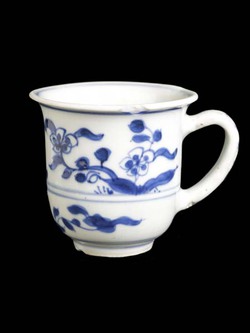
Over time Chinese potters produced European forms and designs ewers, mugs, candlesticks, sugar bowls and milk jugs. Wooden models were sent so they could learn how to produce these unfamiliar objects. European motifs Christian imagery, heraldry, classic mythology were used.
Chinese Export Porcelain Coffee Mug 1750 (Museum of London) 
1690 Porcelain Mug made for the English Market (Michael Pashby Antiques) 
By the late 18th century imports from china were declining as English ceramic innovation and mass production took over.  

Friday, 8 February 2013

Mudlarking Another Day's Finds

A late January Monday morning. The whole of working London is joining the city's transport arteries, iron filings and magnets come to mind. It wasn't 8am and already queues of orange lights stretched into the distance. A bunch of commuters were gathering at each bus stop. The bus was going to take too long, so reluctantly I joined the tube, god it was foul, completely packed. Not what I wanted to be doing on my day off. 

As I stepped down to the Thames intense sun lit up the foreshore rubble, almost blinding me. It seemed the sun hadn't been there for months. It was meant to be a low tide, but it didn't look as though it was going to go out that far today, maybe all the rain is to blame? 

Find of the day is a first for me, a glass seal, I suspect from a wine bottle. A similar one on the Portable Antiquities Database is dated between 1650 - 1750 and was found in Southwark London, not far from where I found my one. Both seem to be painted gold, their irregularity shouting handmade. 


Mudlarking Find: Glass Seal  17th - 19th Century
Glass Seal 1650 - 1750  (Portable Antiquities Database)

Wine bottle with seal 1711- 1730 (Museum of London) 

Three letters I, S and E surround what looks like a Tudor rose. It's good to find something completely new. 

From the 18th Century some pipe makers advertised their brand by using moulds which imprinted their business signature on the foot of their pipes. On this trip I found one with 'W' on one side and 'I' on the other and another with 'P' and 'S'. Unfortunately  I haven't been able to trace either of these to specific pipe makers. 
Mudlarking Finds: Clay Pipes 'feet' with lettering 
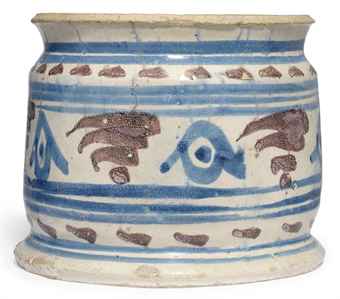
A sizeable chunk of a 17th century delft drug jar circled with paint brushed prints  and lines of cobalt blue. 
Mudlarking Find: Base of a 17th Century Drug Jar

London Delft Drug Jar 1650 - 1700 (Christies) 

I couldn't resist two rather magnificent chunks of course pottery probably from the 16th century.


The first is a pot rim and  boasts a very common thumbed decoration. I usually pass these by but this time the rim piece has a return, perhaps the top of a large bellied pot. The inside is coated with a thick dark deep green glaze. 
Mudlarking Find: Thumbed redware rim
I've picked up a nifty shard chart from the 'historic royal palaces' which allows you to work out the size of the plate or pot by matching the curve of your shard to a series of lines, which also give you the percentage of the rim it represents, in this case 17%. If I've got this right the diameter was 47 cm  pretty big. A Thames Discovery guide told me they thought these type of thumbed rim shards, so common on this stretch of the foreshore, were from vats and the remnants of a local Tudor dying industry. 

It was the thick yellow glaze and a thumbed end of a handle that prompted me to sweep up the second shard. Is it from a large jug? On examining it more closely at home I noticed a line of stamped decoration ending at the top left of the handle base. 


Mudlarking Find: Redware with yellow glaze
It was good to meet a new mudlarker, a vivacious French guy who'd been an archaeologist but had turned to corporate life to up his salary. Recently installed in a company flat overlooking the Thames he'd wondered what those souls wandering around the foreshore were up to, so he donned his boots and went down to ask. That was in December, now he's a regular as he says 'I've got the virus'. 

Finally the eccentric inscription ' our own make' earns this little pressed copper alloy button its place. 
Mudlarking Find: Pressed Copper Alloy Button 'Our own make'. 

Friday, 1 February 2013

Chelsea Sprig Pattern 1860- 1900s.

With many mudlarking months under my belt, I now realise that the Thames chooses to give up shards from the same object over time, sometimes several months apart. 

When I  fancy unearthing the story behind a fragment I rifle through my trove, pulling out all examples of type. Often it’s only then I realise two shards slot together or are so close in design or form I conclude they must originate from the same thing. 

These first two were found six weeks apart. Whilst worn differently, I suspect they’re from the same cup.
Mudlarking Finds: Chelsea Sprig Pattern
They aren’t the most refined pieces but are full of aspiration with their relief blue posey sprigs, echoing Wedgewoods Jasperware.

Two of the next lot I suspect are from the same shiny plate. This time the sprigs, still with the flowery theme, bleeding slightly under the glaze. The companion piece feathery and herbaceous.
Mudlarking Finds: Chelsea Sprig plate shards
Several different names are attached to this genre, ‘Chelsea Sprig’, ‘Granmother’s ware’, Chelsea pattern’, ‘Aynsley’. The sprigs tend to be flowers, thistles or vines and grapes. 
Mudlarking Find: Chelsea thistle sprig. 
This stuff was churned out by many different potteries in the Victorian era between 1860- 1900s, perhaps even later. Almost exclusively sold by ebay and seemingly shunned by the antiques sites suggesting they were cheap and mass produced wares for the middle and working classes, unsought after and not collected – still it must have been quite tricky getting those clay relief bits to stick. 
Chelsea Grape Sprig 1900 (Postrex) 
Chelsea Pattern (Betty Ann Antiques).

Friday, 25 January 2013

Mudlarking Double

A low low tide brought out the mudlarkers. Even London's first snow didn't deter. I linked up with familiar faces on the Georgian mud bank. Andrew pulled out an almost complete Worcester jug that he'd found a few weeks ago and asked us to look out for the missing shard. Later he kindly handed me a large bag full of Worcester shards, 'spares' from his 20 years mudlarking. 
Andrew's Worcester Jug found Mudlarking
Andrew and Brian pointed out that there was an even lower tide the next day, just too tempting to resist, I scuttled down again the following day squeezing an hour in before I met my husband for our exploring 'secret London' walk in the city. There was no way he was coming down to the Thames on a cold and snowy day, even a flask of coffee couldn't tempt. 

These 300+ year old Bartmann beards seem to be coming my way at the moment. What appears at first glance a pottery accident are intentional daubs of cobalt blue. Satisfyingly I came across a match in the Museum of London's collection, I still don't quite 'get' the effect. 
Mudlarking Find: Bartmann Beard with splashes of blue glaze
Frechen stoneware bottle  15551-1700 (Museum of London) 
Two favourite finds are stoneware, I think. Unnervingly both look freshly cast, suggesting the Thames has just released them from its preserving muddy embrace. Two hours pursuing them on google failed to reveal their identity - enough was enough and I gave up the chase. 

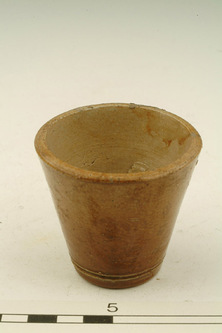
The first is 9cm tall. The potter has decorated the vessel with ribbing as they pulled up the clay on the wheel. The flared base has been lightly thumbed to decorate, a more restrained version of the German Raeren and Siegburg jugs and beakers from the 14th - 19th C.The straight sides are confusing me somewhat, as these old jugs and drinking vessels tend to be bulbous, is it a tumbler?  Covered in a rather handsome brown mottled glaze. Rather messy brush stokes hidden on the base make it all rather human, suddenly collapsing the centuries. 

Mudlarking Find stoneware beaker?
The second is slightly taller and I suspect a pot handle. Wheel made spiralling up inside. Whilst not perfect it's rather refined and covered in the confident swish swash brush stokes that applied the glaze, I like the fact you can see it gunking up in places.

Mudlarking Find: Stoneware handle
Mudlarking Find: Stoneware pot handle


A few other pieces I thought were worth putting up are a delftware swirl and  an earthenware pottery lid with small white relief flowers


Mudlarking Find: Delftware swirl

Mudlarking Find: Small earthenware lid
Update 
I came across the picture below on this pinterest site, apart from the dog it's exactly the same, from a Staffordshire glazed redware armorial teapot circa 1740 - 1745, with white slip sprigs. 


Lastly my first butterflies, one porcelain courtesy of Brian's sharp eyes,  strangely a rather finely drawn Worcester insect and a transfer swift and a nice chunk of incised Westerwald fired up with cobalt blue below. 
Mudlarking Finds: Birds Butterflies and insect. 
Mudlarking Find: Incised Westerwald 

Friday, 18 January 2013

Blacking Pots 19th Century

Took me a little while to find out what this small salt glazed stoneware vessel was.Tapping stoneware drinking or  goblet into google failed to  flash up a twin. It was 'ink' that did it. The excellent Museum of London seems the only site to give this little object its voice and they have done it so brilliantly I can't do better than quote their account 


Mudlarking Find: Blacking Pot

Blacking Pot 1835-1895 (Museum of London) 

' Such pots traditionally contained blacking paste. Blacking ink was widely used in the 19th century for the cleaning and polishing of boots and shoes, floors and doorsteps. The most famous and successful blacking factory in London was Robert Warren's located at 30, the Strand. In the 1830s Warrens' was selling blacking liquid in bottles and blacking paste in pots of three different sizes, priced 6d, 12d and 18d each 'in every town in the Klngdon'. Many firms were set up as rivals to Warren's, attempting to cash in on the success and emulate the 'secret' recipe of the firm. One of these was run by James Lambert at Hungerford Stair who employed the 12 year old Charles Dickens to work in the factory. Dickens never recovered from the humiliation of having been sent to work in the factory due to his father's financial problems. He described his work as 'to cover the pots of paste-blacking;first with a piece of oil paper, and then with a piece of blue paper;to tie them round with a string' and then to clip the paper close and neat, all round, until it looked as smart as a pot of ointment from an apothecary's shop. When a certain number of grosses of pots had attained this pitch of perfection, I was to past on each a printed label; and then go on again with more pots'. (Museum of London)
A Midshipman Blackening his boots 1825 (National Maritime Museum, Greenwich, London)

Friday, 11 January 2013

Imari Porcelain

Over the last year I’ve collected six pieces of porcelain with lines etched in red. Looking closely you spot trails of paintbrushed gold. You can just see the gold line gliding through the middle of the branch below on the left shard.  The red and gold are over glazed and contrast strikingly with the chunkier splashes of under glazed cobalt blue.
Mudlarking Find: Imari Porcelain

Mudlarking Finds: Imari Porcelain shards


Surprisingly they could be 350 years old. Initially made in Arita, Japan  and exported from the port of Imari, between 1650 – 1750. There are many subcategories, the shards pictured above I suspect are Kinrande Imari.

Imari porcelain was exported by the Dutch East India Company and became popular when Chinese Porcelain was difficult to source due to the chaos at the end of the Ming Dynasty in 1644 and subsequently by the decision of the Qing Dynasty to cease trading between 1656-1684. Quite something to think these small fragments may have been carried by these enormous old, old ships below 
Dutch Ships 1685 by Isaac Sailmaker (National Maritime Museum)
Export from Japan ceased when China opened for business again, as Japan couldn’t compete with China’s low labour costs. China cashed in on the popularity of Imari in Europe and replicated the designs. This pattern is most common in export porcelain in the early Qing dynasty period from 1662-1722.  I've also read there was a surge in Imari imports into England in late 19th century when all things Japanese were in fashion. 
Chinese Imari Tea Caddy (Antiques now) 

Chinese Imari Style (Aspire Auctions)