Friday, 27 September 2013

Cloth Seals

Embodied in these small slivers of lead is so much of England's past and Thames history. Cloth represented 90% of England's exports in the 16th Century and was the main export until the industrial revolution. London controlled 75-80% of this export trade, the Thames its conduit.

Cloth made up a large proportion of London’s £1 million export trade in 1560. It must have been linked with the livelihoods of many, many Londoners and funded so much of London's landscape.

Cloth seals were used across Europe from the late 14th century – the early 19th century as a means of identification, quality control and were part of state administration. The seals were attached to cloth by weavers, dyers or ‘alnagers’, crown officials who assessed whether the goods were of requisite quality and that tax had been paid. 

Blank cloth seals were caste in stone moulds
Stone Cloth Seal Mould (Bagseals.org)

Cloth seals were usually two discs (occasionally four) joined by a thin strip. One disc had a rivet, the other a hole. The   discs were folded together over the edge of the cloth, and hammered together with a die, which imprinted information onto the lead disc.
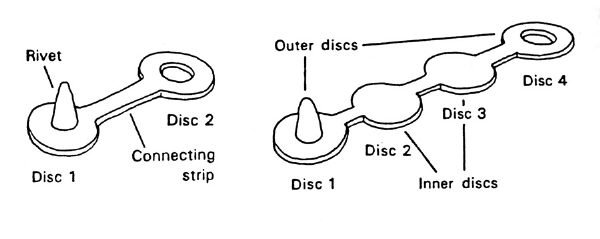
 
2 and 4 part cloth seals (office of history and archaeology Alaska) 

It’s the intricate designs on so many of the cloth seals which make them appealing. These can include the date and region of production or inspection, touchingly personal maker’s marks or symbols indicating alnage. The latter included heads of royalty, the crown, coats of arms, griffins or lions rampart. Alnage was abandoned in 1724 and sealing was abolished in 1889.

I haven’t found many cloth seals so far, but I’m now on a bit of a mission. I’ve found one I suspect is an alnager’s with a very small and faint crown at the top and either a letter or number below


Other examples of alnager’s cloth seals, all of which will be 300+ years old,  can be found below
Elizabeth I Alnage Cloth Seal 1558 onwards (bagseal gallery)
George I Alnage Cloth Seal 1714 onwards (bagseal gallery)
17th C Alnage cloth Seal (http://proteus.brown.edu)

The other one I’ve found I recon has a makers mark on it
 Mudlarking Find: Cloth Seal

I found a few other pictures of seals with makers marks.
Cloth Workers Personal Cloth Seal  18th or 19th C (Bagseal Gallery) 
Cloth Workers Personal cloth seal 1775-1825 (Bagseal Gallery)

Sometimes you can see the texture of the cloth on the reverse, as in this case


Most of the cloth seals found in the UK come from the Thames foreshore, most commonly from the late 15th to early 19th centuries.  One theory is that many dropped off textiles during the finishing processes of shearing, dyeing and fulling carried out in the many riverside workshops along the Thames. There was a concentration of dye houses along Thames Street, between Cannon Street and Southwark Bridge. In one study of seals found along the Thames, they identified seals from 24 different counties together with imported seals and many from London dyers.

The beauty of these Thames finds is that the tiny detailed imprints are often perfectly preserved due to the Thames anaerobic mud, whereas the lead found buried in other locations is often so badly corroded that no surface detail remains.

There are a few sites which are helpful in identifying cloth seals, including one put together by Stuart who generously offers to identify your finds, here. Also LM has found loads of cloth seals on the Thames and her potted history is also worth a read here.

It’s taken me a couple of years of mudlarking and the help of mudlarking friends to start spotting lead cloth seals along the Thames foreshore. The trick is to go slowly and scan between the stones and other debris, ‘look through them’ as one friend advised. Once you set your heart on finding a particular type of find, you usually start spotting them and don’t forget to take them down to the finds officer at the Museum of London.

Monday, 23 September 2013

Another Mudlark and the Thames Festival

Unexpectedly both the youngest and husband were off on separate weekends away. Suddenly I was a free agent. Summer had closed and London was bathed in its familiar grey. Everyone was back in town the roads were crammed with traffic and tubes were chocca. But the city was weekend empty just the occasional group of blokes clad in orange day glo directing juggernauts to the latest corporate building site. 

I bounced down to the foreshore in my last time shiny new posh boots, which I'd finally got round to buying two years after I starting this mudlarking thing. They make life so much easier down there, wish I'd got some before. 


Met up with  LM and we quietly mudlarked away for the new few hours. 

Well chuffed with my first ever thimble find. I think it's mid 17th - late 18th century as it has a waffle pattern of indentations on the top.  The dipples are very regular so it must have been machine made. A good thimble identification site is here.


Mudlarking Find: Mid 17th - 18th Century Thimble

Not sure what this is, it's 7.5cm long and 3.5cm wide. Could be made of lead but not certain. If it was a medieval fish weight I'd be very pleased, but it doesn't quite match the pictures I've found of these, another find to take to  the Finds Officer at the Museum of London. 

Metal Mudlarking Find. 
Medieval Fish Weights (time line auctions)

and I also rather like this top of a clay stopper, probably because I've found nothing similar before. 
Mudlarking Find: Clay stopper
Plus in 10 minutes picked up one or two pipe stems for my mosaic. 

Mudlarking Finds: Clay Pipe Stems & a few pipe bowls.
As we sat in the pub later we sifted and cooed through our finds, both our partners are rather bewildered by our continued fascination with the same old things we keep finding, so it's nice to find another soul who can find endless pleasure in revisiting their finds. 

I was free to spend the evening mooching around the Thames festival. I'm so disappointed they no longer run  banqueting tables down the middle of Southwark bridge, it was so brilliant to feast together with loads of other people, a very unLondon like social event - I blame it all on that man Boris. I wanted to seek out a couple of Thames films, managed to track down 'Portrait of a River' but whilst interesting it didn't match up to the films I'd seen at the Estuary Exhibition. Then ambled back towards Tower bridge to see 1513 A Ship's Opera, billed as 'a moving, operatic concerto of ships’ steam whistles, bells, horns, hooters, sirens and cannon as the centrepiece of the 2013 Thames Festival' I was intrigued. It wasn't quite as spectacular as I'd imagined it might be, but interesting none the less although mainly just a lot of hooting and tooting. Rather gorgeous though to see Tower Bridge opening and lit up and the Tower of London pooled with light. I took a very unprofessional little film on my phone, mainly to show my family, but thought I'd also bung it here. 


Ended up waiting for my bus at London bridge station which has been transformed from the Victorian dive into modernity with the Shard rising up from the bus station forecourt. Mad. 

Saturday, 7 September 2013

Roman Tegula

Tegula is the twin of Imbrex the two types of tile which made up the Roman roof, a design nicked from the Greeks and still in use in Rome today.

I presume most of the red tiles you see on the Thames foreshore are medieval and they certainly are if they have one or two holes in them. But perhaps I'm wrong and many of the tile pieces are Roman for me it's just impossible to differentiate.

The Thames foreshore is littered with tiles. 
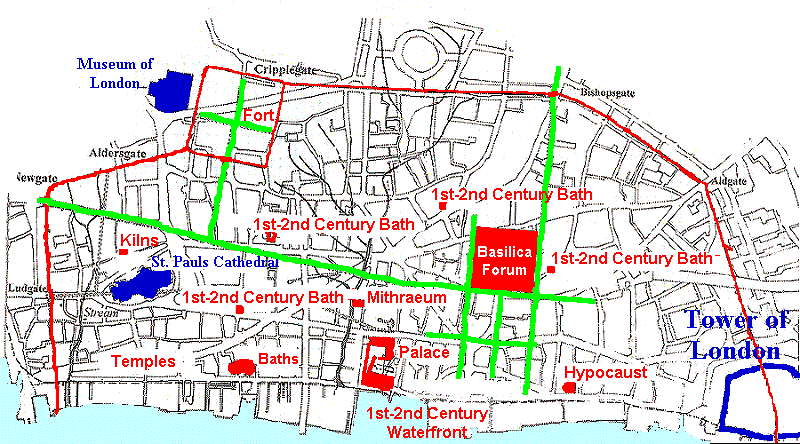
If the tile has a return like the one below it and it is found where Roman London lay, it may be a Roman tegula. 
Tom's mudlarking find Roman Tegula. 
This find was one of Florida Tom's gifts to me. Later that day I found another. Funny how you spot things once their image and identity is imprinted in your brain. 


Roman Londinium superimposed over modern London (Romanobritain.org)
The tegulae were laid in overlapping fashion. Some were just plain flat tiles, others had raised edges on each side (like the ones I've found) preventing the water from seeping between the join and channeling the water to the bottom of the tile. Later tegulae were a v shape whereby the edges converged slightly each becoming a funnel which slotted into the one below forming a continuous channel. 

The imbrex were semi circular and were place over the joins between tegulae. If well laid the result was a fully waterproof roof. 


tegula (a) imbrex (b) (wiki)
The roofing area was usually surrounded by antefixa and these were frequently decorated, now that would be a nice find. 
Roman Roof with Antefixa (Grahams Potted History) 

Sunday, 1 September 2013

A few more mudlarking finds & the Estuary Exhibition

I had serious post holiday blues. After a few weeks in the country I was finding it difficult to accommodate ubiquitous concrete, endless coppices of different sized buildings healed into every patch of land, roads scarred with pot holes and tarmac tracks and the absence of big skies. A bit of Thames therapy was what I needed. I went down a couple of times, mainly to collect pottery for mosaic making. Few notable finds. My favourite is this piece of plate rim with apt snatch of poetry 'how I love to calmly muse..such an hour as this'. 
Mudlarking Find 'how I love to calmly muse such an hour of this'
Liked this romanticised river summer scene decorating the bottom of a bowl.
Mudlarking Find Transferware, bottom of small bowl.
A sucker for writing on pottery pleased to find T Andrews with its inverted N. The shard is hand sized and slightly curved. Nothing on the net on this one, so haven't a clue about its date. There are a few inclusions in the clay. Later I spotted a tile piece with 'rews' imprinted amongst the pottery of my blog header, which I would have found at least 18 months ago, perhaps from the same vessel? 
Mudlarking Find: T Andrews
This time did pick up one of the Raeran pottery bases I quite frequently spot, with its distinctive thumbed decoration and colour. The bottom of the  jug bulge seems far larger and thinner than usual, so perhaps I'm wrong. 


Mudlarking Find: base of Raeren ?drinking mug


Raeren Driking mug 1481 - 1610 (Museum of London) 
Walked through the city to Bank and caught the DLR which winds its way through the juxtaposition of council blocks and corporate opulence to Canary Wharf and meandered through the interesting but rather soulless 80's docklands redevelopment to the Museum of London Docklands. I'd be meaning to visit their Estuary Exhibition for ages. If like me you are rather drawn to landscapes on the margin,  with iron hulks of industrial pasts and worn resorts or just fascinated by the Thames you'll love this. The Museum of London's says 


Estuary brings together the work of 12 artists who have been inspired by the outer limits of the Thames where the river becomes the sea. The exhibition marks the 10th anniversary of the Museum of London Docklands, a converted Georgian warehouse on West India Quay. 
With its dramatic landscape – desolate mudflats and saltmarshes, vast open skies, container ports, power stations and seaside resorts – the Estuary has long been a rich source of inspiration for artists and writers. Through film, photography, painting and printmaking, the contemporary artists featured in this exhibition offer new insight into this often overlooked, yet utterly compelling, environment and the people that live and work there.

I particularly liked John Smith's Turner inspired film of the changing sea set against the sound of the waves breaking on the beach (Horizon (Five Pounds a Belgian) an interview with Smith about this work can be found here. Another favourite was the speeded up film of the Thames from the Sea to the City with old men of the Thames animated in their silent tales of their river and the bright fairground of Canvey Island peeking over its grey walled defence. Loved Bow Gamelan Ensemble brilliant performance on Rainham barges, as they are slowly submerged by the Thames tide. All very inspiring it made me want to 'do art' rather than spend my time in cerebral research about my Thames  finds - but sometimes these thoughts are best kept as thoughts as the realisation is much harder and the result often disappointing - we'll see. 

Friday, 23 August 2013

Finds from last month's midnight mudlark

Another evening mudlark on a balmy summer's evening after work. Met up again with London Mudlark and picnicked overlooking the Thames as we waited for the tide to go out. It's strange being down there on a weekday evening. The noise of city workers drinking interrupted our expected peace. As usual very impressed with London Mudlark's finds which you can find on her site here. 

I must say I didn't have the concentration or perseverance on this trip. At times I was certainly more interested in savouring the views and cracking open the bottle of beer I'd brought along. 

As the sun was setting we were surprised to be joined by a whole determined gang of no messing mudlarkers. They were drawn by the lowest tide of the year, we hadn't realised it was going to be so low. Loads of pipes were suddenly exposed, so I scooped up several with long stems. According to my pipe identification chart most of these are Georgian from around 1770, which is incredible as they look spanking new. You can find a previous post on clay pipes here.

Mudlarking Finds. Clay Pipes from around 1770s. 
A large section of what I presume is a German stoneware mineral water bottle, probably from the 19th Century. 
Mudlarking Find: Probably German Stoneware Mineral Water Bottle ca. 1800
I picked up some usual pins. The first is 4.5cam long and has an unusually large head and unpointy end, the others are thicker than the average Thames pin.  A previous post on pins can be found  here.
Mudlarking Finds: Pins 14th - 17th Century. 
A particularly large section of metropolitan slipware and a star design spotted by London Mudlark. A previous post on slipware can be found here.

Mudlarking Finds: Metropolitan Slipware probably 17th - 18th Century 
Surrey/Hampshire border ware 1580-1800 (Museum of London) 
Two interesting large pottery shards both painted over the glaze, I think this is called enamel.  The first I suspect is Georgian, the second with back and front shots is porcelain and possibly Japanese. I can't find anything similar on the net. 

Mudlarking Find. Hand painted pottery shard. 


Thursday, 25 July 2013

Another Midnight Mudlark

Sadly I've had to return to pretty much full time work, so very little time to mudlark and no time to blog, so I suspect posts will be far and few between. However  I did manage to meet up with London Mudlark last night, to catch the lowest Thames tide of the year. This time we weren't the only ones down there and there were several head torched mudlarkers, each stooped over their individual pool of light, you can just make them out dotted along the foreshore in this rather poor picture below. It will take a while for me to post my finds, but I expect London Mudlark will be posting hers soon and she found some delights, which you'll be able to see shortly here https://www.facebook.com/LondonMudlark 

Midnight Mudlarking

Friday, 5 July 2013

More Low Tide Mudlarking

I always cycle to work and as I said goodbye my husband asked me where my bike was, I’d forgotten to tell him I’d taken the morning off work to go mudlarking. Having been down for the midnight mudlark the night before, ‘your obsessed’ were his parting words, but one more mudlark during these midsummer low tides was not to be missed. 

As I descended the stairs to the Thames I spotted a woman I recognised,  Hilary Bravo who I follow on pinterest, an artist who makes jewelry from her mudlarking finds, which you can see here.  It was lovely to meet her out of that social networking world and a coincidence as I’d arranged to meet Tania Covo, another artist who makes fabulous jewelry from her Thames pottery finds, you can see her work on her facebook page here.

I did a bit of mudlarking London Mudlark style, where the rewards are usually small and metal and find of the day has to be this minuscule spoon at the end of a hollow 4cm silver arm with a hole for attaching at one end. I didn’t have a clue what it was. I assumed it was part of something larger but expert mudlarker Mackie put me right and immediately identified it as a ear scoop the equivalent of today's cotton buds. No idea what period it's from, could be anything from 15th C to the Victorian period. 

Mudlarking Find: Silver Ear Scoop
Mackie said he thought it was silver so I later looked up the treasure act, which requires you to report items (apart from coins) which are 300+ years old and silver, presumably including this little thing if it's that old. I'll certainly be taking this find down to the Museum of London when I finally get a slot. 

Also found a couple of lead cloth seals, these ones are probably 19th Century and a clay marble, only my second. 
Mudlarking Finds: Clay Marble and lead cloth seals 
Ended the morning with lunch at the Tate with the 'Ladies who Mudlark' , after which we pored over and delighted in each others finds. Again struck by how this mudlarking business takes you to places off the beaten track you never would have visited and lovely people you never would have met.