Friday, 28 September 2012

The History of Tea

So many Thames mudlarking finds are from tea ware.

As I was trying to trace its development, it occurred to me to make sense of it all; the place to start was the history of tea. Tea was first brought to England in the 17th century and first consumed in coffee houses. ‘China tea’ and hot chocolate were introduced to the beverage menu from the late 1650s. Thomas Garroways promoting tea in his coffee house advert placed in Mercurius Politicus in 1658 ‘That Excellent, and by all Physicians approved, China drink, called by the Chinese, Tcha, by other nations Tay alias Tee, ...sold at the Sultaness-head, ye Cophee-house in Sweetings-Rents, by the Royal Exchange London".   
Coffee House 17th Century from British Museum. 
Samuel Pepys noted in 1660 "I did send for a cup of tee, (a China drink) of which I had never had drunk before". At one level the coffee houses appear to be equitable establishments with the aristocracy and wealthy business men rubbing shoulders with the less well to do. These establishments buzzed with discussion of current affairs and functioned as business networking hubs.

Different coffee houses attracted different clientele. Garraway’s was the haunt of scientists and natural philosophers. St James’ was favoured by traders and mariners. Will’s was for poets and White’s for actors and musicians. The mark of a true Renaissance Man in those days was to regularly patronise as many different houses as possible. 

Coffee houses play an important part in London history

‘Lloyd's of London had its origins in a coffeehouse run by Edward Lloyd,  where underwriters of ship insurance met to do business. By 1739, there were 551 coffeehouses in London; each attracted a particular clientele divided by occupation or attitude, such as Tories and Whigs, wits and stockjobbers, merchants and lawyers, booksellers and authors, men of fashion or the "cits" of the old city center. According to one French visitor, Antoine François Pervost, coffeehouses, "where you have the right to read all the papers for and against the government," were the "seats of English liberty." In London, coffeehouses preceded the club of the mid-18th century, which skimmed away some of the more aristocratic clientele. Jonathan's Coffee-House in 1698 saw the listing of stock and commodity prices that evolved into the London Stock Exchange. Lloyd's Coffee House provided the venue for merchants and shippers to discuss insurance deals, leading to the establishment of Lloyd's of London insurance market, the Lloyd's Register classification society, and other related businesses. Auctions in salesrooms attached to coffeehouses provided the start for the great auction houses of Sotherby's and Christie's. In Victorian England, the temperance movement set up coffeehouses for the working classes, as a place of relaxation free of alcohol, an alternative to the public house,’ (Wiki)
Edward Lloyd's Coffee House 1798
 ‘Coffeehouses were such important institutions to London society that one did not inquire where a fellow lived but rather what coffeehouse he frequented’.  (research.history.org)

The tea they consumed would be considered undrinkable today. Until 1689 tea was taxed in liquid form. The day’s tea would be brewed in the morning enabling the excise officer to tax, it was then kept in barrels and reheated when needed throughout the day. After 1689 tea was taxed by weight and fresh brews ensued.

Outrageously women were banned from coffee houses. You could however buy loose tea from coffee houses, this enabled women to enjoy tea at home. Kicking off the tradition of afternoon tea, women from wealthier households would gather for tea parties, a very genteel social occasion. The tea equipment would be set up by servants and the lady of the house would unlock the tea caddy and spoon the precious tea into the tea pot. Tea was unbelievably expensive, up to £10 a pound more than a labourer earned in a year. Sugar was added, another very expensive import. In this period milk was not used.
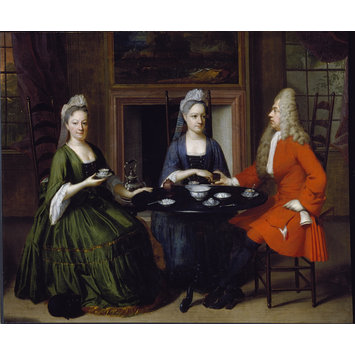
Tea drinking at home ca 1715 (Victoria and Albert Museum) 
Tea stimulated various claims and warnings, Pepys writing again in 1667 ‘Home, and there find my wife making of tea a drink which Mr. Pelling the Pottecary tells her is good for her colds and defluxions."

'After experiencing the Dutch "tavern garden teas", the English developed the idea of the Tea Garden. Here ladies and gentlemen took their tea out of doors surrounded by entertainment such as orchestras, hidden arbors, flowered walks, bowling greens, concerts, gambling, or fireworks at night. The tea garden began in the reign of King Charles II. Diarists John Evelyn and Samuel Pepys recorded visits to the New Spring Garden (also called Vauxhall or Foxhall) in the early 1660s. The tea garden reached the height of its popularity in the mid 18th Century the most famous were Vauxhall and Ranelagh. The gardens were both places to stroll and to be seen.

Tipping as a response to proper service began in the Tea Gardens of England. Small, locked wooden boxes were placed on the tables throughout the Garden. Inscribed on each were the letters "T.I.P.S.". If a guest wished the waiter to hurry (and so insure the tea arrived hot from the often distant kitchen), he dropped a coin into the box on being seated "to insure prompt service", hence TIPS. '(teacakesandteddybears.com)
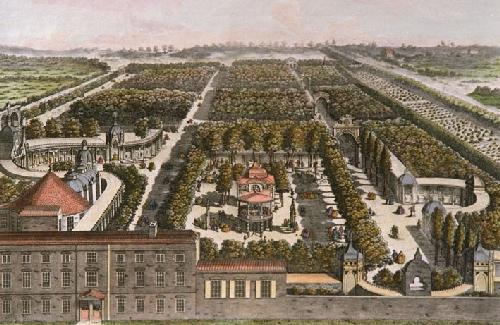
Vauxhall Pleasure Gardens Samuel Wale 1751


Between 1720-1750 imports of tea through British East Indian Company quadrupled. One commentator Fernand Braudel asked "is it true to say the new drink replaced gin in England". By 1766 exports from Canton stood at 6 million.

In 1785 the government significantly reduced the tax on tea in an attempt to undermine the flourishing black market, which was diminishing the profits of legal tea merchants. Whilst tea remained expensive it was now acceptable to a much broader spectrum of society, seeds of our national tea drinking habit were set. 

The impact on pottery  covered in the next post. 

Sunday, 23 September 2012

A Good Days Mudlarking

To celebrate partial return to part time working,  Friday before last treated myself to a mudlark and a day out in “central” as the older teens call it. Whilst grey and 12 degrees surprised to see Londoners jumpered and coated, perhaps anticipating the autumn ahead.  Optimisticly I had pulled on jeans and a thin sleeveless top. As I travelled down on the bus, hoped it wasn’t me who’d made the wrong clothing choice. Not a particularly low tide today and at 7:30am a bit early for me. Confused by the buses diversion mistakenly got off too early. Wiggled my way down to the Thames through the ancient alleys and courtyards, passing the city workers noticing faces hung with work worry.


Very happy to scamper down the familiar steps to the exposed shore. The upper foreshore was covered in a slick of silky mud due to the absence of waves from tourist boats in the early morning. 

For an hour I was the only one down there.  After a four week gap I noticed I was full of determination  my eyes sharply and quickly interrogating  the rubble, hunting for those ancient fragments.  Aware my husband would probably have left to visit his mother by the time I returned I didn’t hold back on filling my bags.

Met a lovely guy from Cornwall who’s been mudlarking for 4 years. He’s particularly interested in stoneware and very generous with his knowledge. He pulled out  a couple of pieces he’d picked up today, one the remains of a tankard that would have held a gallon. 300+ years ago they were into big and sharing.  In the past he’d delighted in the same squiggy clay pieces littered with finger prints that we’d come across and had also concluded they’d been used to position pots in a kiln. When I scrabbled to find the small mother of pearl lovely I’d found, he asked if I’d noticed the large  chunks on the foreshore,  I hadn’t. He surmised there must have been a workshop nearby. A co-incidence as today I’d picked up a handful of mother of pearl slithers which had congregated in the same place. My friend Gerry had already guessed that a piece I’d recently given her had been worked. It is the detective work that surrounds these tantalising finds  that is so compelling. 

It was a great day for finds.  I guess find of the day has to be the 2 centimetre mother of pearl 'cross' with a tiny hole through the pointy bit at the top.

Mudlarking Find: Mother of Pearl 'bead' 
Now I look more closely at the mother of pearl pieces I picked up they do look as though they have been worked, their fairy tale sheen catapults me back to the magic of childhood beach stumble upons.
Mudlarking Finds: Mother of Pearl Slithers
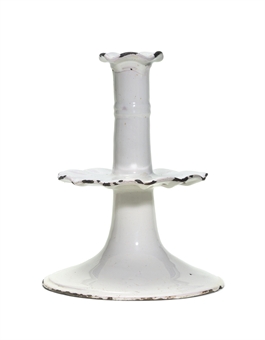
An unexpectedly good day for potentially 400 year old delft ware, I’ve got it into my head that the white cylindrical object is a candlestick (pic of complete one from 1650 below). Very taken with the old looking snatch of tulip like flowers, the base of a large jar and the smaller slightly more refined hand painted shards.
Mudlarking Finds: Delftware
1650 London Delft Candelstick probably Southwark (Christies) 
Very pleased to find the handsome good as new salt glazed stoneware base, probably originating from a Bellamine jug, alternatively a plainer drinking jug. They weren't often decorated with rings around the base and I suspect this one is German.  It could be more than 400 years old. 


Mudlarking find: Salt glazed Stoneware Bellamine Base.

German Bartmann Jug 155101700 (Museum of London) 
The next set are very old, I don’t usually pick this stuff up any more, but today - well just did. The jug handle I'm pretty sure is medieval Surrey/Hampshire ware, the other more refined  buff piece with a thicker green glaze is possibly Tudor, the red pieces may be Tudor too, intrigued by the chunky green glazed corner piece.
Mudlarking Finds: Medieval and Tudor Shards. 
Moved by the three small pieces of hand painted ceramic, with their little dots, dashes, stars and imperfect lines, probably all Georgian
Mudlarking Finds: Hand painted Georgian shards
Was this tiny, tiny flower painting done by hand too?


Some nice illustrations captured in transfer ware, 


Beginning to get a bit more interested in the remains of very old glass bottles shown with a couple more clay pipe bowls, the smaller one from 1610.


Mudlarking Finds: Old bottle necks and clay pipes
Still very taken with the bold as brass transfer ware blooms 

Mudlarking Finds:Transferware blooms
The rest is a motley collection of  pearlware handles, bits of tea bowl, drainer, solid agateware (a handle of a carving knife?), embellished creamware, a cute bit of slipware handle and the usual stoneware,debased scratched blue, mocha and some banded ware, all of which somehow found their way into my bags too. 


The rest of the Mudlarking Finds
After I’d had my fill made my way over Millennium bridge and along the Southbank towards the Royal Festival Hall. London was so quiet, workmen dismantling after the Olympics and recent festivals and later erecting stalls and stages for yet more. The Southbank must be London’s best public spirited development of the last 20 years. It just gets better and better, I love the new riverside glass entrance to Blackfriars station and nearby colourful planting. The national theatre reaches out with its huge green outside armchairs, a colourful giant material baobab sculpture was rising out of  Queen Elizabeth Hall’s  grey concrete, the large world flags topping the Royal Festival Hall catching the wind. Crossed back over the Thames, the  Hungerford bridge depositing me at the Tube just in time to get to South Ken to meet Victoria at the Victoria and Albert Museum.  

Festival of the world Southbank Centre
I never fail to  enjoy coming up the  escalator at South Ken and diving straight into the 1885 white tiled tunnel leading to the museums, as a kid it seemed endless. So good to meet up again with Victoria, such a treat to sit in the V&A's central courtyard in the sunshine, backed by beds of orange dahlias and purple flowers, sharing our stories of summer. Felt like one of our long ago trips to  Paris. 

Later we ascend the grand stairwells lined with sheets of marble on the last mission of the day. As we reached the top,  a tower of glass rose from the floor and there they were, shelf upon packed shelf of the ceramics I’ve become so familiar with through my foreshore finds. I have to admit I was slightly over exciting , my heart racing just a little bit faster. It was just great seeing them ‘in the flesh’ together in one place, almost like old friends. Also very funny knowing that a year ago I wouldn’t have given the time of day to a load of old crocks – in fact I couldn’t have thought of many things that would have been more boring. 

Wednesday, 19 September 2012

Rosso Antico and Red Stoneware

Perhaps it's not surprising that a Wedgwood pottery shard distinguishes itself so markedly on the foreshore. They are clearly so well made, the markings so precise, so refined. 


Mudlarking Find: Red Stoneware 
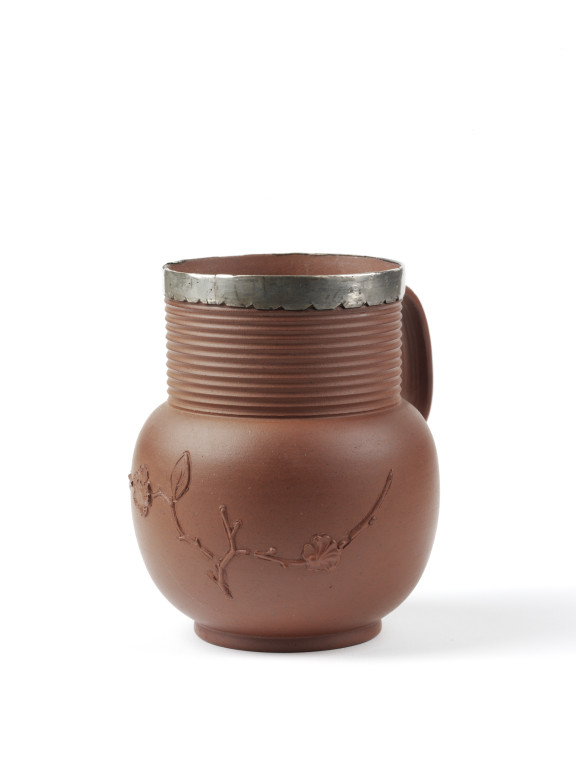
I've only found one piece of a handle from what I think is Rosso Antico, not an Italian wine as google would have it, but unglazed red stoneware produced by Josiah Wedgwood from 1760s. He was not the first to produce red stoneware, John Dwight in the 1670s made imitations of the red porcelain Chinese imports which appeared in London from the 1660s. The Elers brothers began producing a sophisticated red stoneware in 1693 in Staffordshire, later moving to Chelsea in London, once their production secrets had been discovered by other potters in the area. Both ended production by 1700. Now that I look at the photos my shard is closer in colour to the browney Elers jug below, than the redder Rosso Antico of Wedgwood - so clearly identification not for the amateur here. Last Friday visited the V&A British Ceramics collection for the first time and none of the red unglazed stoneware held the handle markings seen on shard above, the items below were also tiny, so much smaller than I'd imagined. 
Red Stoneware Elers Brothers 1690 -9 (V&A) 


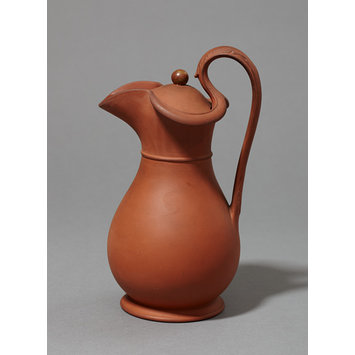
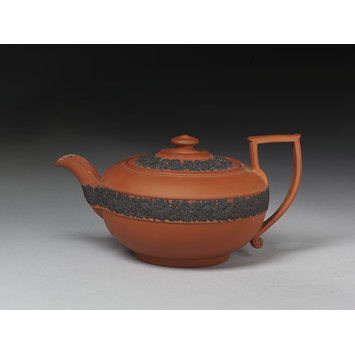
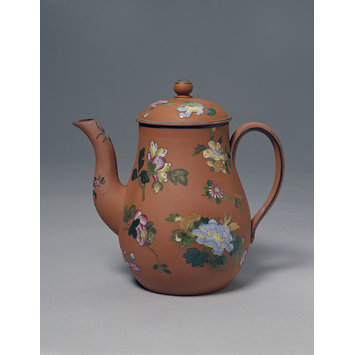
Rosso Antico means 'antique red'. The objects manufactured were teaware, jugs, dishes and vases. Wedgwood went on to decorate the red forms with intricate black clay patterns and classical scenes, alternatively with enammeled pictures. 
Wedgwood Rosso Antico Jug Late 18th C or early 19th C 
Wedgwood Ross Antico Teapot 1810-20 (V&A) 
Wedgwood was never very keen on Rosso Antico believing it was just too close to redware which anyone could produce and therefore didn't fit with his aspiration to produce premium pottery of distinction. He therefore only made it sporadically, production ceased in 1940. 


Wedgwood Rosso Antico Coffee Pot 1815 (V&A) 

Sunday, 9 September 2012

Solid Agateware 1730 - 1760

This post is for Gerry,  the only person I don't feel guilty about continually bombarding with handfuls of my latest finds and old treasures - as she takes as much or even more delight in them than I do.

I love these pieces and have found only two in what is now almost  a year of mudlarking. When I picked up the first large shard, I presumed it was from the 1950s. Searched long and hard to identify their clan, finally getting there in the last few weeks. Less surprised that these finds are really old, in this case 250+ years, than I used to be.

Thames Mudlarking Find: Solid Agateware shard. 
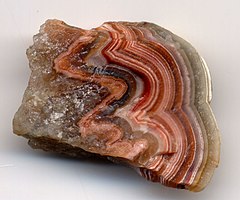
As the post heading reveals they are are solid agateware named after the polished technicolour stone 


Banded Agate (Wiki) 
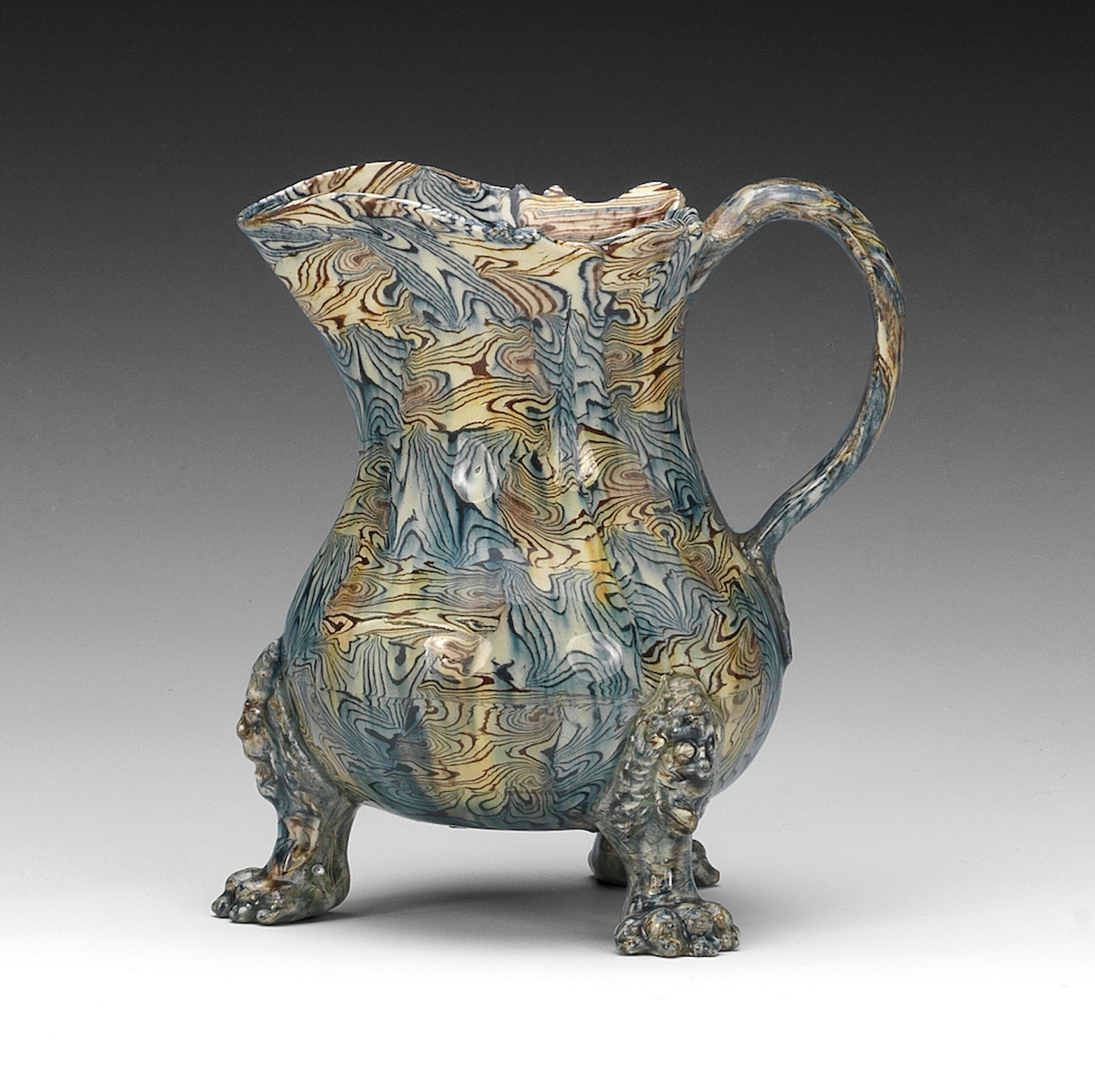
The stunning decoration characteristic of solid agate is achieved by rolling together sheets of different coloured clay. It looks as though the layers sometimes varied in thickness. On compression some would squash through the original neat lines. The large blocks of clay were then sliced to expose the layering and moulded into forms. Additional techniques must have been used to create the arcs of lines seen on many of the mugs and teapots. The way to distinguish solid agate fragments from agate ware which only uses surface marbling is to check whether the lines of colour can be seen throughout the cross section, as below - took me a while to spot that. 
Cross Section of Agateware showing the lines of colour throughout
To preserve the effect objects had to be made in moulds rather than on the wheel. They hadn't perfected the means of hiding the seams of a join, hoping the kalidascope of colour would mask it. The seam can be seen quite clearly down the middle of the fragment below and on the teapot below that. Initially I thought this piece was from the handle of a teapot or jug, it would have been a very straight one. 
Mudlarking Find: Solid Agateware
These two small mudlarking finds tell yet another interesting story about the development of ceramics. Staffordshire was the pottery silicon valley of early 18th century. As tea became cheaper its popularity increased, fuelling the demand for new and innovative teaware.  Dr T Wedgewood of Rowley Pottery Burslem, Staffordshire is credited with introducing solid agate in 1730. He used red and buff clays to give broad veined effects. Thomas Whieldon (1719-95) pottery genius, improved the technique considerably in the 1740s  by adding metallic oxides to white clay to achieve the effect. It was very expensive to make therefore production declined considerably after 1760, so only around for quite a short period of time. Today a small coffee cup will sell for £1,000. 
Thomas Whieldon 1719-95 (Whieldon Genealogy) 
Agate ware coffee mug 1750 (Martyn Edgell antiques) 

Solid Agateware Teapot 1740 - 50 (Victoria and Albert Museum) 

Agateware jug 1755- 60 (V&A) 

Friday, 31 August 2012

Tygs and Blackware 1580-1700

It took me a while to notice and even longer to appreciate the bold, sometimes high shine black glazed fragments on the Thames Foreshore.  I suspect for a long time I didn’t pick any up – being much more attracted to the pretties or the evidently old.
Thames Mudlarking Finds: High Shine Blackwear. 
Mudlarking Find: Base & Side of Blackware bowl?


There isn’t much available on the net on this stuff so hard to craft a clear story. At the moment I have a number of rather general leads. Quite amusing that all blackware means is that the pottery is black – or perhaps it’s nice that the archaeologists can be quite straight forward and dispense affectation.

Cambridge University archaeologists describe blackware as ‘Made between 1580 and 1700AD. The clay is very similar to that of Colchester Ware and Glazed Red Earthenware, but the vessels have a black glaze, coloured by the addition of iron. Usually drinking vessels such as mugs, but also tall, narrow cups with up to eight handles, known as 'tygs'.

Black Glazed Earthenware Tyg 1590-1700 probably from  Harlow (St Alban's Museum) 
Some talk about black glazed pottery being made at Harlow in Essex around the time they made metropolitan slipware in 1630 – 1700, others suggest  that they were made in Wrotham in Kent from 1675-1700. 

One source claims that this glaze was more expensive to make because they needed more fuel than low fired earthenwares (I presume either higher temperatures or a longer firing in the kiln).

Kathryn Kane on her blog Regency Redingote has done a nice bit of research on tygs, 

'The oldest of all these drinking vessels is the tyg and it can trace its origins back to Elizabethan times. Its name is even older, tracing back to the Anglo-Saxon word tigel, which meant anything made of clay, particularly red clay. Over the centuries, the word tyg, or tig, came to mean a special kind of drinking cup. A tyg was similar to a loving cup, but it had many more handles, the number increasing with the size of the cup. Tygs have been found with as many as ten handles. A tyg was a social drinking vessel, for it was filled to the brim, then passed around a group of drinkers. Each member of the group would have his own handle and a section of the rim of the tyg to himself. Through the sixteenth and seventeenth centuries, tygs were primarily made of ceramic, but by the eighteenth century, they could also be made of pewter, and very occassionally, might be made of silver. Because they were meant for use by multiple drinkers, tygs were found almost exclusively in taverns and the tap rooms of inns and public houses. But there were some who favored convivial private drinking parties and they might have had a tyg or two in their homes. It was these privately owned tygs which were most likely to be made of silver. These silver tygs might be engraved, sometimes with the name of the owner, or more often with some amusing rhyme about the consumption of the alcoholic beverages which they contained.'
Slip-decorated earthenware, Wrotham, Kent, 1682  (Allen Gallery)


Three Handled Tyg 1621 (Steve on Steins)


Tyg from Bernard Rackham's Mediaeval Pots


Tygs being passed Brugal 1525-1569 (Steve on Steins) 

Saturday, 25 August 2012

Torpedo Bottles

When I was a child, teenager and young adult I would look aghast, with disbelief and contempt at the middle aged plus as they tried to work the unfamiliar.  Disappearing brain cells and diminished synaptic connectivity mean I am now that person. I therefore edge slowly into the technology of social networking.  For those of you who receive email updates (and I have no idea how many of you do this or who you all are ) or look at the blog regularly, I  proudly point out that you can now search by category on the right. My inability to fix different historical periods in my head  has been a long time frustration,  so I’m hoping now I’ve got the Georgians  and Co. with their dates  this mudlarking spin off  might just do the trick. Thank you to those who have left such lovely and encouraging comments,  I’m not quite sure about blog etiquette so haven’t responded to them all.  Now on to torpedo bottles. 

On my first ever mudlarking trip I picked up an unusual thick glass pointed bottle end. It belongs to a torpedo bottle, also referred to as ‘Hamiltons’, the original producers called them ‘egg’ bottles.  A simple but clever invention. The rounded end forced the bottles to lie on their side keeping the cork wet, stopping it from shrinking and thus preventing the fizz escaping from carbonated drinks.


Mudlarking Finds: The end of Torpedo Bottles
I was surprised to learn that artificially created carbonated drinks were first produced in 1790s. Somehow I  thought it all started with coke in the 1940s or with the perrier water my teenage sophisticated best friend used to buy in 1980.

The line running down each side of the bottle fragments and meeting at the top reveals they were made in a mould and were therefore produced after 1831.

Several hours detective work on the web which I know makes me sound rather sad,  but I just couldn’t let it go – and I'd  found the company the bottles were made for. John Webb, the soda water company was only a mile or so from us in Islington. Founded in 1818 and granted a royal warrant in 1830 the first embossed lettering was ‘J. Webb, manufacturer/double soda water/to his majesty/Islington/Near London’, very close to the endings on the bottle fragment ‘...ers of /...ter/...sty/...on/....n, looks like the first bottle  -  ‘...rs/...y’ could be from the same company, later labelling was ‘Webb’s double soda & other waters/to her majesty/Islington/London’  this one from around 1840. In a matter of ten years Islington, an out of London town had been absorbed into the metropolis, funny given we now think of Islington as very inner city. 

 Webb's Double Soda Torpedo Bottle with blob top c1840 with 'WEBB'S DOUBLE SODA & OTHER WATERS-TO HER MAJESTY- ISLINGTON- LONDON' embossed.  (ebay)
Victorian households purchased special stands for the torpedos, so the bottles could stand on the dining table. All looks rather elegant - I wonder if there'd be a market for them today?  

Torpedo Stands (backpackagingdesign)

Sunday, 19 August 2012

Mudlarking: Find of the Day and the Rest

In retrospect an early visit to Hampstead Women's ponds for a bit of wild swimming in London would probably have been a wiser way to spend a sweltering 32 degrees in London. Yesterday, Maddy and I swam in the Thames, albeit the estuary at Canvey Island, it was surprisingly unsalty, slightly muddy and you could feel the current pulling you seawards, but still delightful. Consequently was seeking a bit of mudlarking as my last weekend treat.

I don’t usually go mudlarking on a Sunday, expecting the foreshore to have been too well picked over by the end of the weekend. The beauty was the church bells ringing out, which doesn’t seem to happen outside the centre of London anymore. First Southwark Cathedral and then as I walked homewards the wondrous bells of St Pauls, the Choir was still emanating from the Millennium bridge speakers, all rather uplifting.


This time I didn’t come across a thrilling find, but as usual when I got home and reflected on the bits and pieces I’d picked up, concluded there were quite a few satisfying pieces. 

Complete clay pipe bowls were picked up today rather than left for another beachcomber, as I have a plan for these. The small one is from 1660 and the larger ones from 1700 – 1820. 


Clay Pipes Found Mudlarking no the Thames
Scouped up a small collection of rather nice Westerwald shards, the cobalt blue still so strong, one even included the rare manganese. The incised patterns and colouring are so definite.
Westerwald Shards Found Mudlarking on the Thames
A delft picture is a rare find. It was only when I looked at this delft fragment later I realised the marks outlined a roof and house. Later in the day I came across a similar delft tile, when surfing the web.
Mudlarking Find: Roof on Delft Tile
Delft Tile 
I couldn’t walk away from this piece of iridescent glass, with its oil slick of colour. As I understand it the older the glass the more iridescent it becomes, so probably at least 400 years old, but I haven’t done my research here. 


Mudlarking Find: Iridescent Glass
Not well photographed I’m afraid, but a rather fetching group of very delicate porcelain fragments, I suspect  from tea ware.  
Mudlarking Finds, delicate Porcelain fragments from teaware
I seldom find black transferware and unusual to find a picture that isn’t flowers. 

Mudlarking Find: Child with cat
I will have to make more of an effort to turn over stoneware pieces as it's such a thrill to be rewarded with writing. Not brilliantly photographed here, it says ‘W: Num 95’, can’t track down a precise match on the net, the closest is German stoneware bottles, which people are guessing held mineral water. 
Mudlarking Find: Stoneware with W: Num 95
I’m working myself up to research and post about transfer ware, so I collected quite a few pieces today. I keep putting it off as it seems so immense and confusing. Found another fishing stone, a shard with a modern mark ‘Solian Ware SIMPSONS (Potters) Ltd. Cobridge, England' 1944+, delft, slipware, debased scratch blue white stoneware and a couple of  fragments with boat people.

Thames Mudlarking: The rest of the Days Finds