Sunday, 25 May 2014

Medieval Surrey Whitewares

I thought the mosaic might be a good way of ending this blog, but then I remembered my original intention -  to create something people could use to identify the pottery finds they found along the Thames foreshore, along with their back story. Essentially what I wanted but couldn't find when I started out.

The big gap in the blog is the old stuff. Unless you are an experienced archaeologist  I can't quite see how you can tell the difference between different types of old white or red earthenware pottery, so I've put off writing about it. A visit to the Museum of London's finds identification session organised by Thames discovery and the usual internet searching, have filled me with slightly more confidence, although I expect they'll be a few mis-identifications along the way - but here goes. 

The first clue is that most old stuff is characterised by green glaze. It was the first coloured glaze used in Britain, from the 11th century and achieved by adding copper to lead glaze. Not all green glazed ceramic is that old however, as it was in common use until at least 1700. 

The other clue is that certain 'forms' are associated with different periods, with jugs, cooking pots and storage vessels typical of medieval forms. Some venture the prevalence of jugs increased as wine became more available and popular.

If the pottery is white, it is likely to have been produced in Surrey, from 1240 in Kingston a Thames crossing point upstream, then from 1260 in multiple sites along the Surrey Hampshire border and from 1350 in Cheam. 


Pottery was produced in the Surrey Hampshire borders into the 17th Century. The medieval stuff is coarser with lots of 'bits' in the clay. Most of the pieces below have black flecks, which if you look closely are tiny pieces of quartz .  The finds below are are all from jug strap handles,  they were frequently adorned with stabbing or slashes which were practical as well as decorative, allowing steam to escape from the thicker sections of the jug thus preventing fracturing during firing. 

Mudlarking Finds:  Sections of Medieval Jug Handles 


Kingston Jug 1240-1360 (British Museum) 

Jug 14-15th C (Museum of London)


The green was used decoratively on jugs and the glaze was used inside pots to render them non porous.  
Mudlarking Finds

The last two finds are a decorative section with two different colours of clay, perhaps it formed part of a baluster jug similar to that below, a classic of the medieval period. The second is a frying pan or 'skillet' handle.  

Mudlarking Find 
Medieval Frying Pan Handle 

Medieval Baluster Jug mid-late 13th C (Museum of London) 
The white firing clay didn't occur locally and had to be transported by cart or by boat the 25 or so miles from the Reading Beds near Farnham. Most goods were wheel made although a few such as dripping trays were slab made.When finished they were most probably transported by boat along the Thames to London.  

These Surrey Whitewares were tremendously popular and gradually became the most common pottery in London between 1350-1450. This was a time of plague with the Black Death reducing London's population by half to 40-50,000. Subsequent plagues and famines suppressed population increase until the early 1500s. It was also the period of the Hundred Years war a dynastic conflict between English and French Kings beginning with England's Edward III. 
Edward III (Its about Time) 
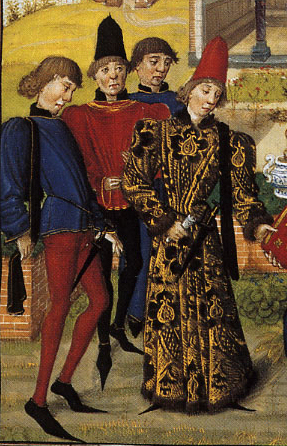
Money was required to fund the war stimulating trade in woolen cloth, an export trade centered on the capital, promoting further expansion in both the size and wealth of London. Even in these difficult times there seems to have been both the means and desire for people to indulge in a bit of consumerism, which included purchasing whitewares from Surrey, luxury imports from Europe and for the boys at least poulaine, those pointy shoes, the height of fashion in 1380 and than again a hundred years later. 
Poulaine France 1468
There are few pictures of London from this period, but here is one I tracked down from the 15th Century with the Tower of London in the foreground and London Bridge behind

London from 15th C manuscript (British Library) 
and a reconstructed map of medieval London with its Friaries, markets (including Leadenhall, Poultry, Guildhall and Cheapside), early hospitals and the population of the waterfront by foreign merchants from Cologne, France, Bruges and Antwerp. 

Medieval London (medart.pitt.edu) 

Wednesday, 14 May 2014

Medieval Anthropomorphic Jugs

Whilst some hanker after pilgrim badges or coins, the find I'd probably be most delighted by is from one of these 
Face Jug 1270-1310 (British Museum) 
a medieval jug with a face on it.  I rather like the 'proper' term for these too, a right mouthful, 'anthropomorphic' - which in this instance means pots with partial or complete depiction of human bodies. 
1301-1400 (Museum of London) 
Apparently these jugs were very popular in London, the ones above were made in one of the main towns supplying pottery to London in the 13th-15th centuries, Kingston. They tend to be quite small around 12cm.  Most jugs depict men with beards and they often seem to be tugging or stroking them. Their meaning has been lost over time, I like to think they embodied some irreverent joke. 
Kingston Anthropomorphic Jug 14th Century (Christies)  
As I packed away my finds and sifted through the old stuff, I pondered over one piece of decorated green glazed medieval pottery. I worked out the decoration  would have gone diagonally - I wonder, could it possibly be one of those arms?...
Mudlarking Find 
14th C (MetMuseum)


Saturday, 3 May 2014

Martincamp Ceramic Flasks

This broken bit of pottery has been on the blog before, but it wasn't until the finds id session organised by Thames Discovery earlier this year that I finally found out what it was. Nigel Jeffries from the Museum of London Archaeology immediately recognised it as the neck of a Martincamp flask, amusingly Nathalie Cohen from Thames Discovery captured the moment here., with Nigel animated in his enthusiasm and me all eyes and ears and geekily taking notes! 
Mudlarking Find: Stoneware Martincamp Flask
This stuff is named after the village of Martincamp in Normandy France, although it’s thought these vessels were produced across a larger area in northern France, allegedly just for export. Unsurprisingly it's a type of 'Normandy Stoneware'. 

The won’t stand up flask was made on a potter’s wheel. The neck was made separately and then attached over the crudely made hole in the flask as seen below, which I'd always been a bit perplexed by. 


The internal messiness is rather at odds with the rather polished outward appearance. 

Stoneware Martincamp Flask 1501-1600 (Museum of London) 
The flasks would have been covered in a wicker casing, similar to the bottle in Lubin Baugin's painting below ca. 1610–1663. Apparently they were used as water bottles by field workers and soldiers, slung over their backs using a strap attached to the wicker. It's surmised that a wicker base would have enabled the bottle to stand up. I wonder if the roundness of the bottle made it stronger, like an egg. At the very least a nifty design with no easily bashable edges and wicker padding to boot. They were also much cheaper than glass. 

Le Dessert de Gaufreetes, Lubin Baugin, ca. 1610–1663 (Louvre)

One of the 'signs' of a Martincamp canteen is the rings around the neck. Are these really caused by the imprint of the wicker or are they the potters throwing rings? As I finally cleared away my finds, which had crept onto every surface in the shed, I spotted what looked like another neck of a Martincamp flask, this time earthenware. Still, I suspect if not rare they are a fairly uncommon find along the Thames - but perhaps I'm wrong?

Mudlarking finds:  Martincamp Flask Necks 
There are apparently three diabetes type categories for these vessels (John Hurst 1986)

  • 1475-1500 off white fabric often with buff surfaces and a flattened profile (Type I) 
  • 1500- 1600 dark brown stoneware with a more globular form with one side slightly flattered and the other side breast shaped (Type II) 
  • 1600-1700 earthenware usually a low fired orange colour, but can be fired to near stoneware and appear reddish orange. (Type III)
1501-1600 (Museum of London) 

So my type II from the beginning of the post was knocking around when London looked like this, 
Anton van den Wyngaerde 1543

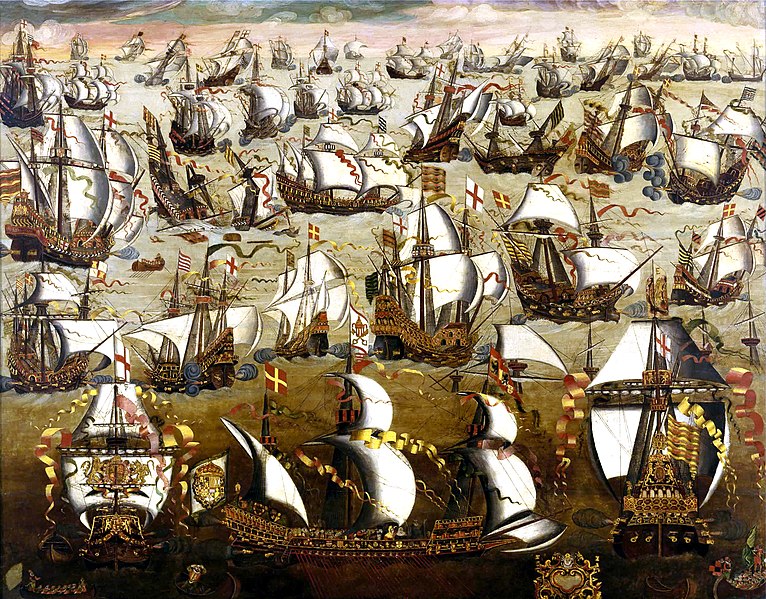
the century when England was ruled by our most famous Monarchs Henry VIII and Elizabeth I, the time of Shakespeare, the Spanish armada, and when potatoes came to Britain. It was the period when London became established as a great port which was accompanied by a trebling of the London population from 60,000 in 1500 to 190,000 in 1600, the average size of a London borough today. 


Spanish Armada and English ships in August 1588, by unknown painter (English School, 16th century) Wiki

Sunday, 27 April 2014

Cistern Bung Holes

This post is for Facebook's London Mudlarker who has given up asking me to post on bung holes. Revealing our ultimate nerdiness. Not a great deal to say about these, part of the reason for the delay - but LM here you are.  

From time to time I've noticed largish earthenware shards with a hole surrounded by another piece of applied clay. Not all that appealing or interesting but certainly a 'type' so I decided to take one home with me, intending to work out what it was some time later. 

Medieval Bung Holes from Cisterns. Left Coarse Whiteware bundhole from 1340 to 1440 AD, 
They are bung holes from cisterns. Cistern comes from the middle English word cisterne which in turn is derived from the Latin cista for 'box' or the Greek kiste for 'basket'. They are waterproof vessels for holding liquids. 

Probably the most interesting thing about them is that they are very old and still hold the original potter's thumb indentations. Many will be medieval and others will be from the Tudor period. 


Coarse Borderware with Bung Hole 1340 - 1440 (British Museum) 
Some commentators speculate that their increase in the 15th century was due to an increase in home brewing and the popularity of beer. 

Medieval Cistern York (Doug Fitch Blog) 

London Redware Cistern 1480-1600 (Museum of London) 

Thursday, 17 April 2014

Finished

Seven months later and it's finished. Hour upon happy hour ensconced in the shed, slowly assembling this manifestation of mudlarking passion. Immersed in music in a way I haven't had the luxury of doing since I was a teenager, from opera to Rudimental, I've been in heaven. 


Whilst the mosaic is essentially a copy of  Emma Bigg's mudlarking mosaic, as I became more confident I've gone off piste, keeping religiously to her pattern but improvising. The most daring is this central slash of green glazed shards surrounding a wave of glass bottle tops and bottoms, some possibly dating from the 16th Century, although more likely from 17th century onwards. The oldest thing on the board is probably a deeply incised section of strap handle likely to have been made in Kingston in medieval times.


I had to slip in a few mudlarking classics. No mudlarking mosaic could be complete without a gurning Bartmann face, slotted in another section of salt glazed stoneware, 


originating from one of these. 


Saltglazed Bartmann Jug 1485-1714 Freshen Germany (Museum of London) 

Tucked in a corner above the creamware teapot spouts is the foot of a pipkin or skillet, still dusted with smoke from the charcoal it sat upon hundreds of years ago, with a smidgen of green glaze, the earliest form of coloured glaze used in Britain. 


It perhaps graced the bottom of a vessel similar to this

Surrey Hampshire ware skillet 1566-1700 (Museum of London) 

Elsewhere are the tops of green Tudor pottery money boxes used to collect entrance fees to theatres and some archetypal naive hand painted delft patterns, 


probably made in London and likely to have come from dishes akin
 to this
London Delft Dish 1680 (Christies) 

A mudlarking mosaic didn't seem quite right without one more section of delft, this time the more unusual polychrome type.


A cat's paw print caught forever in a medieval tile is fenced in by twisted creamware handles, possibly from a teapot. 


Or perhaps from something really posh like this punch pot or a Wedgwood melon tureen. 

Creamware Punch Pot 1765-1780 (historic new england) 

Right at the top are those marvelous shards  of iridescent glass you find along the Thames, their patina the sign of glass aged by several centuries. 


Tantalising snatches of writing on stoneware give clues to their story, a collection of ink pots, German mineral bottles, a Whites lemonade bottle and a few mysteries.   


To my surprise transferware is only marginally represented. A line of my favourite floral fragments highlights a row of clay pipe bowls standing to attention, with my collection of bartmann beards beneath. 


The early morning sun flooding through the shed windows illuminates the bottoms of three delft drug jars from the 17th century interspersed with large sections of dining plates, 


jars which would have looked something like this, 


London Delft Drug Jar 1650 - 1700 (Christies) 


So here it is, propped up against the shed wall. Fragments from around 1,500 objects belonging to 1,500 people living in London or visiting, over 7 centuries. Some treasured some hardly noticed, between them travelling hundreds of thousands of miles, telling stories of trade, human innovation and technical advancement, fashion and our desire for beautiful things. 


Saturday, 8 February 2014

Mudlarking Mosaic - 3/4 way through

Visually this pipe section would have looked better if I'd orientated the pipes so they cascaded in a more higglety pigglety way with their bowl mouths open to the viewer, as in Emma Bigg's original mosaic. Instead illuminating the history won out. Lined up in date order lie 50% of the types of clay pipe produced. Starting with the small ones from the 1610 on the right and ending with the large spurred pipes made until the 1840s, positioned so it's easy to see their development over the centuries. Their spurs, different types of feet with or without initials  are all exposed.  I couldn't quite bring myself to cement in any of my decorated relief pipes. 

And then the view from the top, which once on the wall will never be seen. 


Rather chuffed how this line of Westerwald turned out, its deep cobalt blue creating such  a strong impression. The epitome of German domination of 17th and early 18th Century European ceramics, with its precise moulded reliefs and careful incised patterns executed by hand and perfectly glazed.

To the right, purposely included one of the drilled mother of pearl 'shards' I've picked up along the Thames, in this section of iridescent discarded worked pieces. 


The Westerwald shards most likely came from tankards and jugs

Westerwald Jug 1702-1714  with moulded relief design (prices4antiques)

Westerwald Mug 17th C (Crocker Farm) 
Westerwald Jug circa 1730 with incised patterns made by hand (Martyn Edgell) 
Again copying Ms Biggs mosaic, I've included a row of large chunks of 19th century utilitarian English stoneware, the remains of ink bottles and other storage vessels. The impressed writing reveals a Derbyshire bottle produced by Bourne (a longer post on this can be found here) and the neat lettering of Stephen Green's Imperial Pottery in Lambeth, the centre of English saltglazed stoneware pottery from the mid 17th - mid 19th century.

'The imperial pottery in Princes Street Lambeth places Mr Stephen Green amongst the foremost.. The variety of its productions comprises jugs, garden vases and figures, water pipes, filtering machines and vessels for chemical purposes..About seventy persons are employed on the premises; and the consumption of materials amounts to one thousand tons of clay, one hundred of sand, twenty tons of burnt flint and Cornwall stone, twelve tons of salt and eight hundred tons of coal annually...The business was begun nearly 60 years ago' (E W Brayley 1841).

I haven't been able to track down the the origin of 'Waterlow London'. 


Complete Bourne Ink Bottle (Museum of London) 

The hand painted blue and red laced with gold, Japanese Imari porcelain (1650-1750) is scattered through this next section. A previous post about its history can be found here.


and to end - a large chunk of the will be finished in another month or so mosaic.